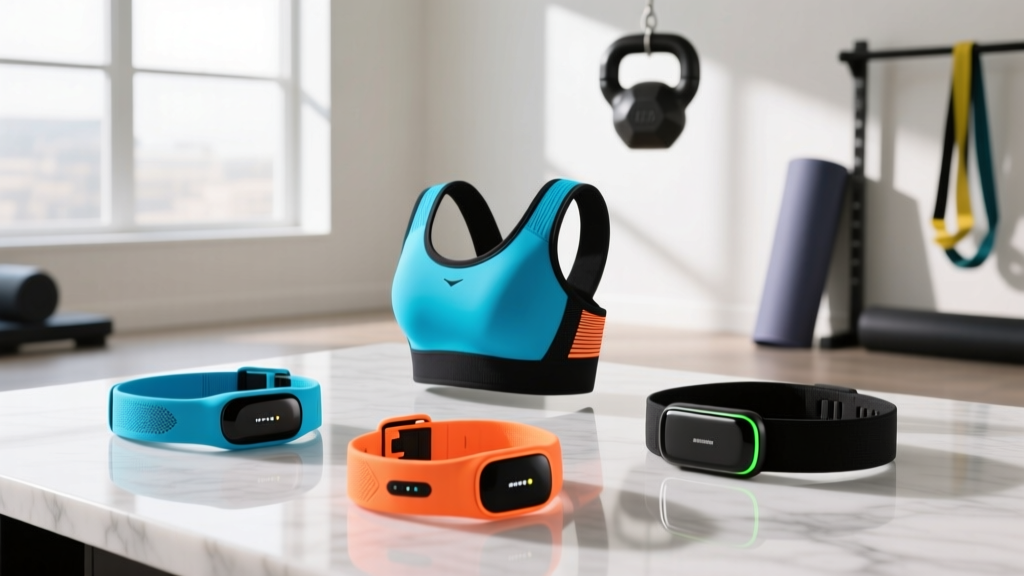
Fitness Tracker Not Wrist: Top Wearables for Strength Training
Seeking a fitness tracker not wrist-based? We compare top non-wrist wearables for strength training, including armbands and chest straps for accurate HRV.

The Biomechanical Flaw of Wrist Wearables in the Weight Room
If you have ever tried to track a heavy deadlift or kettlebell snatch session with an Apple Watch Ultra or Garmin Fenix, you already know the frustration. The optical heart rate (OHR) sensors on your wrist suddenly report a 180 BPM spike during a slow, controlled eccentric lowering phase, or they flatline entirely during a high-tension isometric hold. When athletes start searching for a fitness tracker not wrist-based, it is usually because they have encountered this exact hardware limitation.
The issue is not necessarily the sensor quality; it is human anatomy. Wrist-based OHR sensors rely on photoplethysmography (PPG), which shines light into the skin to measure blood volume changes in the radial artery. During strength training, gripping a thick barbell or dumbbell handle engages the flexor carpi radialis and palmaris longus muscles. This muscle contraction physically shifts the wearable away from the artery, while tendon movement creates massive 'motion artifacts' that confuse the sensor's algorithm. Furthermore, intense gripping temporarily restricts peripheral blood flow, leaving the wrist sensor with no pulse signal to read.
To get accurate training load, heart rate variability (HRV), and calorie expenditure data during resistance training, you must move the sensor to a location with high muscle perfusion and low tendon interference. Below, we break down the best non-wrist alternatives available in 2026, pitting them head-to-head to find the ultimate strength training companion.
Head-to-Head Comparison Matrix
Before diving into the deep-dive reviews, here is how the top three non-wrist wearables stack up on paper for the modern lifter.
| Device | Form Factor | Sensor Tech | Price (2026) | Battery Life |
|---|---|---|---|---|
| Polar Verity Sense | Optical Armband | 9-LED Optical Array | $89.95 | 20 Hours |
| Garmin HRM-Pro Plus | Chest Strap | ECG (Electrocardiogram) | $129.99 | 1 Year (CR2032) |
| WHOOP 4.0 (Bicep Mount) | Bicep Sleeve/Band | 5-LED Optical Array | $30/month (Sub) | 4-5 Days |
Contender 1: Polar Verity Sense (The Optical Armband)
The Polar Verity Sense remains the gold standard for lifters who despise chest straps but need clinical-grade accuracy. By strapping the 9-LED optical sensor to the fleshy part of your forearm (just below the elbow) or your bicep, you completely bypass the wrist-flexion problem.
Strengths for Lifters
- Zero Chest Compression: Unlike chest straps, it does not interfere with your breathing mechanics during heavy Valsalva maneuvers or high-rep Olympic lifts.
- Multi-Gym Broadcasting: It broadcasts simultaneously via Bluetooth and ANT+. You can connect it to your smartwatch, a gym's cardio equipment, and a third-party app like Hevy or Strong simultaneously.
- Swimming & Sweat Proof: Rated to 50 meters, it survives the most profuse sweaters and post-workout ice baths without issue.
Edge Cases & Failure Modes
The primary failure mode for the Verity Sense during strength training is strap slippage. If you place it on your forearm and perform heavy farmer's carries, the repetitive gripping pumps blood into the forearm muscles, causing them to expand. This can either make the strap uncomfortably tight or cause it to slide down toward the wrist if not secured properly. Pro Tip: Always wear it on the upper bicep for heavy grip-intensive days, or use the included clip to attach it to your sports bra or shirt collar for zero-limb interference.
Contender 2: Garmin HRM-Pro Plus (The ECG Chest Strap)
When discussing a fitness tracker not wrist-mounted, the chest strap is the traditional answer. The Garmin HRM-Pro Plus utilizes electrocardiography (ECG) to measure the electrical activity of the heart. According to the American College of Sports Medicine, ECG chest straps remain the most accurate method for capturing rapid heart rate fluctuations outside of a clinical setting.
Strengths for Lifters
- Instantaneous Response: Optical sensors take 3 to 5 seconds to 'catch up' to a sudden heart rate spike. The HRM-Pro Plus registers it in milliseconds. This is crucial for tracking rest-pause sets or high-intensity interval circuits.
- Running Dynamics & Form Metrics: If your strength training includes CrossFit WODs or conditioning finishers, the built-in accelerometer tracks ground contact time and vertical oscillation.
- Offline Memory: If you leave your phone in the locker room, the strap stores your heart rate data and syncs it to Garmin Connect later.
Edge Cases & Failure Modes
The Achilles heel of ECG straps is the 'dry electrode' problem. The rubber pads require a conductive medium (sweat or water) to read your heart's electrical signals. If you are doing a low-sweat powerlifting session (e.g., 5 sets of 2 reps with 5-minute rests), the strap may drop the signal entirely. You must pre-wet the electrodes with water or electrode gel before stepping onto the platform. Additionally, during barbell bench presses, the friction of the strap against the bench pad can cause motion artifacts or physically shift the sensor module off-center.
Contender 3: WHOOP 4.0 (The Bicep / Any-Wear Mount)
WHOOP takes a different approach. It is a screenless recovery and strain tracker that, when worn via their Any-Wear bicep sleeves or impact-resistant bicep bands, becomes a highly effective non-wrist fitness tracker.
"For pure strength athletes, the value of WHOOP isn't in tracking the exact calories burned during a 45-minute lifting session—it's in measuring the central nervous system (CNS) toll that heavy axial loading takes on your body via overnight HRV and respiratory rate tracking."
Strengths for Lifters
- Invisible Profile: Worn under a compression sleeve, there is zero risk of the device banging against a kettlebell or getting caught on a barbell.
- Recovery-First Algorithm: WHOOP's strain coach is excellent at warning you when your muscular and CNS recovery is insufficient for a heavy PR attempt, based on deep sleep and HRV baselines.
Edge Cases & Failure Modes
Optical lag is the main issue. Because WHOOP relies on a 5-LED optical array, it suffers from the same 2-to-4-second algorithmic smoothing as wrist wearables, just applied to the bicep. If you are doing a 10-minute AMRAP (As Many Rounds As Possible) and want to see your peak heart rate at the exact end of the buzzer, WHOOP's app will likely show a delayed, smoothed-out curve rather than a sharp spike.
Real-World Edge Cases: Sweat, Chalk, and Gym Environments
When choosing your non-wrist wearable, you must account for the unique environment of the weight room:
- Magnesium Carbonate (Gym Chalk): If you use chalk for heavy pulls, chalk dust will inevitably get onto your skin. If chalk gets between an optical armband (like the Polar or WHOOP) and your skin, it blocks the light refraction, instantly killing the heart rate signal. Chest straps are largely immune to chalk dust unless the dust cakes directly onto the rubber electrodes.
- Equipment Friction: Wrist trackers get smashed against power rack uprights during squats. Armbands on the bicep are generally safe, but forearm-mounted optical sensors can scrape against your thighs during deadlifts. Chest straps can snag on the knurling of a barbell if you rest the bar low on your chest during front squats.
- Hygiene and Maintenance: Chest straps require the elastic band to be washed weekly to prevent salt buildup, which can cause 'ghost readings' (the strap registering a 150 BPM heart rate while you are sitting on the couch due to salt bridging the electrodes). Optical armbands simply need a quick rinse under the tap.
The Lifter's Decision Framework
Which fitness tracker not wrist-based should you buy in 2026? Use this framework to decide:
Choose the Polar Verity Sense If:
You are a bodybuilder, CrossFit athlete, or general fitness enthusiast who wants highly accurate optical heart rate data without the claustrophobia or breathing restriction of a chest strap. It is the most versatile, set-it-and-forget-it device for the gym environment, provided you remember to charge it weekly.
Choose the Garmin HRM-Pro Plus If:
You are a powerlifter, Olympic weightlifter, or tactical athlete who requires millisecond-accurate ECG data to measure exact rest intervals and cardiovascular recovery between heavy sets. You do not mind the ritual of wetting the strap and wearing it under your shirt.
Choose the WHOOP 4.0 (Bicep) If:
You care less about real-time heart rate zones during the workout and more about how your strength training impacts your long-term recovery, sleep architecture, and CNS fatigue. It is the ultimate 'invisible' tracker for athletes who want data without screens or distractions.
Ultimately, moving your biometric tracking away from the wrist is the single best upgrade you can make for your strength training data integrity. By eliminating the motion artifacts caused by grip and wrist flexion, you finally get a true picture of your cardiovascular output under the bar.
More gear to consider
All reviews
Scale Accuracy & Google Pixel Watch Fitness Tracker Sync

2026 Market Trend: Budget Fitness Tracker Open Source Under $100

Apple Watch 2 as Fitness Tracker vs Garmin Venu Sq 2 for Lifting

Best Fitness Tracker That Tracks Blood Pressure: 2026 Value Guide

Cully Fitness Tracker Maintenance for Multi-Sport Athletes
