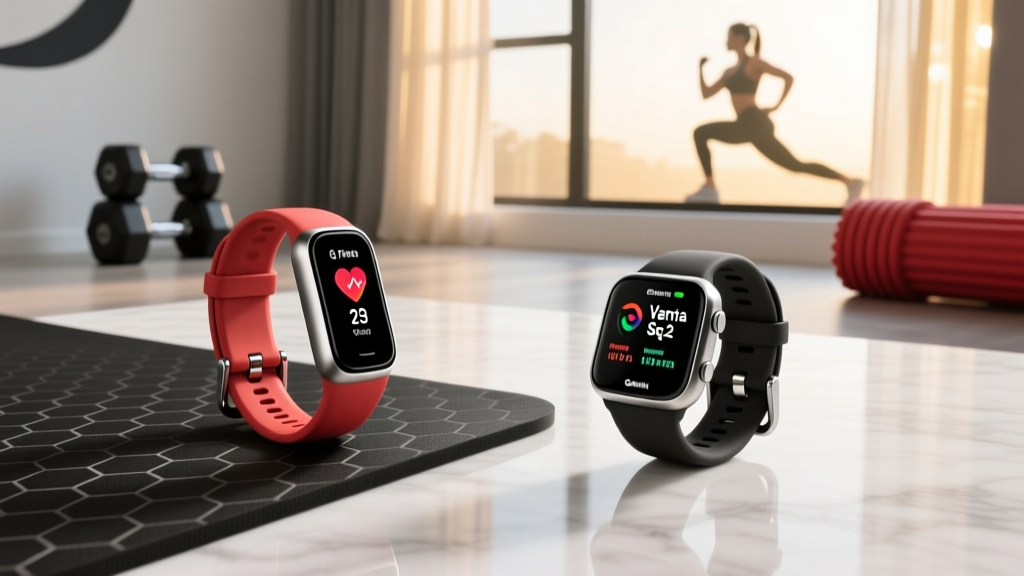
Fitbit Inspire 2 Health & Fitness Tracker vs Garmin for Lifting
We compare the Fitbit Inspire 2 health & fitness tracker against Garmin's Venu Sq 2 for strength training. Find out which wearable tracks lifts best.

The Strength Training Dilemma: Budget Baseline vs. Dedicated Metrics
As we navigate the wearable landscape in 2026, the market has sharply divided into hyper-specialized fitness computers and budget-friendly lifestyle bands. For weightlifters and gym-goers, this creates a unique purchasing dilemma. On one side, we have the Fitbit Inspire 2 health & fitness tracker, a device that dominated the budget category for years and remains a highly sought-after staple on the secondary and refurbished market (typically priced between $45 and $65 today). On the other side sits the Garmin Venu Sq 2 ($199–$249), a smartwatch engineered with dedicated strength training profiles and advanced biomechanical algorithms.
But does a dedicated strength profile actually matter when you are under the barbell? In this head-to-head comparison, we strip away the marketing fluff and analyze how these two devices handle the harsh realities of the gym environment, from optical heart rate (HR) failures during wrist flexion to post-workout muscle load analysis.
The Biomechanical Challenge: Optical HR Under the Barbell
To understand how these trackers perform, we must first address the fundamental flaw of wrist-based photoplethysmography (PPG) sensors during resistance training. According to research published by the National Institutes of Health (NIH), wrist-worn optical sensors experience significant accuracy degradation during exercises that require intense grip or wrist flexion.
⚠️ The 'Muscle Pump' Artifact
When you perform high-volume sets of bicep curls, deadlifts, or front squats, your forearm muscles engorge with blood (the "pump"). This swelling changes the optical density of the tissue. The green LEDs on the underside of both the Fitbit Inspire 2 and Garmin Venu Sq 2 struggle to penetrate this swollen tissue to read capillary blood flow. Consequently, both devices will routinely underreport peak heart rates by 15% to 25% during heavy compound lifts. Neither wrist-based device is immune to this physiological limitation.
However, how the devices handle this missing data differs vastly. The Fitbit Inspire 2 relies on a basic continuous HR algorithm that simply averages the available data, often resulting in a flatlined or erratic calorie-burn estimate for a 45-minute lifting session. The Garmin Venu Sq 2 utilizes Garmin’s Elevate V4 sensor suite, which includes an accelerometer to detect motion artifacts. When the Venu Sq 2 detects the rhythmic motion of a lift but loses the optical HR signal, its algorithm attempts to interpolate the heart rate based on the intensity of the movement, providing a slightly more accurate (though still imperfect) caloric expenditure model.
Feature Matrix: Tracking the Actual Lifts
Where the comparison truly diverges is in the software architecture designed specifically for the weight room. The Fitbit Inspire 2 health & fitness tracker approaches strength training as a generic cardiovascular event, whereas Garmin treats it as a structured, data-rich activity.
| Feature | Fitbit Inspire 2 (Refurb/Budget) | Garmin Venu Sq 2 (Mid-Range) |
|---|---|---|
| Activity Profile | Generic "Weights" Log | Dedicated "Strength" Profile |
| Rep Counting | No (Time & HR only) | Yes (Auto-detects reps & sets) |
| Muscle Map | Not Available | Yes (Highlights primary muscle groups) |
| Rest Timer | Manual (Requires phone app) | On-screen auto-prompt between sets |
| Current 2026 Price | $45 - $65 (Secondary Market) | $199 - $249 (Retail) |
The Reality of Auto-Rep Counting
Garmin’s auto-rep counting is a standout feature on paper, but it requires a nuanced understanding of its failure modes. The Venu Sq 2 uses its internal accelerometer to count repetitions. For linear, bilateral movements like barbell bench presses or strict overhead presses, the algorithm is highly accurate, typically missing or adding only 1 rep per set of 10. However, for asymmetrical or lower-body movements like walking lunges, Bulgarian split squats, or kettlebell swings, the algorithm frequently fails, often counting steps as reps or missing the movement entirely. You will spend time manually correcting your sets via the watch's touchscreen between rests.
Conversely, the Fitbit Inspire 2 makes no such promises. You simply tap "Weights," and it records the duration and your heart rate. For powerlifters or bodybuilders who already log their sets in dedicated apps like Hevy or Strong, the Fitbit’s passive approach is actually a benefit—it stays out of your way and doesn't require mid-set screen tapping.
Ecosystem and Recovery: Daily Readiness vs. Body Battery
Strength training is only half the equation; recovery dictates your progress. Both ecosystems offer robust recovery metrics, but they calculate central nervous system (CNS) fatigue differently.
- Fitbit Daily Readiness Score: Fitbit calculates this based on your recent sleep history, heart rate variability (HRV), and activity levels. However, because the Inspire 2 lacks the advanced multi-path optical sensors found in premium 2026 models, its nighttime HRV tracking is sampled less frequently. This can lead to a "Ready" score that feels disconnected from the deep CNS fatigue you experience after a heavy 5x5 squat session.
- Garmin Body Battery & Training Status: As detailed in Garmin's official Venu Sq 2 specifications, this watch utilizes Firstbeat Analytics to calculate Training Load. It differentiates between aerobic and anaerobic strain. A heavy, low-rep powerlifting session will correctly register as high anaerobic strain, appropriately draining your Body Battery and advising a lighter recovery day, making it vastly superior for periodized strength programs.
Hardware and Gym Durability
The physical environment of a gym is hostile to wearables. Barbells, dumbbell knurling, and sweaty hands pose constant threats.
The Fitbit Inspire 2 features a slim, lightweight polycarbonate chassis with a silicone band. Its low profile is its greatest asset in the gym; it rarely snags on clothing or equipment, and it slides easily under the cuff of a long-sleeve compression shirt. However, the standard silicone band can trap sweat and cause contact dermatitis during high-volume summer training sessions.
The Garmin Venu Sq 2 utilizes a Gorilla Glass 3 display surrounded by a polymer bezel. While the glass is highly scratch-resistant against accidental bumps into squat racks, the larger, square footprint makes it more prone to catching on gym equipment or clothing. If you frequently perform cleans or front squats where the barbell rests near the wrist, the Venu Sq 2's larger profile is a distinct liability compared to the Inspire 2's minimalist band design.
"If your primary goal is tracking pure cardiovascular output and you prefer to log your lifting numbers manually on your phone, the budget-friendly Fitbit Inspire 2 remains an unobtrusive, highly capable tool. But if you want your watch to actively manage your rest periods and map your anaerobic strain, Garmin is the undisputed heavyweight."
The Pro-Tip: Bypassing Wrist Limitations
💡 Expert Workaround: The Chest Strap Standard
Because both the Fitbit Inspire 2 and Garmin Venu Sq 2 suffer from the wrist-flexion HR drop-off, serious lifters in 2026 are increasingly pairing their wearables with a Bluetooth chest strap (like the Polar H10 or Garmin HRM-Pro). Note: The Fitbit Inspire 2 does not support external Bluetooth HR sensor pairing. If accurate heart rate data during heavy deadlifts and curls is non-negotiable for your programming, you must choose the Garmin Venu Sq 2, which seamlessly integrates with external chest and armband monitors.
Final Verdict: Which Should You Choose?
The decision ultimately hinges on your budget, your logging habits, and your need for anaerobic data.
Choose the Fitbit Inspire 2 Health & Fitness Tracker If:
- You are on a strict budget and are comfortable purchasing from the refurbished/secondary market.
- You already use a third-party app (like Strong or Hevy) to log your sets, reps, and RPE (Rate of Perceived Exertion).
- You want a minimalist, lightweight band that won't interfere with your wrist wraps or barbell placement.
- Your strength training is supplementary to your primary focus on daily step counting and general cardio.
Choose the Garmin Venu Sq 2 If:
- You follow a structured, periodized strength program and need accurate anaerobic training load metrics.
- You want on-screen rest timers and auto-rep counting to streamline your gym sessions.
- You plan to use an external chest strap for 100% accurate heart rate tracking during heavy compound lifts.
- You value detailed post-workout muscle maps and Firstbeat-powered recovery analytics.
Frequently Asked Questions (FAQ)
Does the Fitbit Inspire 2 count reps during weightlifting?
No. The Fitbit Inspire 2 does not have the accelerometer algorithms required to count individual repetitions. It only tracks the total duration of your "Weights" session, your estimated calorie burn, and your heart rate zones.
Which tracker is better for CrossFit or HIIT weight training?
For high-intensity functional fitness or CrossFit, the Garmin Venu Sq 2 is superior. Its ability to connect to external chest straps ensures accurate heart rate data during rapid transitions between gymnastics, cardio, and weightlifting, whereas the Fitbit Inspire 2 will struggle to keep up with rapid HR spikes without external sensor support.
How long does the battery last on these devices during gym sessions?
Both devices excel in battery life. The Fitbit Inspire 2 can last up to 10 days on a single charge, though continuous heart rate tracking during daily wear brings this closer to 5-6 days. The Garmin Venu Sq 2 offers up to 11 days in smartwatch mode, and a 1-hour GPS or intense tracking session will only drain about 5% to 7% of the battery, meaning you rarely need to charge mid-week.
More gear to consider
All reviews
Fitbit Inspire 3 vs Inspire HR: Which Fitness Tracker Wins?

Whoop 5.0 Peak Health and Fitness Tracker Value: Smartwatch Comparison

Zeacool Fitness Tracker Setup: Chest Strap vs Wrist HR Guide

Whoop 5.0 Fitness Tracker: Sport-Specific Care & Longevity

Upgrading Your Jawbone UP3 Fitness Tracker to a Cycling Computer
