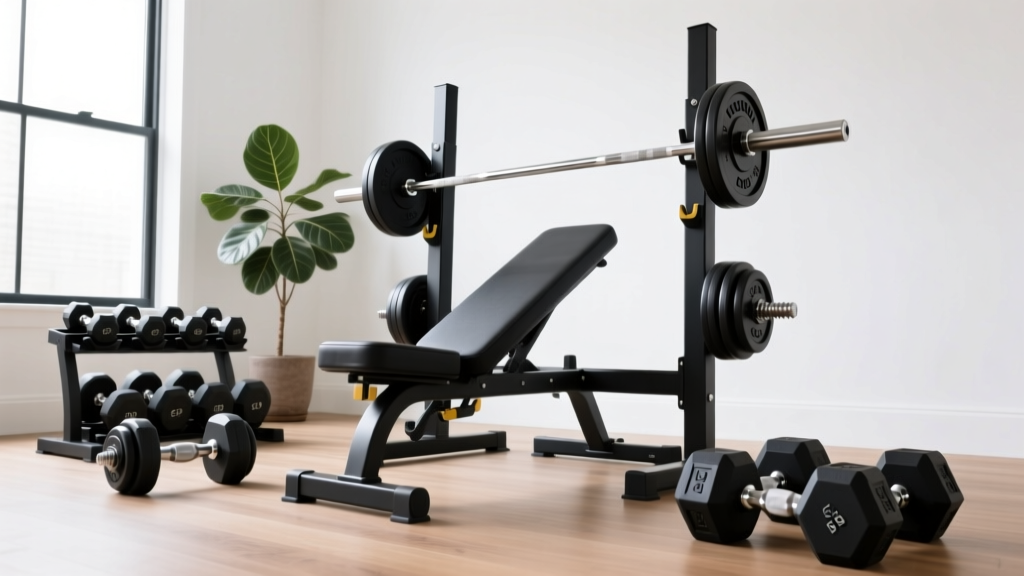
EZ vs Straight Bar: Value & Dumbbell Bicep Curl Incline Bench Setup
Compare EZ and straight bar costs, biomechanics, and joint health. Learn how to budget for these alongside the dumbbell bicep curl incline bench setup.

The Economics and Biomechanics of Arm Training
When outfitting a home gym for serious arm development, lifters are immediately confronted with a classic debate: EZ curl bar vs. straight bar. While both implements have occupied gym floors for decades, the modern fitness consumer in 2026 must evaluate these tools not just through the lens of muscle activation, but through a strict budget breakdown and value analysis. Purchasing the wrong barbell can lead to chronic joint pain and wasted capital, while ignoring complementary movements can leave your hypertrophy potential on the table.
In this comprehensive guide, we break down the metallurgical and biomechanical differences between straight and EZ bars, analyze current market pricing, and demonstrate how to integrate these tools with the dumbbell bicep curl incline bench movement to build a cost-effective, joint-friendly arm station.
The Biomechanical Cost: Joint Health vs. Muscle Tension
To understand the value of an EZ bar compared to a straight bar, you must first understand the cubital valgus, commonly known as the 'carrying angle.' When your arms hang naturally at your sides with palms facing forward, your forearms angle slightly away from your body. For most adults, this angle ranges between 5 and 15 degrees.
The Straight Bar Dilemma
A standard 47-inch straight curl bar forces your wrists into full supination (palms completely flat facing up). This unnatural alignment zeroes out your carrying angle, transferring immense valgus stress directly to the medial epicondyle of the elbow and the ulnar collateral ligament. Over time, heavy straight-bar curling is a primary culprit behind medial epicondylitis (golfer's elbow) and wrist impingements. While it does provide a peak contraction for the short head of the biceps, the 'biomechanical cost' to your connective tissue is exceptionally high.
The EZ Bar Advantage
The EZ curl bar features angled grip shafts, typically set at 30 and 45 degrees. This semi-supinated grip accommodates the natural carrying angle of the arm, drastically reducing torque on the wrists and elbows. According to research sponsored by the American Council on Exercise (ACE), varying your grip angle is essential for balanced brachialis and brachioradialis development, making the EZ bar a superior, safer investment for long-term joint health.
2026 Equipment Cost Breakdown: Bars and Benches
The market for specialty barbells has matured significantly. Budget options no longer mean accepting dangerously poor knurling or sleeves that seize up after a month of use. Below is a value analysis of the top contenders in the current market.
| Equipment Type | Recommended Model (2026) | Approx. Cost | Primary Value Proposition |
|---|---|---|---|
| Budget EZ Bar | Titan Fitness Olympic EZ Curl Bar | $99.00 | Decent chrome shaft, bronze bushings, best entry-level price. |
| Mid-Tier EZ Bar | REP Fitness EZ Curl Bar | $135.00 | Superior 1.2mm knurl, black oxide finish, excellent sleeve rotation. |
| Premium EZ Bar | Rogue Fitness Curl Bar | $245.00 | Ceramic coating, aggressive knurl, needle-bearing sleeve smoothness. |
| Standard Straight Bar | CAP Barbell 47' Super Curl Bar (Straight) | $65.00 | Ultra-cheap, but passive knurling and high risk of wrist strain. |
| Incline Bench | REP Fitness AB-3100 2.0 | $399.00 | Adjustable from flat to 85 degrees, crucial for stretch-mediated work. |
Expert Insight: The Hidden Cost of Cheap Sleeves
When buying a budget straight or EZ bar under $100, the failure mode is rarely the steel shaft snapping; it is the sleeve bushings seizing. If the sleeves do not rotate freely during the curl, the rotational inertia of the weight plates transfers into your wrists. Always budget an extra $35-$50 to step up from a basic chrome bar to a black oxide or ceramic-coated bar with high-quality bronze bushings to protect your joints.
The Stretch-Mediated Hypertrophy Factor
A complete value analysis of arm equipment must account for the limitations of barbells. Both straight and EZ bars lock your wrists into a fixed, bilateral path. This is excellent for overloading the mid-range of the curl, but it completely fails to target the biceps in their fully lengthened state.
This is where the dumbbell bicep curl incline bench exercise becomes a non-negotiable component of an optimized arm program. While a barbell restricts your range of motion, the dumbbell bicep curl incline bench setup allows for unilateral tracking and a deep, stretch-mediated contraction at the shoulder joint. By setting an adjustable bench to a 45-to-60-degree incline and letting your arms hang behind your torso, you place the long head of the biceps under immense mechanical tension at its longest muscle length.
Recent biomechanical analyses, including data referenced by ExRx.net regarding incline dumbbell curl mechanics, confirm that stretch-mediated hypertrophy yields superior muscle growth compared to mid-range or peak-contraction-only movements. Therefore, allocating your entire arm-training budget to a single straight bar is a poor return on investment. You must balance barbell overload with dumbbell stretch work.
Value Analysis: Building Your Arm Station by Budget Tier
How should you allocate your capital based on your total available budget? Use this decision framework to maximize your hypertrophy ROI.
Tier 1: The Minimalist (Under $250)
- Equipment: Titan Fitness EZ Curl Bar ($99) + 50 lbs of used cast-iron Olympic plates ($100) + Standard Flat Bench ($50).
- Value Verdict: You sacrifice the incline stretch, but you protect your elbows by avoiding the cheap straight bar. Focus on strict EZ bar curls and hammer curls using the neutral grip on the EZ bar.
Tier 2: The Hypertrophy Optimizer ($500 - $700)
- Equipment: REP Fitness EZ Curl Bar ($135) + Adjustable Dumbbell Set (e.g., Bowflex 552 or Nuobell, ~$350) + Budget Adjustable Incline Bench ($150).
- Value Verdict: This is the sweet spot for home gym owners. You gain access to the vital dumbbell bicep curl incline bench movement, allowing for long-head stretch, while retaining the EZ bar for heavy, joint-friendly bilateral overloading.
Tier 3: The Complete Arm Station ($900+)
- Equipment: Rogue Curl Bar ($245) + Premium Adjustable Dumbbells ($450) + REP AB-3100 2.0 Incline Bench ($399).
- Value Verdict: Commercial-grade longevity. The ceramic-coated Rogue bar will outlast your lifting career, and the high-quality incline bench provides the precise 45-degree angles required for optimal stretch-mediated tension without shoulder impingement.
Edge Cases and Failure Modes in Budget Gear
When conducting a budget breakdown, you must factor in the 'replacement cost' of gear that fails prematurely. Here are the specific failure modes to watch for when comparing EZ and straight bars in the sub-$150 market:
- Chrome Flaking: Budget straight bars often use low-grade decorative chrome. After a year of sweat exposure and plate loading, this chrome can pit and flake, tearing your calluses. Black oxide or hard chrome finishes (found on mid-tier EZ bars) are vastly superior for longevity.
- Aggressive vs. Passive Knurling: Cheap straight bars feature 'hill' knurling that is barely felt, forcing you to squeeze the bar excessively, which limits forearm and bicep neural drive. Premium EZ bars feature 'volcano' knurling (around 1.2mm to 1.5mm deep) that bites into the skin without tearing, securing the bar in your palms during heavy eccentrics.
- Shaft Whip and Diameter: Most dedicated curl bars feature a 28mm to 28.5mm shaft diameter. Lifters with smaller hands should avoid budget straight bars that sometimes use thicker 30mm+ shafts disguised as standard Olympic bars, as this prematurely fatigues the brachioradialis before the biceps reach failure.
'The best arm day setup is not about buying the most expensive single barbell; it is about purchasing the right angles. An EZ bar protects your elbows for heavy loading, while an incline bench and dumbbells unlock the stretch required for maximum long-head growth.' — FitGearPulse Biomechanics Review Team
Final Verdict: Optimizing Your Equipment Spend
When comparing the EZ curl bar vs. straight bar from a strict value and joint-health perspective, the EZ bar is the undisputed winner for 90% of lifters. The straight bar's risk of inducing medial epicondylitis simply outweighs the marginal gains in short-head activation. However, neither barbell can replicate the biomechanical benefits of the dumbbell bicep curl incline bench movement.
For the most cost-effective home gym arm station in 2026, skip the straight bar entirely. Invest $135 into a high-quality, black-oxide EZ curl bar with bronze bushings, and funnel the rest of your budget toward an adjustable incline bench and a set of adjustable dumbbells. This hybrid approach ensures you can safely overload the mid-range while capitalizing on stretch-mediated hypertrophy, delivering the highest possible return on your fitness investment.
More gear to consider
All reviews
Hexagon Shaped Dumbbells: 2026 Rubber vs Urethane Market Trends

Rubber vs Urethane: Dumbbell Single Leg Romanian Deadlift Value Guide

Neoprene Dumbbells for Swiss Ball Dumbbell Chest Press
Troubleshooting the Dumbbell Heart: Neoprene Coated Weight Mistakes

2026 Trends: Bumper vs Iron Plates & Bench Press Workout With Dumbbells
