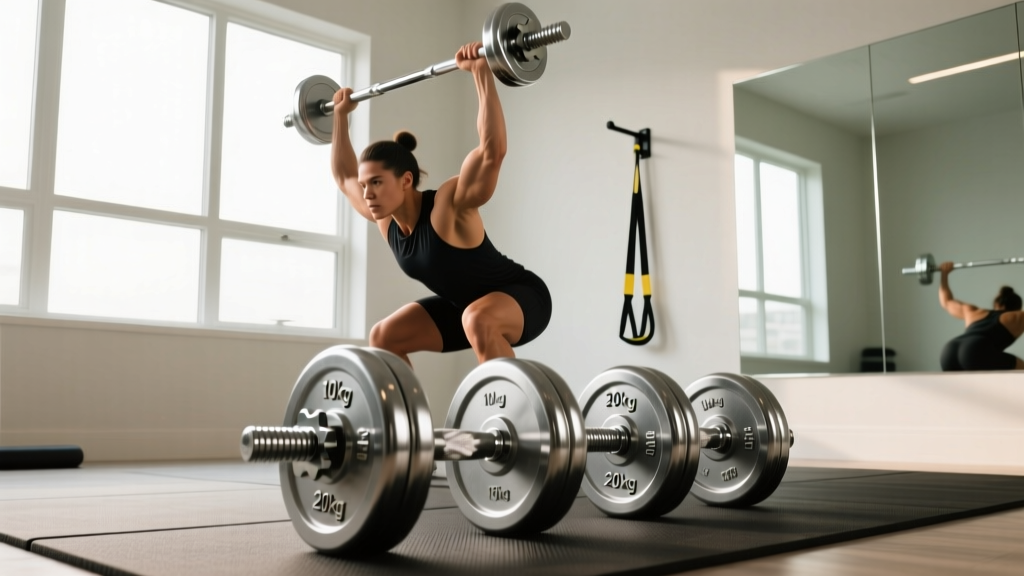
EZ Curl Bar vs Straight Bar: Budget, Value, and the Dumbbell Emoji
We break down the true cost, biomechanical value, and ROI of EZ curl bars versus straight bars to see which earns the dumbbell emoji in your rack.

The Real Cost of Arm Day: Beyond the Dumbbell Emoji
When logging your daily lifts on fitness tracking apps, it is common practice to simply assign a generic dumbbell emoji to your arm isolation work. It is a quick visual cue for bicep curls and tricep extensions. However, if you are investing hundreds of dollars into a home gym in 2026, the choice between an EZ curl bar and a traditional straight barbell demands a much more rigorous budget breakdown and value analysis than a simple emoji can convey.
Both bars serve the fundamental purpose of loading the elbow flexors and extensors, but their upfront costs, long-term durability, biomechanical implications, and spatial footprints vary wildly. In this guide, we strip away the marketing fluff and analyze the exact price-per-pound, tensile strength ratings, and real-world ROI of both bar types to help you allocate your free weight budget effectively.
The Upfront Capital: Entry-Level vs. Premium Tiers
To understand the value proposition, we must first segment the market into entry-level and premium tiers. The price gap between a big-box store barbell and a specialized fitness brand is driven by steel quality, knurling precision, and sleeve construction.
The Straight Bar (Olympic Barbell) Profile
A standard 86-inch, 20kg Olympic barbell is the backbone of any rack. Entry-level models, such as the CAP Barbell Olympic Weight Bar, typically retail between $120 and $150. These bars usually feature a tensile strength of around 130,000 PSI, which is sufficient for curling but will permanently bend if subjected to heavy, repetitive squats or drops.
Premium options, like the Rogue Fitness Ohio Bar, sit in the $295 to $345 range. You are paying for 190,000 PSI tensile strength, bronze bushings for smooth sleeve rotation, and a hard chrome or Cerakote finish that resists oxidation. For strict arm work, a premium straight bar is arguably overkill, but its value lies in its versatility across all compound lifts.
The EZ Curl Bar Profile
The EZ curl bar is a specialized tool. Entry-level models, such as the Yes4All Olympic EZ Curl Bar, can be found for as low as $75 to $95. These budget bars are often constructed from lower-grade steel with a 30mm shaft diameter, which can feel uncomfortably thick and fatiguing for lifters with smaller hands during heavy skull crushers.
Premium EZ bars, like the Rogue Curl Bar, cost around $295. The premium here is justified by a 28.5mm shaft diameter, precise medium-depth knurling, and high-quality bushings that allow the sleeves to rotate freely, reducing torque on the wrists during dynamic movements like reverse curls.
Biomechanical ROI: Wrist Health and Muscle Activation
According to biomechanical principles outlined by the National Strength and Conditioning Association (NSCA), joint alignment is paramount for long-term injury prevention. The financial cost of a barbell must be weighed against the potential physical therapy costs of wrist impingement.
💡 The Supination Factor
Straight Bar: Forces the wrists into full supination (palms facing directly up). While ExRx.net notes that full supination maximizes the activation of the biceps brachii (specifically the short head), it places immense valgus stress on the wrist and medial elbow. If you have a high carrying angle, heavy straight-bar curls can lead to medial epicondylitis (golfer's elbow).
EZ Curl Bar: The angled grips allow for a semi-supinated position. This slightly shifts the mechanical load to the brachialis and brachioradialis. While you may sacrifice a marginal percentage of peak biceps brachii activation, the reduction in joint torque makes the EZ bar a vastly superior long-term investment for lifters over 30 or those with pre-existing wrist issues.
The Hidden Cost: Space Economics and Rackability
One of the most overlooked aspects of the EZ curl bar vs. straight bar debate is spatial footprint and rack compatibility. This is where many home gym owners make a costly purchasing error.
- Standard Straight Bar: 86 inches long. Fits perfectly in any standard power rack or squat stand.
- Standard EZ Curl Bar: Typically 47 to 52 inches long. This is a major edge case. A standard 52-inch EZ bar will not fit safely on the J-cups of a standard 49-inch-wide power rack. If you buy a standard EZ bar, you are forced to use it exclusively in the open floor space or on a dedicated preacher curl bench.
- Rackable EZ Curl Bar: To solve this, brands introduced "rackable" curl bars, which measure 58 to 60 inches. The Rogue Rackable Curl Bar costs roughly $325. If your gym lacks dedicated floor space and requires you to curl inside the rack, the premium for a rackable EZ bar is a mandatory, non-negotiable expense.
2026 Price-to-Utility Matrix
To visualize the budget breakdown, refer to the matrix below. This evaluates the true utility you get for every dollar spent based on average 2026 market pricing.
| Equipment Type | Average Cost (Premium) | Usable Grip Positions | Cost Per Grip Angle | Primary Muscle Bias | Rackable? |
|---|---|---|---|---|---|
| Olympic Straight Bar | $315.00 | 2 (Standard, Wide) | $157.50 | Biceps Brachii (Peak) | Yes |
| Standard EZ Curl Bar | $295.00 | 4 (Inner, Outer, Angled) | $73.75 | Brachialis / Forearms | No |
| Rackable EZ Curl Bar | $325.00 | 4 (Inner, Outer, Angled) | $81.25 | Brachialis / Forearms | Yes |
| Swiss / Football Bar | $340.00 | 3 (Neutral Grips) | $113.33 | Brachialis / Triceps | Yes |
As the data illustrates, while the upfront cost of a premium EZ bar is similar to a straight bar, the cost per usable grip angle is significantly lower. The EZ bar offers inner narrow, inner wide, outer narrow, and outer wide semi-supinated grips, effectively functioning as four distinct tools in one.
Long-Term Depreciation: Finish and Bushings
A budget breakdown is incomplete without factoring in depreciation. Cheaper bars use low-grade chrome plating that will flake, chip, and rust within two to three years of heavy use, especially in humid environments like garage gyms. When the chrome flakes off the shaft, it creates a jagged surface that tears calluses and ruins knurling.
"Investing in a black oxide or Cerakote finish on your specialty bars adds roughly $40 to $60 to the initial purchase price but extends the functional lifespan of the bar by a decade or more, completely eliminating the need for replacement."
Furthermore, sleeve rotation matters. Cheap EZ bars use basic metal-on-metal washers. When you load 80 pounds onto a cheap EZ bar and perform a reverse curl, the sleeves will not spin, transferring all the rotational inertia directly into your wrist joints. Premium bars use bronze or composite bushings that absorb this torque, protecting your connective tissue. According to the American Council on Exercise (ACE), minimizing unnecessary joint shear forces is critical for sustaining long-term training volume without overuse injuries.
Final Verdict: Allocating Your Free Weight Budget
So, which bar truly earns the proverbial dumbbell emoji in your workout log? The answer depends entirely on your structural constraints and biomechanical needs.
Buy the Straight Bar If:
- You are on a strict sub-$200 budget: A mid-tier straight bar offers vastly more overall gym utility (squats, presses, rows) than a cheap, whippy EZ bar.
- You prioritize peak biceps isolation: If you have excellent wrist mobility and no history of medial elbow pain, the straight bar remains the undisputed king of biceps brachii overload.
Buy the EZ Curl Bar If:
- You experience wrist or elbow pain: The semi-supinated grip is non-negotiable for lifters managing tendonitis or poor carrying angles.
- You want maximum grip variety: The ability to seamlessly transition from close-grip skull crushers to wide-grip preacher curls makes it the most versatile isolation tool in the rack.
- You can afford the "Rackable" premium: Do not buy a standard 47-inch EZ bar if you own a standard power rack. Spend the extra $30 for a 58-inch rackable model to ensure safe J-cup clearance.
Ultimately, treating your equipment purchases with the same analytical rigor as your training programming ensures that every dollar spent yields maximum hypertrophic return. Ditch the generic dumbbell emoji, log your specific barbell variations, and invest in the steel that best supports your unique biomechanics.
More gear to consider
All reviews
Cast Iron vs Competition: Value & the Kettlebell Swing with Dumbbell

Best Loadable Dumbbells to Master Your Crunch with Dumbbell
Bumper vs Iron Plate Trends: Seated Dumbbell Side Lateral Raise 2026

Bumper vs Iron Plate Care & the Alternating Dumbbell Hammer Curl
EZ vs Straight Bar Care: Longevity and the Dumbbell Isometric Hold