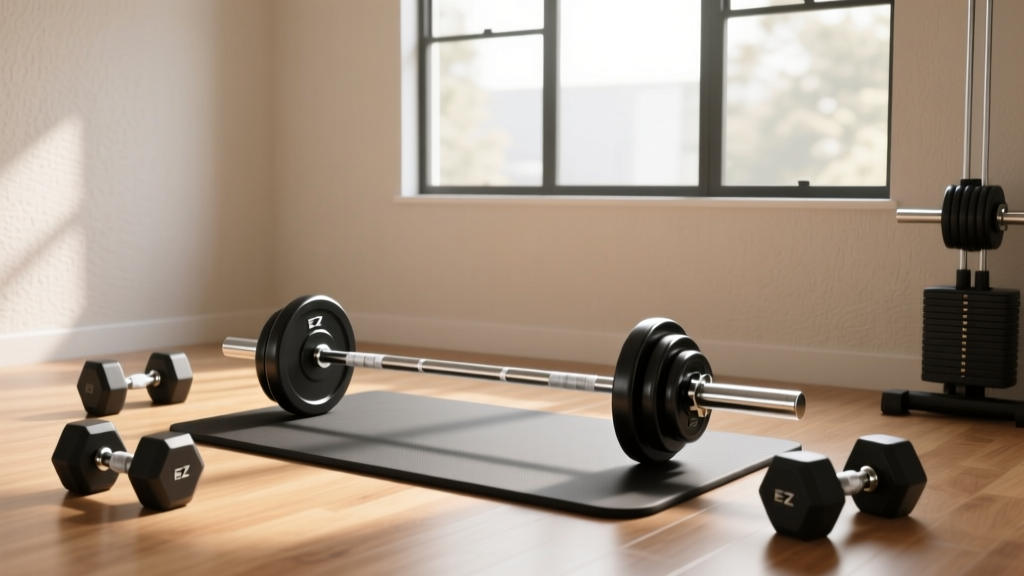
EZ Bar vs Straight Bar: Space Optimization & Dumbbell Radial Deviation Tactics
Compare the EZ curl bar vs straight bar for compact home gyms. Discover layout dimensions, biomechanics, and dumbbell radial deviation alternatives.

The Compact Gym Dilemma: Bicep & Forearm Station Footprints
Designing a high-performance home gym in 2026 often means battling strict spatial constraints. Whether you are converting a 10x10 spare bedroom or carving out a corner of a two-car garage, the 'arm station' is where layout inefficiencies become painfully obvious. Lifters frequently debate the necessity of an EZ curl bar versus a standard straight barbell for bicep and forearm development. However, this debate is rarely framed through the lens of space optimization and lateral clearance.
A standard 7-foot Olympic straight barbell, such as the Rogue Ohio Bar ($295), requires 72 inches of shaft space. When you add standard 45-pound bumper plates (which are 17.5 inches wide each), your total lateral working footprint balloons to 107 inches—nearly 9 feet. If your lifting bay is flanked by walls or a power rack, a straight bar can easily scrape drywall during wide-grip curls or loading sequences. Conversely, a 47-inch EZ curl bar like the Rogue Curl Bar ($165) reduces that total loaded span to roughly 82 inches. But what if you could eliminate the specialty bar entirely and optimize your forearm training using adjustable dumbbells? This is where understanding biomechanics and movements like dumbbell radial deviation becomes a game-changer for compact gym layouts.
Biomechanics vs. Real Estate: EZ Curl Bar vs Straight Bar
To make an informed layout decision, we must look at how these bars alter muscle recruitment and joint stress. The straight barbell forces your wrists into full supination (palms facing directly up). According to kinesiological data from ExRx on the Barbell Curl, this maximizes the mechanical advantage of the biceps brachii. However, it also places immense torque on the distal radioulnar joint and the medial epicondyle, which can lead to golfer's elbow in lifters with poor carrying angles.
The EZ curl bar introduces angled grips (typically 45 degrees), placing the wrists in a semi-supinated position. As noted in ExRx's EZ Bar Curl analysis, this slight shift transfers a significant portion of the load from the biceps brachii to the brachialis and the brachioradialis (the primary forearm flexor).
| Feature | Standard Straight Bar (7ft) | Olympic EZ Curl Bar (47in) | Adjustable Dumbbells (Pair) |
|---|---|---|---|
| Unloaded Length | 72 inches | 47 inches | ~16 inches (per dumbbell) |
| Loaded Span (w/ 45lb Bumpers) | 107 inches | 82 inches | 32 inches (total working width) |
| Primary Bicep Target | Biceps Brachii (Short & Long Head) | Brachialis & Brachioradialis | Biceps Brachii (with supination) |
| Wrist Joint Stress | High (Full Supination) | Low (Semi-Supinated) | Variable (User-Controlled) |
| Storage Footprint | Requires 7ft wall rack or floor stand | Requires 4ft wall rack or J-cup storage | 18x8 inch rack tray or floor cradle |
| Average 2026 Cost | $250 - $320 | $140 - $190 | $350 - $500 (e.g., Nuobell 80) |
The Space-Saving Forearm Builder: Dumbbell Radial Deviation
When space optimization dictates that you must choose between buying a dedicated forearm attachment, an EZ bar, or relying on dumbbells, the dumbbell route offers a unique biomechanical advantage: isolated wrist deviation. Most lifters train forearm flexion (wrist curls) and extension, but completely ignore the lateral movements of the wrist. This leads to muscular imbalances and increases the risk of lateral epicondylitis (tennis elbow), a common overuse injury detailed by the Cleveland Clinic.
Dumbbell radial deviation is the movement of bending the wrist upward toward the thumb side. It specifically targets the extensor carpi radialis longus and brevis. To perform this in a compact gym without a specialized lever machine:
- The Grip: Take an adjustable dumbbell (like a PowerBlock Elite or Nuobell) or a hex dumbbell and grip it off-center. If using a hex dumbbell, grab the handle close to one of the weight heads so the center of mass is heavily biased toward one end.
- The Setup: Sit on a bench or stand, resting your forearm on your thigh with your wrist hanging off the edge, thumb pointing toward the ceiling.
- The Execution: Allow the weight to pull your wrist downward into ulnar deviation, then actively contract the top of your forearm to pull the weight upward into radial deviation.
Space-Saving Blueprint Tip
By mastering dumbbell radial deviation and ulnar deviation, you completely eliminate the need for a dedicated wrist roller station or an EZ bar strictly for brachioradialis hammer curls. A single pair of 50lb adjustable dumbbells occupies less than 2 square feet of floor space while providing the exact resistance profile needed for complete forearm and brachialis development.
Three Layout Blueprints for Compact Home Gyms
How you arrange your free weights depends entirely on your available lateral clearance. Here are three proven layouts for 2026 home gyms:
1. The 5x5 Micro-Bay (Dumbbell & Kettlebell Focus)
Clearance: 60x60 inches. Equipment: Adjustable dumbbell set (5-80 lbs), kettlebell pair, flat/incline adjustable bench. Strategy: No barbells. You perform standing dumbbell curls with a supinating twist to hit the biceps brachii, and utilize dumbbell radial deviation seated on the bench for the forearms. This layout leaves 24 inches of walkway space on all sides, perfect for apartment gyms or tight garage corners.
2. The 6x8 Corner Station (EZ Bar Integration)
Clearance: 72x96 inches. Equipment: Half-rack (e.g., Rep Fitness HR-5000, 49 inches wide), Olympic EZ Curl Bar, plate tree. Strategy: The half-rack handles squats and rack pulls. The EZ curl bar is stored on vertical bar hooks on the rack's uprights. Because the EZ bar is only 47 inches long, you can perform standing curls inside the rack or directly in front of it without the barbell sleeves clipping the rack's uprights or nearby walls.
3. The 8x10 Rack Integration (Straight Bar Purist)
Clearance: 96x120 inches. Equipment: Full power rack (e.g., Rogue R-3, 49x53 inches), 7ft Ohio Bar, wall-mounted plate storage. Strategy: You have the 107-inch lateral clearance required to load and unload a straight barbell safely. The straight bar remains the king of heavy eccentric bicep curls and strict barbell rows, but you must dedicate a 7-foot wall section purely for bar storage and loading clearance.
Purchasing Framework: What to Buy Based on Your Clearance
- Buy the Straight Bar ONLY if: You have a minimum of 9 feet (108 inches) of unobstructed lateral wall space, you prioritize heavy eccentric overload for the biceps brachii, and you already own a 7-foot barbell for deadlifts and presses.
- Buy the EZ Curl Bar ONLY if: You have between 6 and 8 feet of lateral space, you suffer from wrist or medial elbow pain during supinated curls, and you want to emphasize the brachialis for thicker-looking arms.
- Invest in Adjustable Dumbbells & Skip the Bars if: Your lifting bay is smaller than 6x6 feet, you share the space with others, or you want to prioritize joint health through specialized movements like dumbbell radial deviation and unilateral supinating curls without buying multiple specialty bars.
Frequently Asked Questions
Can I build big forearms without an EZ bar or wrist roller?
Absolutely. The brachioradialis is heavily recruited during neutral-grip (hammer) dumbbell curls. Furthermore, incorporating off-center grip exercises like dumbbell radial deviation and ulnar deviation will build the extensor and flexor carpi muscles, resulting in dense, thick forearms without requiring bulky specialty equipment.
How much wall clearance do I actually need for a straight bar curl?
While the bar itself is 72 inches, standard 45lb iron plates add about 13 inches per side, and bumper plates add 17.5 inches per side. Therefore, you need a minimum of 98 inches (8 feet 2 inches) for iron plates, or 107 inches (8 feet 11 inches) for bumper plates, just to hold the bar at arm's length. Add 6 inches for elbow clearance, and a 9.5-foot wall is the practical minimum for comfortable straight bar curling.
More gear to consider
All reviews
Rubber Hex vs Urethane for Your Boxing Workout with Dumbbells

Bumper vs Iron Plates & Best Middle Back Workout Dumbbells

Rubber Hex vs Urethane: Gym Layouts and the Dumbbell Pullover for Lats

Olympic vs Standard Plates & Bench Rows With Dumbbells: Beginner Guide
Bumper vs Iron Plate Comparison & Tricep Dips Dumbbell Alternative
