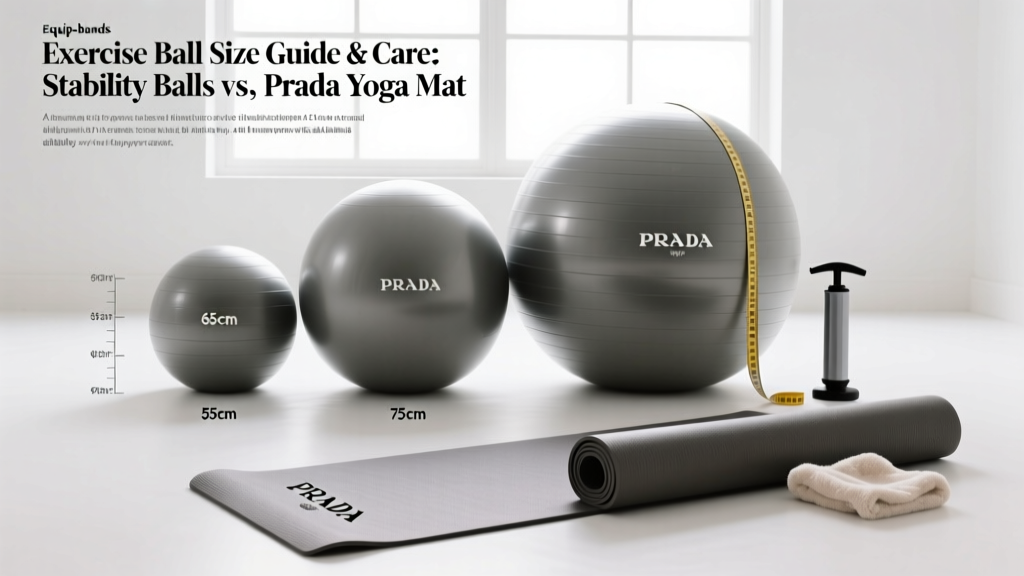
Exercise Ball Size Guide & Care: Stability Balls vs. Prada Yoga Mat
Master the exercise ball size guide and buying tips while learning premium maintenance for stability balls and luxury gear like a Prada yoga mat.

The Foundation of Home Gym Longevity: Sizing and Material Care
Curating a high-end home gym in 2026 requires more than just purchasing premium equipment; it demands a rigorous understanding of biomechanics and material science. Whether you are integrating commercial-grade stability balls into your functional training zone or laying out a luxury Prada yoga mat for your evening mobility flow, the longevity of your gear hinges on proper sizing, precise inflation protocols, and meticulous maintenance. Heavy-duty PVC stability balls and high-end polyurethane or leather floor accessories react differently to environmental stressors, body oils, and cleaning agents.
This comprehensive guide bridges the gap between heavy equipment sizing and luxury accessory care, ensuring your investment remains safe, effective, and aesthetically pristine for years to come.
Exercise Ball Size Guide: Finding Your Biomechanical Match
The most common failure mode in stability ball training is not material rupture, but improper sizing leading to poor spinal alignment and reduced core activation. According to guidelines referenced by the American Council on Exercise (ACE), the correct ball diameter is dictated by your height and the resulting joint angles when seated.
The 90-Degree Rule
When seated on a fully inflated stability ball, your hips and knees should form a perfect 90-degree angle, with your thighs parallel to the floor. If your hips sink below your knees, the ball is too small or under-inflated, which places excessive shear force on the lumbar spine. If your hips are elevated above your knees, you lose the stabilizing engagement required for core exercises.
| User Height | Recommended Ball Diameter | Primary Use Case |
|---|---|---|
| Under 5'0" (152 cm) | 45 cm | Desk chair replacement, light Pilates |
| 5'1" to 5'8" (155 - 173 cm) | 55 cm | Core work, wall squats, stretching |
| 5'9" to 6'2" (175 - 188 cm) | 65 cm | Heavy dumbbell presses, hamstring curls |
| 6'3" to 6'7" (190 - 201 cm) | 75 cm | Full-body stabilization, physical therapy |
| Over 6'8" (203+ cm) | 85 cm | Specialized athletic conditioning |
The 24-Hour Inflation Protocol (Critical for Longevity)
Never inflate a new PVC stability ball to its maximum diameter in a single session. The polymer chains in the PVC need time to acclimate to room temperature and stretch uniformly. Skipping this step is the leading cause of micro-tears and premature bursting.
- Day 1 (Initial Inflation): Inflate the ball to roughly 80% of its target diameter. The material will feel stiff and unyielding. Leave it in a room-temperature environment (68°F - 72°F) for 24 hours.
- Day 2 (Final Sizing): Inflate the ball to the exact manufacturer-specified diameter. Use a measuring tape or the included sizing guide to ensure precision.
- Day 3 (Settling): Check the firmness. If the PVC has stretched slightly, add a few pumps of air to achieve the optimal 'give'—it should depress about 1 inch under your body weight.
Buying Tips: Anti-Burst Technology and Load Ratings
When shopping for a stability ball, ignore marketing fluff and look directly at the burst rating and material composition. According to physical therapy standards documented on Physio-pedia, anti-burst (or slow-deflate) PVC is non-negotiable for any dynamic movement or weighted exercises.
Understanding Load Ratings
Static Weight Limit: The maximum weight the ball can hold while stationary (often rated up to 2,200 lbs for premium models).
Dynamic Weight Limit: The maximum safe weight during active movement (jumping, bouncing, or lifting weights). This is typically much lower, around 300 to 500 lbs. Always buy based on the dynamic limit.
Material Pros and Cons: Anti-Burst PVC
- Pros: Punctures result in a slow, safe deflation rather than an explosive pop; highly elastic; resistant to heavy compression.
- Cons: Susceptible to UV degradation; can be damaged by petroleum-based cleaning solvents; attracts pet hair and dust due to static charge.
Material Degradation: Environmental Threats to PVC
To maximize the lifespan of your stability ball, you must understand what breaks down PVC at a chemical level. Ozone exposure, direct ultraviolet (UV) sunlight, and extreme temperature fluctuations cause the plasticizers in the PVC to leach out, leaving the ball brittle and prone to catastrophic failure.
Cleaning Warning: Never use citrus-based cleaners, bleach, or alcohol wipes on your stability ball. The d-Limonene in citrus cleaners and the ethanol in alcohol wipes strip the protective outer coating of the PVC, accelerating the drying process. Instead, use a microfiber cloth dampened with warm water and a single drop of mild, pH-neutral dish soap.
Luxury Floor Gear: Maintaining the Prada Yoga Mat
While a heavy-duty stability ball is designed for rugged, high-impact abuse, luxury floor accessories require an entirely different maintenance paradigm. Investing in high-end fitness fashion, such as a limited-edition Prada yoga mat (often crafted from premium polyurethane, technical Linea Rossa nylon, or luxury leather accents), elevates the aesthetic of your space but demands meticulous care.
Polyurethane and Leather Care Protocols
If your luxury mat features high-density polyurethane (PU) or leather elements, the maintenance rules are strict:
- Sweat and Oils: Unlike standard PVC mats that can be hosed down, luxury PU and leather are porous. Body oils and acidic sweat will degrade the surface finish over time, causing discoloration and peeling. Wipe the mat immediately after use with a dry, lint-free microfiber cloth.
- Deep Cleaning: Use a specialized leather or PU cleaner. Apply a minimal amount to a cloth—never spray directly onto the mat. Avoid any product containing essential oils (like tea tree or lavender), as oils will permanently stain and break down luxury synthetic leathers.
- Rolling vs. Folding: Never fold a premium mat. Folding creates permanent stress fractures in the PU coating. Always roll the mat with the top surface facing outward so that when you unroll it, the edges lay flat against the floor rather than curling upward.
Storage Frameworks for Premium Accessories
How you store your gear between sessions dictates its lifespan. Implementing a proper storage framework prevents micro-punctures on stability balls and surface warping on luxury mats.
The 3-Point Storage Checklist
- Climate Control: Store both PVC balls and luxury mats in a climate-controlled room (40-60% humidity). High humidity promotes mold growth on natural fibers and leather accents, while low humidity dries out PVC.
- Floor Protection: Never leave a stability ball resting directly on unfinished hardwood or rough concrete for extended periods. Splinters and micro-abrasions can create weak points in the PVC. Use a dedicated ball stand or a protective floor mat.
- Pet Management: Keep cats and dogs away from inflated stability balls. A single microscopic scratch from a claw can compromise the anti-burst webbing, turning a slow-deflate ball into a ticking time bomb under heavy loads.
Frequently Asked Questions (FAQ)
Can I use a stability ball as a permanent desk chair replacement?
While popular, using a stability ball as a desk chair for more than 2 hours a day is not recommended by physical therapists. Prolonged sitting without back support leads to spinal fatigue and slouching. Furthermore, the constant friction against office chair bases or rough flooring accelerates PVC wear. If you must use one, alternate with an ergonomic chair every 45 minutes.
How do I know if my stability ball is losing its structural integrity?
Inspect the ball monthly for 'whitening' or stress marks around the plug hole and the equator. If the PVC feels excessively hard and lacks its usual elastic 'give,' the plasticizers have dried out, and the ball is at a high risk of rupturing under dynamic load. Replace premium balls every 2 to 3 years, regardless of visual condition.
Does a luxury Prada yoga mat provide better grip than standard mats?
Luxury mats often prioritize premium materials, aesthetics, and joint cushioning over the extreme 'tacky' grip found in standard natural rubber yoga mats. If you practice hot yoga or sweat heavily, a high-end PU or leather-accented mat may require a secondary microfiber grip towel to maintain stability during complex transitions. Always check the specific technical specifications of the seasonal release for moisture-wicking properties.
Final Thoughts on Equipment Longevity
Whether you are dialing in the exact 65cm diameter for your weighted core work or carefully conditioning the surface of your Prada yoga mat, the principles of longevity remain the same: respect the material limits, control the environment, and adhere to strict cleaning protocols. By treating your fitness accessories as precision instruments rather than disposable commodities, you ensure a safer, more effective, and highly refined training experience.
For more insights on core stabilization and biomechanics, refer to the Mayo Clinic's guide on core exercises to optimize your routine safely.
More gear to consider
All reviews
Beyond Nike SKIMS Yoga Mat Hype: 2026 Exercise Ball Size Guide

Recovery Setup: Foam Roller Density & Yoga Mat Schoonmaken

Speed vs Weighted Jump Ropes on an Oversized Yoga Mat
Pull Up Assist Band Sizing & Essential Oil Yoga Mat Cleaner Review

Medicine Ball Weight Selection & Yoga Mats That Give Back
