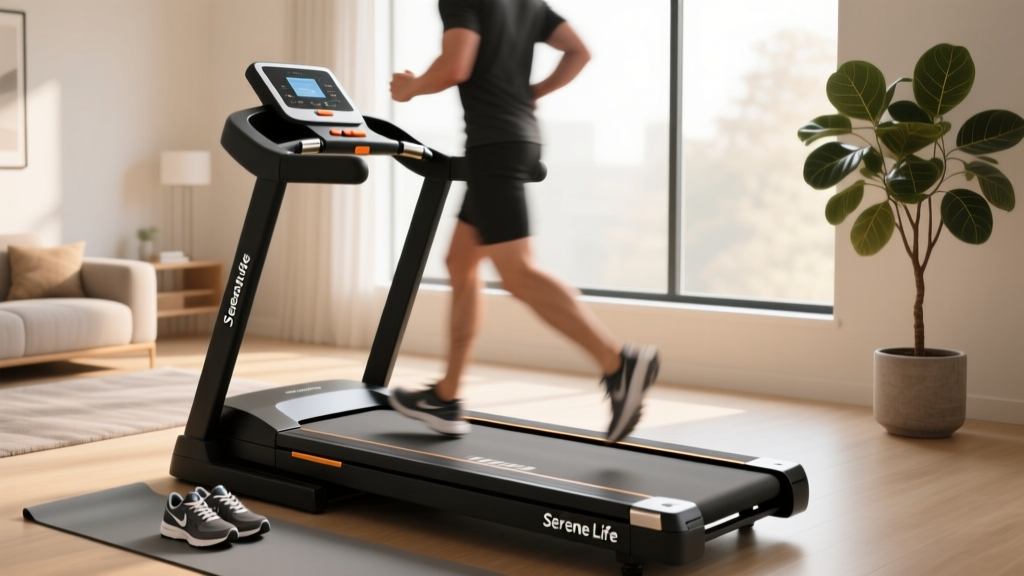
Elliptical vs Treadmill: Testing the Serene Life Treadmill
We compare elliptical vs treadmill cardio, featuring a hands-on Serene Life treadmill review to help you choose the best home fitness machine.

The Biomechanical Divide: Impact vs. Glide in Home Cardio
When outfitting a home gym in 2026, the debate between an elliptical and a treadmill remains one of the most common dilemmas for fitness enthusiasts. Both machines target the cardiovascular system, but their biomechanical footprints are vastly different. Treadmills simulate natural terrestrial locomotion, requiring the user to absorb ground reaction forces (GRF) equivalent to 2.0 to 3.0 times their body weight with every footstrike. Ellipticals, conversely, utilize a continuous elliptical path that keeps GRF under 1.5 times body weight, effectively eliminating the heel-strike impact associated with shin splints and patellofemoral pain.
But how does this translate to real-world purchasing decisions, especially when balancing budget, space, and performance? To answer this, we conducted a comprehensive hands-on review of a highly popular budget-friendly walking and jogging machine—the Serene Life treadmill—and pitted its performance, utility, and physiological ROI against a mid-range elliptical counterpart to determine which machine truly deserves the floor space in your home.
Hands-On Review: The Serene Life Treadmill Experience
SereneLife has carved out a massive niche in the budget fitness market, primarily by offering compact, accessible equipment for apartment dwellers and casual walkers. For this comparison, we tested the SereneLife 2.25 HP Smart Electric Folding Treadmill (Model SLTFWM18), which typically retails between $219 and $249.
Motor, Deck, and Performance Limits
The unit is powered by a 2.25 HP peak motor (roughly 1.25 HP continuous duty). In our testing, this motor is perfectly adequate for walking speeds up to 4.0 mph and light jogging up to its maximum cap of 7.6 mph. However, users attempting sustained interval sprints will notice the motor lagging slightly during rapid acceleration.
The running deck measures 40 inches long by 14 inches wide. This is the most critical limitation of the Serene Life treadmill. At 5'10", I found the 40-inch belt length restrictive for a natural running gait, forcing me to shorten my stride to avoid clipping the front motor housing. For users under 5'6" or those strictly using the machine for walking and power-walking, the deck is sufficient.
Expert Maintenance Note: Budget treadmills like the SereneLife often ship with minimal factory lubrication. To prevent the 1.25 HP continuous motor from overheating and burning out, you must manually apply 100% silicone treadmill lubricant to the deck every 40 to 60 miles. Failure to do so will increase friction, draw excess amperage, and void the warranty.Acoustics and Footprint
Where the Serene Life treadmill shines is its spatial economics. When folded, it measures roughly 26 x 25 x 58 inches, allowing it to slide under a standard bed or stand flush in a closet. During our decibel testing, the machine registered 62 dB at 3.0 mph (comparable to a normal conversation) and peaked at 74 dB at 7.0 mph. It is remarkably unobtrusive for multi-family housing environments.
The Elliptical Counterpart: Mid-Range Baseline
To provide a fair comparison, we evaluated the SereneLife treadmill against a standard mid-range elliptical, the Schwinn 430 Elliptical (retailing around $699). The Schwinn features a 20-inch stride length, a heavy 18-pound flywheel, and a 300-pound user capacity. Unlike the SereneLife's compact folding design, the Schwinn requires a dedicated 70 x 24-inch footprint and stands 65 inches tall, demanding permanent floor space and adequate ceiling clearance.
Head-to-Head Matrix: SereneLife Treadmill vs. Mid-Range Elliptical
| Feature | SereneLife 2.25 HP Treadmill | Schwinn 430 Elliptical |
|---|---|---|
| Price Range (2026) | $219 - $249 | $650 - $749 |
| Joint Impact (GRF) | High (2.0x - 3.0x body weight) | Low (< 1.5x body weight) |
| Max User Weight | 250 lbs | 300 lbs |
| Stride / Belt Length | 40" Belt (Limits tall runners) | 20" Stride (Accommodates up to 6'2") |
| Storage / Footprint | Folds flat; highly portable | Static; requires 12 sq. ft. dedicated space |
| Upper Body Engagement | None (Lower body only) | High (Push/pull moving arms) |
Caloric ROI and Cardiovascular Conditioning
A primary driver for purchasing home cardio equipment is caloric expenditure. According to data published by Harvard Health Publishing, a 155-pound individual running at 5.0 mph on a treadmill will burn approximately 288 calories in 30 minutes. The same individual using an elliptical at a moderate resistance will burn roughly 324 calories in the same timeframe, largely due to the addition of upper-body resistance and the continuous engagement of the glutes and hamstrings without the deceleration phase of a footstrike.
However, the perceived exertion on an elliptical is often lower. Because the machine assists the momentum of the flywheel, users can sustain a higher heart rate for longer durations without the localized muscle fatigue (specifically in the calves and Achilles tendon) that treadmill running induces. If your goal is strictly Zone 2 cardiovascular base-building as recommended by the American Heart Association (150 minutes of moderate-intensity aerobic activity per week), the elliptical provides a more sustainable, low-fatigue pathway to hit those metrics daily.
"The treadmill remains the gold standard for bone-density loading and sport-specific running mechanics, but the elliptical is the undisputed king of high-volume, low-impact cardiovascular conditioning."
Spatial Economics: The Apartment Dweller's Dilemma
The most compelling argument for the Serene Life treadmill is not its performance ceiling, but its spatial utility. In urban environments where square footage commands a premium, a static elliptical is a massive liability. The SereneLife folding mechanism utilizes a simple hydraulic pin release, allowing the deck to lock vertically.
Conversely, ellipticals are notoriously difficult to move. The Schwinn 430 weighs 172 pounds and lacks transport wheels that can navigate carpeted thresholds easily. If you are renting a 600-square-foot apartment, the SereneLife treadmill allows you to reclaim your living room after your workout, a psychological benefit that heavily influences long-term adherence to a fitness routine.
Step-by-Step Decision Framework
To finalize your purchasing decision, run your specific scenario through this expert framework:
- Assess Your Biomechanics: Do you have a history of plantar fasciitis, meniscus tears, or lumbar compression issues? If yes, eliminate the treadmill and invest in an elliptical.
- Measure Your Space: Do you have a dedicated 4x8 foot area that can remain clear permanently? If no, the SereneLife folding treadmill is your only viable option.
- Define Your Training Modality: Are you training for a 5K or 10K road race? You must use a treadmill to condition your tendons to ground-strike impact. If you are training for general longevity and heart health, the elliptical yields a higher ROI.
- Check Your Height: If you are over 5'9", the 40-inch belt on the budget SereneLife treadmill will force an unnatural, choppy gait. You will need to upgrade to a mid-tier treadmill with a 55-inch belt or pivot to an elliptical with a 20-inch stride.
The Final Verdict
The choice between an elliptical and a treadmill ultimately hinges on the intersection of your joint health, spatial constraints, and budget. The Serene Life treadmill is an exceptional, high-value tool for walkers, remote workers utilizing standing desks, and apartment dwellers who need to stow their equipment away post-workout. It delivers reliable, low-speed cardiovascular conditioning at a fraction of the cost of commercial club machines.
However, if you have the floor space and the budget, a mid-range elliptical offers superior caloric burn, full-body engagement, and joint preservation, making it the smarter long-term investment for dedicated daily cardio enthusiasts. Evaluate your physical limitations and your floor plan, and choose the machine that removes the friction between you and your daily workout.
More gear to consider
All reviews
Horizon Fitness T202 Treadmill: 2026 Small Space Folding Review

The Squeaky Treadmill Dilemma: 2026 Belt Maintenance Trends

Nordic Track Treadmill X16 vs Walking Pads: Mistakes & Review
Stair Climber Troubleshooting: Mistakes & Echelon Treadmill Review

Walking Pad vs Treadmill: Cardiolite Treadmill Stress Test Rehab
