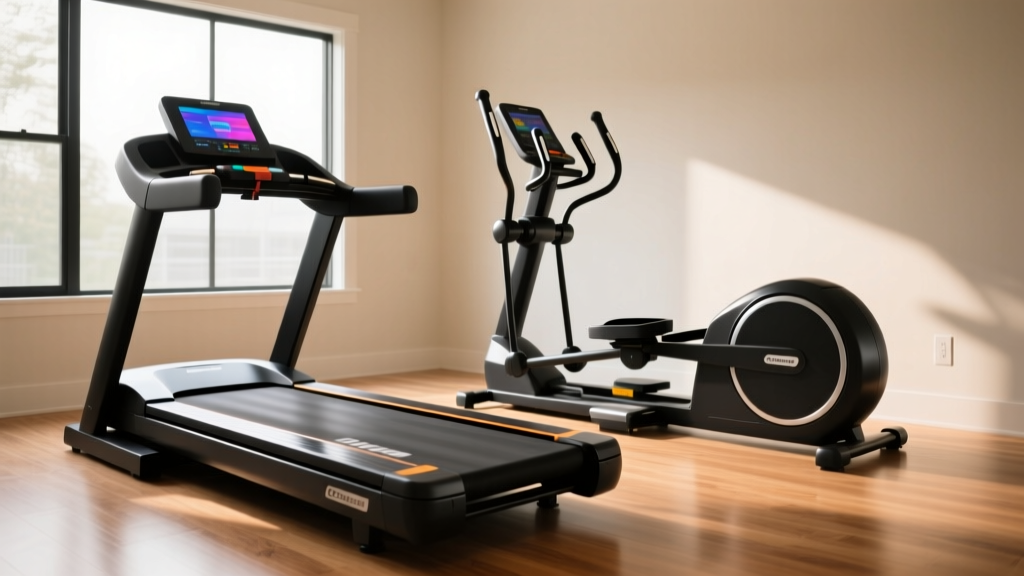
Elliptical vs Treadmill: Can You Train for a Marathon on a Treadmill?
We break down the 5-year costs of ellipticals vs. treadmills for home cardio, answering if you can train for a marathon on a treadmill to maximize ROI.

The Core Dilemma: General Cardio vs. Specific Race Prep
When outfitting a home gym, the debate between an elliptical and a treadmill for home cardio usually comes down to joint health versus caloric burn. However, for runners and aspiring athletes, the ultimate tiebreaker is a highly specific question: can you train for a marathon on a treadmill? The short answer is yes, but the financial and physiological implications of that choice drastically alter your home gym budget and equipment ROI.
If your primary goal is completing a 26.2-mile race, the treadmill transitions from a 'luxury fitness item' to a 'mandatory training tool.' Conversely, if your goal is general cardiovascular health, weight management, or cross-training, the elliptical often presents a superior long-term value proposition. To make the right financial decision in 2026, we must look beyond the sticker price and analyze the 5-year total cost of ownership, maintenance realities, and physiological ROI of both machines.
Upfront Capital: 2026 Pricing Tiers for Home Units
The initial buy-in for commercial-grade home cardio equipment has stabilized following the pandemic-era supply chain surges. Below is a direct comparison of the most popular mid-to-high-tier models that dominate the home market today.
| Machine Type | Model (2026 Standard) | MSRP | Key Specs & Motor/Drive | Warranty Coverage |
|---|---|---|---|---|
| Treadmill | Sole F80 | $1,199 | 3.5 CHP Motor, 20" x 60" belt | Lifetime Frame/Motor, 3 Yr Parts |
| Elliptical | Sole E95 | $1,199 | Heavy-duty flywheel, 20" stride | Lifetime Frame/Motor, 3 Yr Parts |
| Treadmill | NordicTrack Commercial 1750 | $1,999 | 3.5 CHP, 14" HD Touchscreen, -3 to 15% incline | Lifetime Frame, 1 Yr Parts/Labor |
| Elliptical | NordicTrack Commercial 14.9 | $1,699 | Adjustable stride, 14" HD Touchscreen | Lifetime Frame, 1 Yr Parts/Labor |
Value Insight: At the $1,200 price point, the Sole F80 and E95 are virtually identical in cost. However, the NordicTrack ecosystem shows a $300 premium for the treadmill, largely due to the heavier structural steel required to absorb the repetitive impact forces of running.
The Physiological ROI: Why Marathoners Must Choose the Treadmill
To understand the value of the investment, we must address the biomechanics of race prep. According to the Mayo Clinic, ellipticals offer a distinct advantage in reducing impact stress on the joints, making them ideal for rehabilitation and low-impact cardio. However, this exact feature makes them a poor ROI for marathon training.
The Eccentric Loading Factor
Running a marathon requires your muscles, tendons, and bones to withstand thousands of eccentric contractions (the lengthening of the muscle under tension when your foot strikes the ground). This specific stress triggers bone density adaptation and tendon stiffness required to run 26.2 miles without injury.
- Treadmills: While the deck cushioning reduces peak impact by 15-20% compared to asphalt, it still forces the body to absorb eccentric loading. You can accurately simulate race-day fatigue, pace-specific lactate thresholds, and muscular endurance.
- Ellipticals: The elliptical path eliminates the 'strike' phase entirely. You cannot build the specific lower-leg durability required for a marathon on an elliptical. Using one as your primary marathon trainer will likely result in a DNF (Did Not Finish) or severe delayed onset muscle soreness (DOMS) at mile 18.
Coach's Note: If you are asking 'can you train for a marathon on a treadmill' because you live in a harsh winter climate or need precise pace control, the treadmill is a 100% valid and necessary investment. If you are asking because you want to avoid the impact of running, you are investing in the wrong machine for your specific goal.
The Hidden Costs: Maintenance, Subscriptions, and Electricity
The purchase price is merely the entry fee. The 5-year operational costs reveal a stark divergence between these two cardio staples.
1. Maintenance and Wear Parts
Treadmills: The friction between the belt and the deck is the primary point of failure. You must apply 100% silicone lubricant ($15 per bottle) every 3 months or 130 miles. Failure to do so increases amp draw, which will eventually fry the motor control board—a $250 to $400 replacement part. Furthermore, a running belt will stretch and require replacement every 3 to 5 years ($150 for the part).
Ellipticals: Maintenance is vastly cheaper. The primary task is wiping down the aluminum tracks to prevent polyurethane wheel degradation. The internal drive belt may need replacement after 5-7 years of heavy use ($120), but the lack of high-friction surfaces keeps annual upkeep under $20.
2. Electrical Draw
Treadmills with 3.5+ CHP motors running at 8.0 mph on a 10% incline can draw between 15 to 20 amps. If you are running long marathon training sessions (2-3 hours) daily in a room with shared circuits, you risk tripping breakers. Ellipticals, by contrast, draw a negligible 3 to 5 amps, and many high-end models (like those from Life Fitness or Precor) are entirely self-generating, costing you $0 in electricity.
3. The Subscription Trap
In 2026, interactive programming is a major value driver. If you opt for a NordicTrack or ProForm machine, you are essentially locking yourself into the iFIT ecosystem. While you can use the machines in manual mode, the automated incline/resistance adjustments require a subscription ($15/month for individuals, $39/month for families). Over 5 years, that adds $900 to $2,340 to your total cost of ownership. Sole and Bowflex machines offer more robust free manual modes, protecting your long-term budget.
Space, Depreciation, and the Resale Market
Home gym equipment takes up valuable real estate, and its depreciation curve impacts its true financial value.
The Depreciation Matrix
Treadmills: Lose roughly 30-40% of their value in the first year. However, because running remains the most popular cardio exercise globally, the secondary market for used treadmills (especially brands like Sole and Horizon) is highly liquid. You can reasonably expect to recoup 40% of your MSRP if you sell a well-maintained unit after 3 years.
Ellipticals: Lose 50% or more of their value immediately. The secondary market is flooded with ellipticals from buyers who realized they preferred running or lifting. Reselling a 3-year-old elliptical often yields pennies on the dollar, making it a 'buy it for life' or 'lose your investment' proposition.
Aligning With Health Guidelines
Regardless of the machine you choose, consistency is the ultimate metric of value. The American Heart Association recommends at least 150 minutes of moderate-intensity or 75 minutes of vigorous aerobic activity per week. Both machines easily facilitate these guidelines. The financial 'waste' only occurs when the machine's biomechanical output mismatches the user's physiological goal.
The Verdict: Which Machine Wins the Budget Breakdown?
To maximize your home cardio budget, you must align the equipment with your end goal. Use this decision framework to finalize your purchase:
- Buy the Treadmill IF: You are actively training for a 10K, half-marathon, or full marathon. You need to build eccentric leg durability, practice exact pacing, and simulate the impact of road running. The higher maintenance and electrical costs are justified by the specific race-prep ROI.
- Buy the Elliptical IF: Your goal is general cardiovascular health, weight loss, or cross-training for cycling/skiing. You have a history of plantar fasciitis, shin splints, or knee osteoarthritis. The lower maintenance costs, zero electricity fees, and joint preservation make it the superior long-term health investment.
Ultimately, asking 'can you train for a marathon on a treadmill' is the exact right question to ask before dropping $1,500+ on home fitness gear. If the answer dictates your race-day success, the treadmill is not an expense; it is a mandatory investment in your finish line.
More gear to consider
All reviews
Centr Runr Treadmill Review & Space-Saving Bike Layouts

Is a Treadmill a Good Way to Lose Weight? The Noise Test

Curved vs Motorized Treadmills: Calorie Burn Incline Treadmill Guide
Home Stair Climber Guide: What Is 15 Incline on Treadmill in Degrees?

T Series 8 Treadmill Review: Curved vs Motorized 2026
