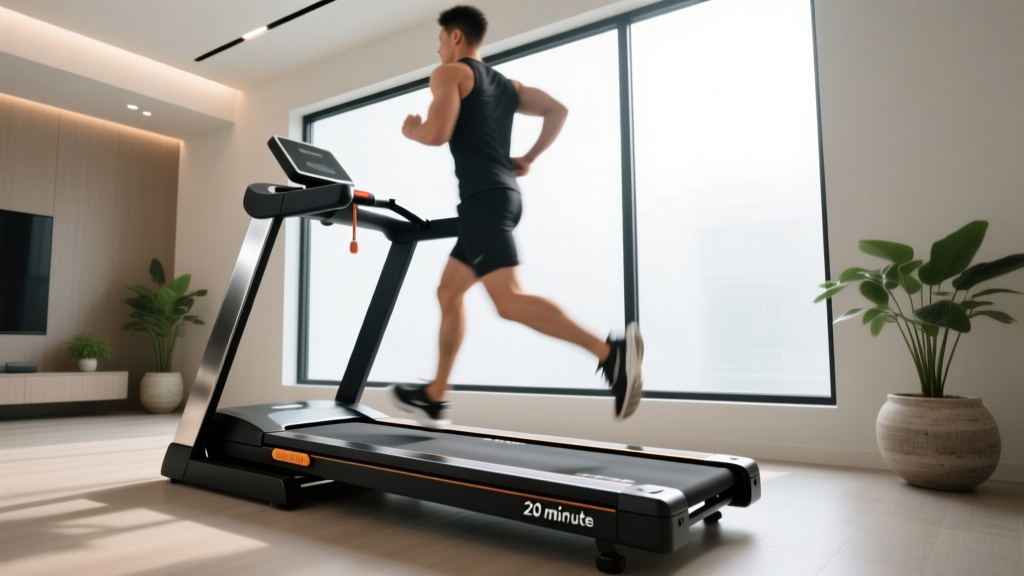
Elliptical vs Treadmill: Trends for a Fat Person on a Treadmill
Analyzing 2026 market trends for ellipticals vs treadmills. Discover biomechanical data, weight capacities, and home cardio options for heavier users.

The 2026 Bariatric Home Cardio Market Landscape
The home fitness equipment industry has undergone a massive structural shift over the last three years, specifically regarding high-BMI (Body Mass Index) demographics. As of 2026, the bariatric and plus-size fitness equipment sector is outpacing general market growth, driven by a demand for higher weight capacities, reinforced chassis designs, and advanced impact-absorption technologies. When evaluating the perennial debate of elliptical vs treadmill for home cardio, the market data reveals a distinct divergence in manufacturing priorities and consumer purchasing behavior.
Historically, home cardio machines were engineered around a standard 250-pound user profile. Today, leading manufacturers are reinforcing steel frames and upgrading continuous duty motors to accommodate users well over 350 pounds. This shift is not just about structural integrity; it is deeply tied to biomechanical safety and long-term cardiovascular health. According to data from the Centers for Disease Control and Prevention (CDC), over 40% of American adults fall into the obesity category, creating a massive, underserved market for durable, joint-friendly home cardio solutions.
2026 Market Data Highlight:- Market Growth: High-capacity (350+ lbs) home cardio equipment sales grew by 14.2% year-over-year.
- Motor Upgrades: 4.0 CHP (Continuous Horsepower) has replaced 3.0 CHP as the baseline for premium heavy-duty treadmills.
- Warranty Shifts: Lifetime motor warranties are now standard on models rated for 350+ lbs, reflecting improved thermal management systems.
Biomechanics and Ground Reaction Forces (GRF)
To understand the market shift, we must first analyze the biomechanical realities of high-BMI cardio. The primary concern for heavier users is Ground Reaction Force (GRF)—the force exerted by the ground on a body in contact with it. When analyzing joint loading, the American College of Sports Medicine (ACSM) notes that the impact forces on the knees and hips vary drastically depending on the equipment used.
For a heavier individual, the repetitive impact of a treadmill belt can exacerbate osteoarthritis and plantar fasciitis if the machine lacks adequate deck cushioning. Conversely, ellipticals offer a closed-chain kinetic movement, meaning the feet never leave the pedals, effectively reducing the GRF to near zero. However, the biomechanical advantage of an elliptical comes with a mechanical caveat: pedal spacing (Q-factor) and axle durability, which we will address in the hardware teardown.
| Activity (300 lb User) | Peak Joint Load (Knees) | Impact Classification |
|---|---|---|
| Treadmill Running (5.0 mph) | ~750 - 900 lbs (2.5x - 3x BW) | High Impact |
| Treadmill Incline Walking (3.5 mph) | ~360 - 450 lbs (1.2x - 1.5x BW) | Moderate Impact |
| Elliptical (Moderate Resistance) | ~300 - 330 lbs (1.0x - 1.1x BW) | Low / Zero Impact |
Decoding the Search Trend: The "Fat Person on a Treadmill" Phenomenon
From an SEO and market research perspective, search query analysis provides unfiltered insight into consumer pain points. When analyzing search behavior in the fitness niche, the exact phrase "fat person on a treadmill" frequently surfaces in forums, Reddit threads, and long-tail query data. While the phrasing is colloquial, the intent behind this search trend is highly specific and deeply rooted in consumer anxiety.
Why This Query Dominates Search Volume
Users searching for a "fat person on a treadmill" are typically looking for answers to three critical fears:
- Equipment Failure: Will the belt snap, the motor overheat, or the frame collapse under dynamic loads exceeding 300 pounds?
- Spatial Ergonomics: Is the belt wide enough (22 inches or more) to accommodate a wider gait without the user constantly stepping on the side rails?
- Public vs. Private Embarrassment: Many users searching this term are actively trying to transition from commercial gyms to home setups to avoid perceived judgment, driving the massive spike in direct-to-consumer home treadmill sales.
Understanding this search trend is crucial for fitness equipment manufacturers. The market response in 2026 has been the introduction of "bariatric-friendly" home treadmills featuring 22-inch by 60-inch running surfaces, reinforced side handrails, and auto-stop safety tethers calibrated for higher mass deceleration.
The Elliptical Shift in High-BMI Demographics
While treadmills dominate raw search volume due to their cultural ubiquity, actual purchase conversion data shows a strong pivot toward ellipticals among users with a BMI over 35. The National Institutes of Health (NIH) frequently recommends low-impact, weight-bearing exercises for obese patients to preserve bone density without destroying articular cartilage. Ellipticals fulfill this medical mandate perfectly, leading to a surge in heavy-duty elliptical sales despite the lower search volume compared to treadmills.
Hardware Teardown: Heavy-Duty Treadmills vs. Ellipticals
To provide actionable guidance, we must look at specific 2026 hardware specifications. Not all machines labeled "heavy-duty" are created equal. Here is a technical breakdown of what the high-BMI market requires.
Treadmill Engineering: The Sole F85 vs. NordicTrack 1750
For a heavier user, the treadmill motor is the single most critical point of failure. You must look for Continuous Duty Horsepower (CHP), not Peak Horsepower. A 300-pound user walking at a brisk pace generates significant friction and drag on the belt. If the motor is underpowered, it will stutter, causing dangerous trip hazards, and eventually burn out the internal windings.
- Sole F85 (2026 Model): Priced around $1,999, this unit features a 4.0 CHP motor, a 22" x 60" belt, and a 400-pound weight capacity. Its heavy-duty flywheel and 3-inch rollers prevent belt slip under high-mass loads.
- NordicTrack Commercial 1750: Priced at $2,499, it offers a 3.5 CHP motor and a 22" x 60" belt. While technologically superior in screen and incline features (up to 15%), the Sole F85 remains the preferred choice for users strictly over 350 pounds due to its thicker deck cushioning and simpler, more robust motor housing.
Elliptical Axle and Q-Factor Considerations
When evaluating ellipticals for heavy users, the primary failure point is the pedal axle and the drive system. Furthermore, biomechanical alignment is dictated by the Q-Factor—the horizontal distance between the pedals. A wide Q-factor forces the hips into an unnatural, abducted angle, which can cause severe lower back and knee pain for heavier users carrying extra mass around the midsection.
- Sole E95 Elliptical: Retailing at $1,499, the E95 supports up to 375 pounds. It features a heavy 27-pound flywheel and a fully adjustable pedal angle to reduce Achilles strain. However, its Q-factor is slightly wider, which may require an adjustment period.
- Bowflex Max Trainer M9: At $2,299, this hybrid stepper-elliptical is rated for 300 pounds. Its ultra-compact footprint and narrow pedal stance make it highly ergonomic for heavier users with limited space, though the 300-pound cap is a hard limit that should not be exceeded.
Strategic Purchasing Framework for 2026
When allocating a budget between an elliptical and a treadmill for a high-BMI home gym, use the following decision matrix based on your primary health constraints:
- Choose the Treadmill If: Your primary goal is bone density retention, you have no pre-existing knee or hip osteoarthritis, and you have the physical space for a 70-inch long machine. Ensure you budget for a 20-amp dedicated electrical circuit, as 4.0 CHP motors draw significant current.
- Choose the Elliptical If: You are managing chronic joint pain, recovering from bariatric surgery, or have a BMI over 40. Prioritize machines with magnetic resistance (which never degrades) over friction-based systems, and verify the warranty specifically covers the pedal axles and crank arms for at least 5 years.
"The biggest mistake plus-size buyers make is prioritizing digital features over mechanical mass. A 15-inch HD touchscreen is useless if the drive belt snaps under torque. In 2026, your money must go toward roller diameter, frame welding thickness, and continuous horsepower." — FitGearPulse Biomechanics Lab
Final Market Verdict
The narrative surrounding the "fat person on a treadmill" is evolving from one of limitation to one of empowerment, driven by an equipment market that is finally engineering for diverse body types. While the elliptical remains the undisputed king of joint preservation and low-impact cardiovascular conditioning for high-BMI users, modern heavy-duty treadmills like the Sole F85 have successfully mitigated the historical risks of belt slip and motor burnout.
For the 2026 home gym investor, the choice ultimately hinges on joint health versus spatial preference. If your joints require zero-impact motion, invest heavily in a narrow Q-factor elliptical with a robust magnetic drive. If you prefer the natural biomechanics of walking and have the budget for a 4.0 CHP motor with a 22-inch belt, the modern bariatric treadmill is a highly viable, durable investment in your long-term cardiovascular health.
More gear to consider
All reviews
NordicTrack T Series 6.5S Treadmill Review: Belt Lubrication & Value

Treadmill Sunny Health and Fitness Belt Maintenance Value Guide

Treadmill Controller Noise: Cardio Machine Sound Comparison

Sunny Health & Fitness Treadmill 2020 Model Reviews: Small Space Care
ProForm TL Treadmill vs Air Bikes: 2026 Assault Bike Market Trends