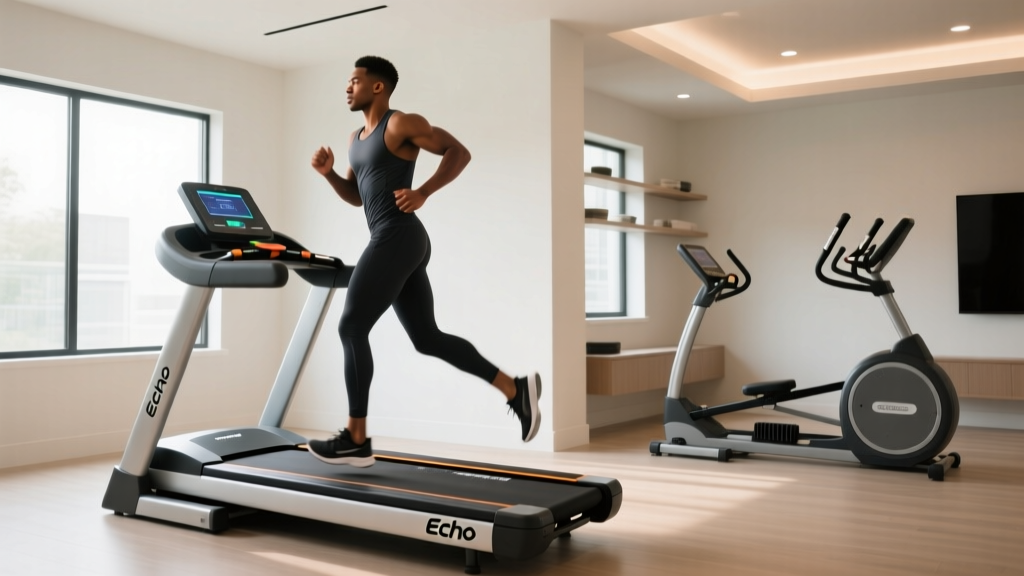
Echo Treadmill vs Motorized: A Beginner's Step-by-Step Guide
Discover how the Echo treadmill compares to motorized models. This beginner-friendly guide covers biomechanics, costs, and a 14-day adaptation plan.

The Core Debate: Curved Manual vs. Motorized Treadmills
Choosing the right cardio equipment for your home gym can feel overwhelming, especially when deciding between traditional motorized belts and modern curved manual alternatives. As of 2026, the market has clearly bifurcated: motorized treadmills offer automated pacing and digital immersion, while curved manual treadmills—like the highly acclaimed TrueForm Echo treadmill—rely entirely on your biomechanics to drive the belt.
If you are a beginner trying to decide which path to take, this step-by-step guide will walk you through the spatial, biomechanical, and financial realities of both options. We will use the Echo treadmill as our benchmark for the curved manual category, comparing it against industry-standard motorized models like the Sole F80 and Horizon 7.4.
Step 1: Assess Your Space, Power, and Placement
Before looking at calorie counts or top speeds, you must evaluate your physical environment. The infrastructure required for these two machines is vastly different.
The Dedicated Circuit Rule (Motorized)
Motorized treadmills draw significant electrical current, especially during startup or heavy incline usage. A standard 2.5 CHP motor can pull 12 to 15 amps. Failure Mode: Plugging a motorized treadmill into a shared 15-amp household circuit often results in tripped breakers or, worse, degraded motor life due to voltage drops. You must ensure you have a dedicated 120V/20A outlet.
The Footprint and Flooring Rule (Curved)
The Echo treadmill requires zero electricity, meaning you can place it in a garage, basement, or off-grid space. However, curved treadmills are exceptionally heavy (the Echo weighs roughly 350 lbs) and generate significant downward force and vibration because there is no motorized deck absorption. Action Step: You must place a curved manual treadmill on a high-density rubber equipment mat (at least 3/8-inch thick) over a concrete or reinforced subfloor to prevent structural vibration transfer.
Space Clearance Matrix:- Curved (Echo): 70" L x 32" W. Requires 20" side clearance. No front/back clearance needed for power cords.
- Motorized (Sole F80): 82" L x 34" W. Requires 30" rear clearance for safety key fall-off and motor ventilation.
Step 2: Compare Biomechanics and Caloric Output
The most significant difference between the Echo treadmill and a motorized model is how your body interacts with the running surface. According to research highlighted by the American College of Sports Medicine (ACSM), non-motorized curved treadmills fundamentally alter your stride mechanics.
On a motorized belt, the ground moves beneath you, which can encourage overstriding and heel-striking. On a curved treadmill, you must actively pull the belt backward with your foot strike. This forces a mid-foot or forefoot strike, engages the posterior chain (glutes and hamstrings), and naturally limits your top speed to your true biomechanical output.
Data Comparison: Echo Curved vs. Standard Motorized
| Metric | TrueForm Echo (Curved Manual) | Standard Motorized (e.g., Sole F80) |
|---|---|---|
| Caloric Expenditure | Up to 30% higher per mile | Standard baseline (100 cal/mile approx.) |
| Foot Strike Pattern | Forces mid-foot/forefoot strike | Allows heel-striking (often encouraged by belt pull) |
| Posterior Chain Engagement | High (Glutes, Hamstrings, Calves) | Moderate (Primarily quads and hip flexors) |
| Top Speed Limitation | Limited by user's physical output (approx. 15-18 mph max) | Limited by motor (typically 12 mph for home models) |
| Joint Impact | Lower peak impact force (rubber slats absorb shock) | Variable (depends on deck cushioning system) |
Note: The American Council on Exercise (ACE) notes that while curved treadmills burn more calories per minute, the perceived exertion is also significantly higher, meaning beginners may fatigue faster.
Step 3: The 14-Day Beginner Adaptation Protocol
The biggest mistake beginners make with the Echo treadmill is treating it like a motorized machine on day one. The learning curve is steep, and jumping into a 5-mile run will almost certainly result in severe calf soreness or Achilles tendonitis. Follow this step-by-step adaptation protocol to safely transition your biomechanics.
Phase 1: Neuromuscular Acclimation (Days 1–4)
- Day 1-2 (Walk & Posture): Spend 15 minutes walking at a brisk pace (3.0 - 3.5 mph). Focus entirely on keeping your torso upright. Edge Case: Beginners tend to lean too far forward and grip the handles. Let go of the handles to engage your core and find your natural center of gravity.
- Day 3-4 (The Push-Off Drill): Introduce 30-second jogging intervals. Focus on 'pushing' the curve of the belt down and back with the ball of your foot, rather than reaching forward.
Phase 2: Building the Posterior Chain (Days 5–10)
- Day 5-7 (Interval Introduction): Alternate 1 minute of jogging with 2 minutes of walking. Total time: 20 minutes. Your calves will feel tight; this is normal as they adapt to the forefoot strike requirement.
- Day 8-10 (Steady State Testing): Attempt a continuous 15-minute jog at a conversational pace. Do not look at the speed metric; look at your heart rate. Keep it in Zone 2 (60-70% of max HR).
Phase 3: Integration (Days 11–14)
- Day 11-14 (Distance Building): Extend your continuous jog to 25-30 minutes. You should now feel a natural 'rhythm' where the belt speed responds instantly to your hip drive. You are now officially adapted to the curved manual mechanic.
Expert Troubleshooting Tip: If you feel sharp pain in your Achilles tendon during Phase 2, stop immediately. Your calf muscles are likely too tight to support the forefoot strike. Spend 10 minutes daily doing eccentric calf drops off a stair edge before returning to the Echo treadmill.
Step 4: Budgeting and Long-Term Maintenance
Understanding the total cost of ownership is crucial for beginners mapping out their home gym investments. The upfront costs and long-term maintenance schedules for these two categories are entirely different.
Upfront Pricing (2026 Market Rates)
- Premium Curved Manual (TrueForm Echo): $3,999 - $4,299. You are paying for aerospace-grade aluminum framing, UV-resistant rubber slat belts, and zero motor-replacement costs.
- Premium Motorized (Sole F80 / Horizon 7.4): $1,599 - $2,199. You are paying for the continuous-duty motor, electronic incline mechanisms, and HD touchscreens.
- Budget Motorized (Sub-$800): Warning. Treadmills in this tier frequently suffer from thermal shutdown, belt snapping, and motherboard failures within 18 months of regular use. Avoid these if you plan to run more than 10 miles a week.
Maintenance Realities
Motorized treadmills require vigilant upkeep. You must vacuum under the motor hood every 3 months to prevent dust from choking the cooling fan, and you must lubricate the deck with 100% silicone liquid every 150 miles to reduce friction on the motor. If you neglect this, the motor will overheat and the control board will fry—a $400+ repair.
The Echo treadmill, having no motor or electronic incline, eliminates these failure points. However, the rubber slat belt and guide wheels require periodic inspection. You will need to check the belt tension and apply specific slat-belt conditioner every 6 to 12 months depending on usage. The mechanical bearings in the guide wheels are sealed and generally last 10+ years without service.
Final Verdict: Which Path Should You Take?
Choosing between the Echo treadmill and a motorized model ultimately comes down to your training philosophy, budget, and spatial constraints.
Choose the Echo (Curved Manual) if: You want to improve your running biomechanics, you lack dedicated electrical circuits, you want a machine that will mechanically outlast a decade of heavy use, and you are willing to endure a 2-week physical adaptation period.
Choose a Motorized Treadmill if: You prefer set-it-and-forget-it pacing, you rely on automated incline intervals for your workouts, you want to integrate with digital coaching apps via Bluetooth, or you are on a stricter sub-$2,000 budget.
By following the adaptation steps and understanding the mechanical realities outlined above, you can confidently invest in the cardio machine that will serve your fitness journey for years to come.
More gear to consider
All reviews
Treadmill Challenge Free Apps: 2026 Hardware Comparison

Sunny Health and Fitness T4400 Treadmill vs Walking Pads: 2026 Guide
How to Lose Stomach Fat on Treadmill vs. Stationary Bikes
Beating the Shin Splints Treadmill Trap: 2026 Bike Market Trends

Yowza Treadmill Footprints and Compact Cardio Alternatives
