Dumbbells Drawing Plans: Rubber Hex vs Urethane Rack Layouts
Optimize your gym layout with our dumbbells drawing guide. Compare rubber hex vs urethane dumbbells for rack compatibility, spatial footprint, and ROI.

Blueprinting Your Free Weight Zone: The Dumbbells Drawing Phase
When commercial gym architects and high-end home gym builders sit down to finalize their equipment floor plans, the dumbbells drawing phase is often the most complex spatial puzzle to solve. Unlike barbells or cable machines, a full dumbbell set requires a unique combination of linear wall space, depth clearance, and vertical tiering. As we navigate the fitness equipment landscape in 2026, where urban residential spaces and boutique studio footprints are at a premium, understanding the geometric differences between rubber hex and urethane dumbbells is critical for spatial optimization.
Your initial dumbbells drawing must account for more than just the weight of the iron; it must factor in the polygonal geometry of the dumbbell heads, the rack style required to house them, and the user clearance zones mandated by safety standards. This guide breaks down the spatial, environmental, and financial realities of choosing between rubber hex and urethane dumbbells for your specific layout constraints.
💡 Layout Pro-Tip: Before purchasing any rack, map your 'dumbbells drawing' on paper using a 1-inch = 1-foot scale. Always allocate a minimum of 36 inches of clearance in front of the rack to allow users to safely pick up and drop heavy weights without obstructing walkways.Dimensional Data: Rubber Hex vs. Urethane Footprints
The fundamental difference in space optimization between these two materials lies in their head geometry. Rubber hex dumbbells feature a six-sided, flat-edged design, while premium urethane dumbbells are typically round or feature a 12-sided polygonal edge. This geometric variance dictates the type of storage rack you can use, which directly impacts your gym's floor plan.
| Feature | Rubber Hex Dumbbells | Urethane Dumbbells (Round/12-Sided) |
|---|---|---|
| Head Geometry | 6-Sided (Hexagonal) | Round or 12-Sided |
| Optimal Rack Type | Flat Tiered Shelving | Saddle / A-Frame Racks |
| Rack Depth Footprint | ~22 to 24 inches | ~28 to 32 inches (A-Frame) |
| Stackability | High (Flush stacking) | Low (Requires individual saddles) |
| Odor / Off-Gassing | Moderate to High (Requires ventilation) | None (Ideal for enclosed spaces) |
| Avg. Cost Per Pound (2026) | $1.50 - $1.90 / lb | $2.80 - $3.50 / lb |
Rack Configurations and Spatial Efficiency
When your dumbbells drawing incorporates flat tiered shelving, rubber hex dumbbells are the undisputed champions of spatial efficiency. Because of their flat edges, hex dumbbells can be placed directly next to one another on a shelf without rolling or requiring specialized dividers.
The Hexagonal Advantage for Flat Shelving
A standard 5-to-50 lb set of Rogue Fitness Rubber Hex dumbbells (10 pairs) can be efficiently housed on a 3-tier flat rack. These racks typically measure around 49 inches wide and 23 inches deep. The flat shelves allow the hex heads to sit flush, maximizing the linear density of the rack. In a tight home gym or a crowded commercial functional training zone, this 23-inch depth profile allows the rack to be pushed flush against a wall or mirror, preserving precious floor space for kettlebell swings or plyometric work.
Urethane Geometry and Saddle Rack Footprints
Urethane dumbbells, such as the Rep Fitness Urethane series, are celebrated for their durability, drop-resistance, and sleek aesthetic. However, their round or 12-sided geometry means they will roll off flat shelves. They require 'saddle racks'—racks with U-shaped cradles that hold the dumbbell by its handle or the base of the head.
Saddle racks are frequently designed in an 'A-Frame' or vertical tower configuration to save linear wall space. While an A-Frame rack might only consume 30 inches of linear wall space compared to a 5-tier flat rack's 60 inches, the A-Frame's depth footprint expands to roughly 30-32 inches at the base. Furthermore, users must stand further back to safely extract heavy dumbbells from the lower tiers of an A-Frame, increasing the required forward clearance zone in your layout drawing.
"When designing a strength and conditioning facility, equipment placement must prioritize user safety and traffic flow. Dumbbell racks should be positioned against walls or in dedicated zones with a minimum of 36 inches of clearance to prevent tripping hazards and allow for proper lifting mechanics." — Facility Design Guidelines, National Strength and Conditioning Association (NSCA)
Environmental Spacing: Ventilation and UV Exposure
Space optimization is not just about physical dimensions; it is also about environmental compatibility. The material composition of your dumbbells dictates where they can be placed within your architectural drawing.
- Rubber Hex and Off-Gassing: Virgin and recycled rubber emit volatile organic compounds (VOCs), resulting in a distinct 'tire' odor. If your dumbbells drawing places the rack in a small, enclosed basement gym or a bedroom conversion without dedicated HVAC return vents, the odor will become overwhelming. Rubber hex sets require cross-ventilation or proximity to open garage doors.
- Urethane and Climate Control: Urethane is a premium elastomer that is completely odorless and highly resistant to UV degradation. This allows facility designers to place urethane dumbbell racks directly in front of sun-drenched windows or in high-end, climate-controlled luxury apartment amenity centers without fear of the material degrading, cracking, or smelling up the room.
Cost-to-Space Ratio Analysis
For commercial gym owners and budget-conscious home builders, the financial ROI per square foot is a vital metric. A full 5-50 lb set (1,100 total pounds) of rubber hex dumbbells will cost between $1,650 and $2,090. The same set in premium urethane will range from $3,080 to $3,850.
If your spatial layout requires purchasing two separate 5-50 lb sets to flank a large functional training turf area, the rubber hex option saves you upwards of $2,500—capital that can be reallocated to purchasing an additional Rogue 3-Tier Dumbbell Rack or upgrading your flooring. However, for boutique studios where aesthetics and odor elimination justify the premium, urethane's space-saving A-Frame compatibility often wins out despite the higher cost per pound.
Frequently Asked Questions (FAQ)
Can I use rubber hex dumbbells on an A-Frame saddle rack?
Yes, but it is not recommended. The sharp corners of the hexagonal rubber heads will catch on the U-shaped saddles, making them difficult to insert and remove. Over time, the friction will tear the rubber coating on the edges, leading to premature degradation and an unsightly appearance.
Which dumbbell type is better for a 10x10 foot home gym?
For a compact 10x10 space, rubber hex dumbbells on a low-profile, 3-tier flat rack pushed flush against the wall is the most space-efficient layout. This keeps the center of the room entirely open for a bench and free movement, whereas an A-Frame rack will protrude too far into the limited floor area.
Do 12-sided urethane dumbbells roll on flat surfaces?
While 12-sided urethane dumbbells (like those from Eleiko or Rep Fitness) are designed to minimize rolling compared to perfectly round dumbbells, they are not entirely roll-proof on slightly unlevel floors. For your dumbbells drawing, if you plan to use flat shelving rather than saddle racks, traditional 6-sided hex dumbbells remain the safest and most stable option.
Final Layout Verdict
Choose Rubber Hex if your layout prioritizes maximum linear density, flat-shelf stacking, and budget efficiency in well-ventilated spaces. Choose Urethane if your dumbbells drawing incorporates A-Frame racks, requires odorless equipment for enclosed luxury spaces, and demands superior drop-durability for heavy commercial use.
More gear to consider
All reviews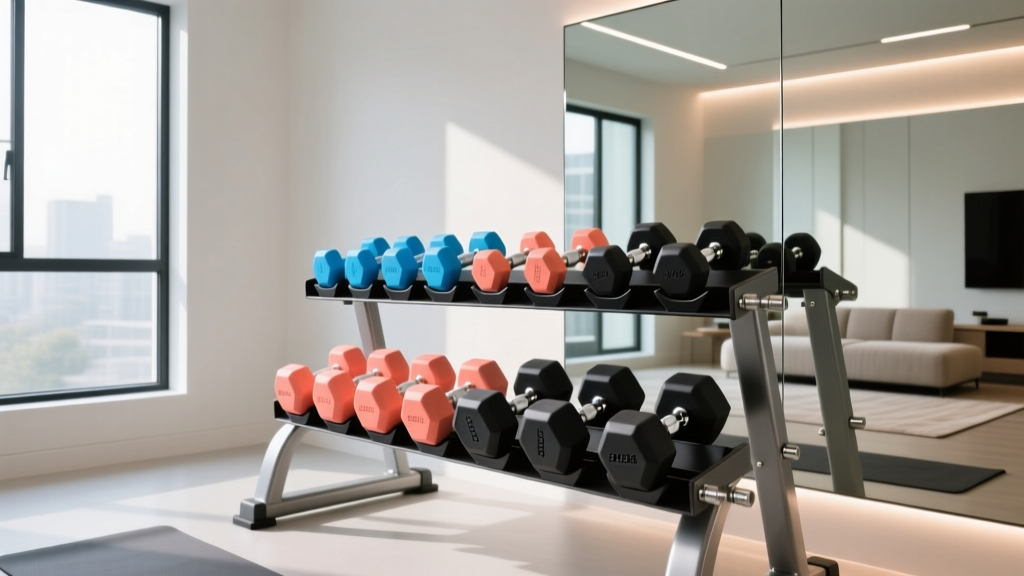
2026 Dumbbell Rack Trends: Storage for Push Presses with Dumbbells
Best Adjustable Dumbbells for Bicep and Tricep Workouts (2026)

Bumper vs Iron Plates: Layouts for Dumbbell Posterior Deltoid Raises

Beyond a 5 Pound Dumbbell Workout: Olympic vs Standard Plates

5 8 10 Dumbbell Set Guide: Best Adjustable Alternatives 2026