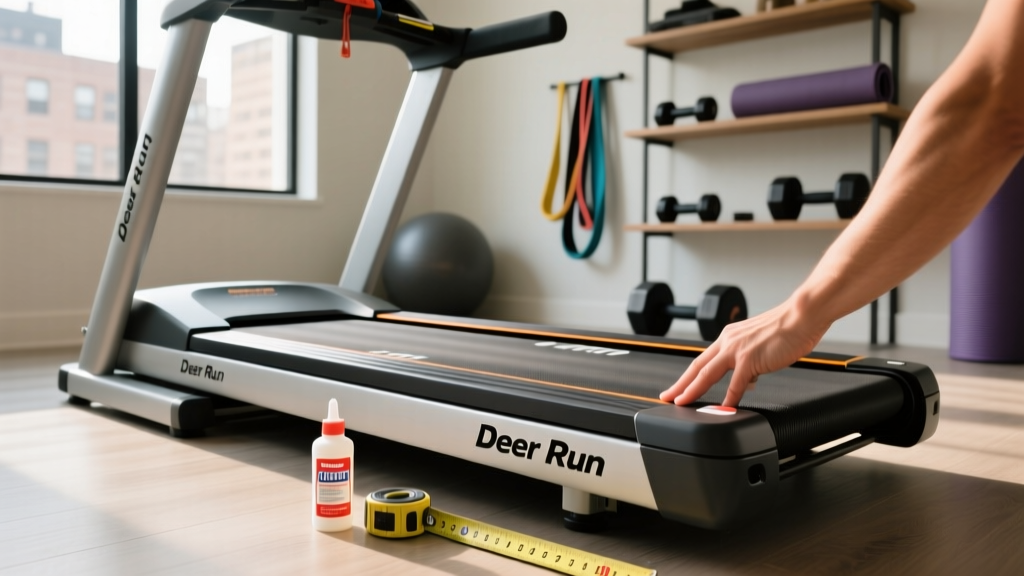
Are Deer Run Treadmills Legit? Belt Maintenance & Value Analysis
Are Deer Run treadmills legit? We break down the true cost of ownership, focusing on belt maintenance, lubrication, and long-term value for budget buyers.

The 'Are Deer Run Treadmills Legit?' Verdict for Budget Buyers
If you have been browsing Amazon or TikTok Shop for affordable home cardio equipment, you have likely encountered the brand Deer Run. With walking pads and folding treadmills frequently priced between $149 and $279, a common search query naturally emerges: are deer run treadmills legit? The short answer is yes, but with a major caveat. Deer Run treadmills are not 'scams' or inherently defective; rather, they are ultra-budget machines that shift the burden of longevity from the manufacturer to the user.
Premium treadmills from brands like NordicTrack or Sole are engineered with heavy-duty steel frames, 3.0 CHP continuous-duty motors, and multi-ply belts that can tolerate neglect. Budget treadmills like the Deer Run 2024/2025 folding models operate on much tighter mechanical tolerances. They utilize smaller DC motors (often peaking at 2.0 to 2.5 HP but running at roughly 1.0 to 1.25 CHP) and thinner, single-ply PVC belts. When you pair a low-tolerance motor with a high-friction belt, the result is rapid motor strain. Therefore, the 'legitimacy' and lifespan of your Deer Run treadmill are almost entirely dependent on your willingness to perform strict, scheduled belt maintenance and lubrication.
The Hidden Cost of Budget Treadmills: Friction and Motor Strain
To understand why maintenance dictates the value of a budget treadmill, you must understand the relationship between belt friction and DC motor amp draw. According to equipment testing standards highlighted by Consumer Reports, a well-lubricated treadmill belt allows the motor to operate at its baseline amperage. For a budget Deer Run motor, normal walking or light jogging should draw between 6 and 8 amps.
When the silicone lubricant factory-applied to the belt dries out—which typically happens within the first 40 to 60 miles of use—friction between the belt and the wooden or MDF deck increases exponentially. The motor must work harder to pull the belt, causing the amp draw to spike to 12, 15, or even 18 amps. This excessive current generates immense heat, which will eventually trip the internal thermal breaker, melt the wiring harness, or permanently fry the lower control board. When users report that their Deer Run treadmill 'died after three months,' they are almost always describing a motor burnout caused by a dry belt, not a factory defect.
Deer Run vs. Premium Brands: Belt Material and Motor Tolerances
How does the maintenance requirement of a Deer Run compare to a premium machine? The table below illustrates why budget buyers must be more proactive.
| Feature | Deer Run (Budget Tier) | Premium Brand (e.g., Sole F63) | Impact on Maintenance |
|---|---|---|---|
| Belt Composition | Single-ply PVC/Rubber blend | 2-ply or 4-ply orthopedic rubber | Thinner belts retain less factory lubricant and stretch faster. |
| Deck Material | Standard MDF with light wax coating | Phenolic resin or silicone-impregnated wood | MDF decks create higher friction once the initial wax wears off. |
| Motor Type | 2.0 HP Peak (approx. 1.0 CHP) | 3.0 CHP Continuous Duty | Budget motors lack the thermal mass to dissipate friction heat. |
| Lubrication Interval | Every 40-50 miles (or 3 months) | Every 150-200 miles (or 6-12 months) | Deer Run requires 3x more frequent manual lubrication. |
Step-by-Step Deer Run Belt Lubrication Guide
To keep your Deer Run treadmill running smoothly and protect your investment, you must use 100% silicone treadmill lubricant. Never use WD-40, household oils, or petroleum-based products, as these will chemically degrade the PVC belt and destroy the deck. As recommended by fitness equipment experts at the American Council on Exercise (ACE), proper lubrication reduces kinetic friction and extends motor life.
⚠️ CRITICAL WARNING: Applying petroleum-based lubricants will instantly void your Deer Run warranty and cause the belt to delaminate. Only use 100% pure silicone liquid (not gel or spray with propellants). Brands like Spot On or Impresa cost roughly $12 to $15 per bottle and will last for years.The 5-Minute Lubrication Procedure
- Power Down: Unplug the treadmill from the wall. Never perform maintenance on a live machine.
- Access the Belt: Stand at the rear of the treadmill. Use a 6mm Allen wrench (usually included with the Deer Run) to loosen the left and right rear roller end caps by exactly two full turns counter-clockwise. This releases belt tension.
- Apply Silicone: Reach under the center of the belt and lift it slightly. Squeeze exactly 0.5 ounces (about half a tablespoon) of 100% silicone lubricant in a zig-zag pattern across the width of the deck. Repeat on the other side of the center line.
- Distribute the Lubricant: Re-tighten the rear roller bolts by turning them two full turns clockwise to restore tension. Plug the machine in, turn it on to 2.0 MPH, and walk on the belt for 3 minutes. Your footfalls will press the silicone outward to the edges of the deck.
- Check Tension: After walking, you should be able to lift the belt about 2 to 3 inches off the deck in the center. If it is tighter than 1 inch, loosen the rear bolts by a quarter-turn.
5-Year Value Analysis: Maintenance Costs vs. Replacement
Let us run a financial breakdown to determine the true value of buying a budget Deer Run treadmill versus a premium alternative, factoring in the mandatory maintenance costs. This analysis proves that a Deer Run is a highly legitimate financial choice, provided you adhere to the upkeep.
Scenario A: The Neglected Budget Buy
- Initial Cost: $199 (Deer Run Folding Treadmill)
- Maintenance: $0 (User skips lubrication)
- Lifespan: 8 months (Motor control board burns out due to 16-amp friction spikes)
- Total Cost: $199
- Cost Per Month: $24.87
Scenario B: The Maintained Budget Buy
- Initial Cost: $199 (Deer Run Folding Treadmill)
- Maintenance: $15 (One bottle of 100% silicone, applied 4x a year for 3 years)
- Lifespan: 36 months (Machine retired due to user upgrading, motor still functional)
- Total Cost: $214
- Cost Per Month: $5.94
Scenario C: The Premium Alternative
- Initial Cost: $899 (Entry-level premium brand, e.g., Horizon or Sole)
- Maintenance: $30 (Silicone and occasional belt replacements over 7 years)
- Lifespan: 84 months (7 years)
- Total Cost: $929
- Cost Per Month: $11.05
The Value Verdict: When properly maintained, the Deer Run treadmill offers the lowest cost-per-month of any option on the market. It is a legitimate, high-value purchase for walkers and light joggers who are willing to spend five minutes every three months applying silicone.
Troubleshooting Common Deer Run Belt Issues
Even with perfect lubrication, budget treadmills can develop mechanical quirks. Here is how to diagnose and fix the most common Deer Run belt issues without calling a technician.
1. The Belt is Slipping During Use
The Cause: Belt stretch or improper tension. Budget PVC belts stretch up to 1% in their first 50 miles. If your foot strikes the belt and the belt pauses for a fraction of a second while the front roller keeps spinning, it is slipping.
The Fix: Do NOT add more lubricant; this will make it worse. Use your 6mm Allen key to tighten both rear roller bolts by exactly one-quarter turn clockwise. Test the machine. Repeat only if necessary. Over-tightening will strain the motor bearings.
2. The Belt is Drifting to the Left or Right
The Cause: Uneven tension on the rear roller or an unlevel floor.
The Fix: If the belt drifts to the left, tighten the LEFT rear bolt by one-quarter turn, or loosen the RIGHT rear bolt by one-quarter turn. Always make micro-adjustments and let the belt run at 3 MPH for 60 seconds to track the movement. Referencing the Sole Fitness Maintenance Guidelines, adjusting tracking requires patience; never turn a tension bolt more than a half-turn at a time.
3. Fraying on the Belt Edges
The Cause: The belt is misaligned and rubbing against the plastic side rails, or the user consistently walks with a heavy lateral foot strike.
The Fix: Re-center the belt using the tracking method above. If the edge is already frayed, inspect the side rails for burrs or rough plastic seams from the manufacturing process. Lightly sanding the inside edge of the plastic rail with 400-grit sandpaper can prevent further belt degradation.
FAQ: Deer Run Walking Pads vs. Treadmills
Do Deer Run under-desk walking pads need lubrication too?
Yes, and arguably more frequently. Walking pads have much smaller front and rear rollers (often 40mm to 50mm in diameter compared to 70mm on standard treadmills). Smaller rollers create a sharper bend radius for the belt, generating more localized heat and friction. Lubricate your Deer Run walking pad every 30 miles.
Can I use a silicone spray aerosol instead of liquid?
It is not recommended. Aerosol sprays contain propellants and solvents that can dry out the PVC belt material over time. Furthermore, overspray can coat the treadmill's internal electronics and motor brushes, attracting dust and causing short circuits. Always use a squeeze bottle with an application tube.
Final Verdict: Maximizing Your Budget Treadmill Investment
So, are Deer Run treadmills legit? From a purely mechanical and financial standpoint, they represent an excellent entry point into home cardio, provided you accept the maintenance contract that comes with budget pricing. By committing to a strict 100% silicone lubrication schedule and monitoring your belt tension, you can easily extract three to five years of reliable service from a sub-$250 machine. Treat the belt and deck with respect, and the Deer Run will deliver undeniable value for your home gym.
More gear to consider
All reviews
Flylinktech Treadmill Review: 2026 Walking Pad Comparison
Stationary Bike or Treadmill for Belly Fat? Hidden Maintenance Costs
F3 Folding Treadmill: Small Space Review & Maintenance Guide
Air Bike vs Assault Bike: ProForm Crosswalk Fit 415 Treadmill Layout
The Long Walk Treadmills: 2026 Walking Pad Review
