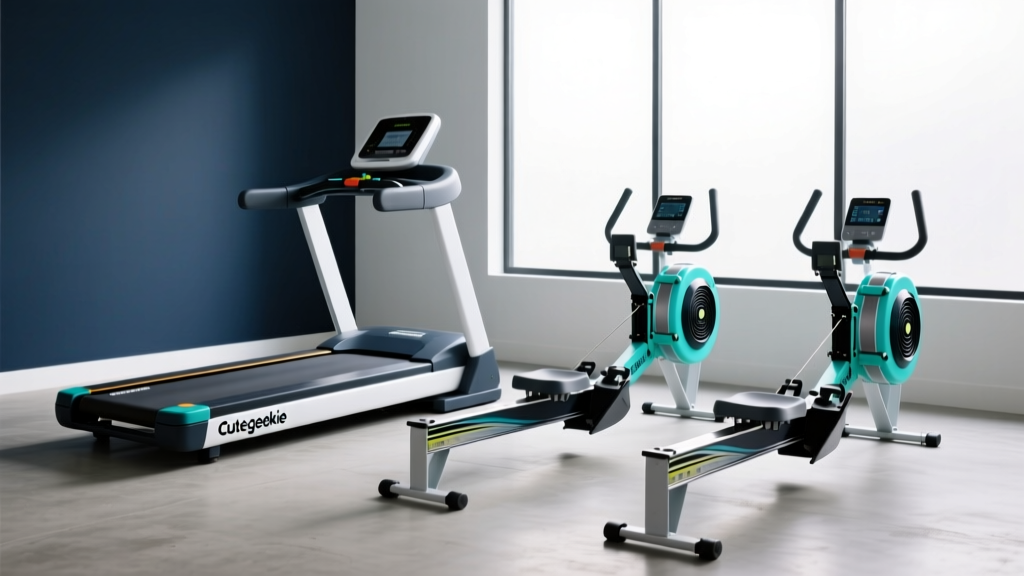
Cutegeekie Treadmill vs Rower: 2026 Buying & Technique Guide
Compare the Cutegeekie treadmill to top compact rowers. Explore our 2026 rowing machine buying guide, technique breakdowns, and expert cardio tips.

The Space-Saving Cardio Dilemma: Walking Pads vs. Full-Body Rowers
When outfitting a compact home gym in 2026, fitness enthusiasts frequently face a crossroads: do you prioritize low-impact daily movement with an under-desk walking pad, or invest in a high-yield, full-body cardio machine? The Cutegeekie treadmill has dominated social media feeds as a budget-friendly, ultra-compact walking pad designed for closing your daily step rings while working from home. However, when it comes to cardiovascular conditioning, muscular endurance, and caloric expenditure, rowing machines remain the undisputed heavyweights of the indoor cardio world.
This head-to-head comparison will evaluate the Cutegeekie treadmill against modern compact rowing machines. More importantly, we will transition into a comprehensive rowing machine buying guide and technique breakdown, ensuring you have the biomechanical knowledge and purchasing framework to make the right choice for your home setup.
Expert Insight: While walking pads like the Cutegeekie are excellent for combating sedentary behavior (NEAT - Non-Exercise Activity Thermogenesis), they lack the resistance required to elevate your heart rate into the vigorous aerobic zone (70-85% of max HR) that rowing machines effortlessly achieve.Head-to-Head: Cutegeekie Treadmill vs. Top Compact Rowers
To understand the value proposition of a rower, we must look at the raw specifications and physiological outcomes compared to a standard walking pad. Below is a 2026 comparison matrix featuring the Cutegeekie Treadmill, the gold-standard Concept2 RowErg, and the budget-friendly Sunny Health SF-RW5515 Magnetic Rower.
| Feature | Cutegeekie Treadmill (Walking Pad) | Concept2 RowErg | Sunny Health SF-RW5515 |
|---|---|---|---|
| Primary Use | Low-intensity walking / Under-desk | High-intensity full-body cardio | Moderate full-body cardio |
| Motor / Resistance | 2.5 HP Continuous Motor | Air Resistance (Infinite) | Magnetic (8 Levels) |
| Muscle Engagement | Lower body only (~30% of body) | Full body (~86% of muscles) | Full body (~86% of muscles) |
| Max User Weight | 265 lbs | 500 lbs | 250 lbs |
| Approx. 2026 Price | $160 - $199 | $1,095 | $220 - $260 |
The Rowing Machine Buying Guide: What to Look for in 2026
If you decide that the caloric and muscular demands of a rower outweigh the passive convenience of the Cutegeekie treadmill, you must navigate the diverse rower market. According to Harvard Health Publishing, rowing provides a unique combination of cardiovascular endurance and muscular strength training, making the investment highly worthwhile. Here is your technical buying framework.
1. Resistance Mechanisms: Air vs. Magnetic vs. Water
- Air Resistance (e.g., Concept2 RowErg): Utilizes a flywheel with fan blades. The harder you pull, the more resistance is generated. This offers a dynamic, infinite resistance curve favored by competitive athletes and CrossFit gyms. The trade-off is noise; air rowers are loud.
- Magnetic Resistance (e.g., NordicTrack RW900, Sunny Health): Uses magnetic braking systems to create drag. These are virtually silent, making them ideal for apartment dwellers or early-morning workouts while family members sleep. However, the resistance curve feels slightly less 'organic' than air.
- Water Resistance (e.g., WaterRower Natural): Features a water-filled tank that mimics the exact physics of a boat moving through water. They offer beautiful aesthetics and a soothing swoosh sound, but require periodic water purification tablet maintenance to prevent algae buildup.
2. Rail Length and Inseam Clearance
One of the most common purchasing errors in 2026 is buying a compact rower without checking the rail length. If you are taller than 6'2" (inseam > 34 inches), many budget magnetic rowers will cause you to 'bottom out' on the rail before your legs are fully compressed at the catch. Always verify the maximum inseam clearance in the manufacturer's specs. The Concept2 RowErg offers an optional 'Tall Legs' upgrade specifically to address this failure mode.
3. Monitor Metrics and Connectivity
A basic LCD screen showing stroke count is no longer sufficient. Look for machines that track Split Time (/500m) and Stroke Rate (s/m). Advanced monitors should support Bluetooth FTMS or ANT+ heart rate broadcasting to sync with Apple Health, Strava, or Zwift.
Warning: Do not confuse 'Stroke Rate' with 'Intensity'. A common beginner mistake is rowing at 35+ strokes per minute thinking it equals a better workout. True power comes from the 'Drive' phase, not rushing the slide.Mastering the Row: Step-by-Step Technique Breakdown
Unlike the Cutegeekie treadmill, where the machine dictates the movement pattern, a rowing machine requires precise biomechanical coordination. Poor form on a rower doesn't just reduce caloric output; it actively invites lumbar strain. The Mayo Clinic emphasizes that proper form in aerobic exercises is critical to preventing joint and lower back injuries.
As outlined by the experts at Concept2, the rowing stroke is divided into four distinct phases. The power distribution should always follow the 60-20-20 rule: 60% legs, 20% core hinge, 20% arms.
- The Catch: This is the starting position. Your shins should be vertical (knees directly over ankles, never past them). Hinge forward from the hips at roughly a 1-o'clock angle. Arms are fully extended, shoulders relaxed, and core braced.
- The Drive: The power phase. Initiate the movement by pushing explosively through your heels. Do not pull with your arms yet. Once your legs are about 75% extended, swing your torso back to an 11-o'clock position. Finally, draw the handle to your lower sternum.
- The Finish: Legs are fully extended (soft knees, not locked), torso leaned back slightly, and the handle is resting lightly against your ribcage. Elbows should be drawn past the torso, wrists flat.
- The Recovery: The return to the catch, executed in reverse order. Extend the arms first, hinge the torso forward past the knees, and only then allow the knees to bend as the seat glides back up the rail. The recovery should take twice as long as the drive (a 1:2 ratio).
Common Rowing Failure Modes and How to Fix Them
Even experienced athletes fall into bad habits. Here are the three most frequent technical errors we see in home gym setups, along with actionable corrections.
Error 1: Shooting the Slide
The Symptom: Your hips and seat move backward, but the handle barely moves. Your legs extend entirely before your torso opens.
The Fix: This happens when the core is disengaged. Imagine a steel rod connecting your handle to your hips. When your legs push, the handle and your torso must move together simultaneously for the first half of the drive.
Error 2: Early Arm Pull (The 'T-Rex' Row)
The Symptom: Bending the elbows and pulling with the biceps before the legs have done the heavy lifting, leading to severe forearm 'pump' and bicep fatigue.
The Fix: Treat your arms as hooks or straps connecting your body to the handle. Perform 'Legs-Only' drills where you keep your arms completely straight and torso locked, isolating the leg drive.
Error 3: Over-Compressing at the Catch
The Symptom: Sliding too far forward, causing the knees to travel well past the toes and the heels to lift off the footplates.
The Fix: Stop the slide the moment your shins are perfectly vertical. Over-compression puts immense shearing force on the patellar tendon and puts the lumbar spine in a vulnerable, rounded position.
Final Verdict: Which Machine Belongs in Your Home Gym?
The decision between a walking pad and a rower ultimately hinges on your primary fitness objective. If your goal is simply to increase daily step counts, mitigate the dangers of prolonged sitting, and you require a machine that can slide under a standing desk, the Cutegeekie treadmill is an unbeatable, budget-friendly utility tool.
However, if you are seeking a time-efficient, high-calorie-burning workout that builds muscular endurance across your posterior chain, quads, and lats, a rowing machine is the superior investment. For beginners on a budget, a magnetic rower like the Sunny Health SF-RW5515 offers a quiet, accessible entry point. For those committed to lifelong fitness and accurate performance tracking, the Concept2 RowErg remains the undisputed champion of the 2026 home cardio market. Whichever you choose, prioritize consistency, respect the biomechanics, and track your progress over time.
More gear to consider
All reviews
NordicTrack T6.5 Si Treadmill vs Upright, Recumbent & Spin Bike Care

ProForm Carbon TLX Treadmill Details: Motor HP Troubleshooting

Omni Directional Treadmill 2026: Compact Portable Cardio Market

Walking Pad vs Treadmill: Best Gear for Treadmill Exercises (2026)

Real 12 3 30 Treadmill Results With Compact Home Setups
