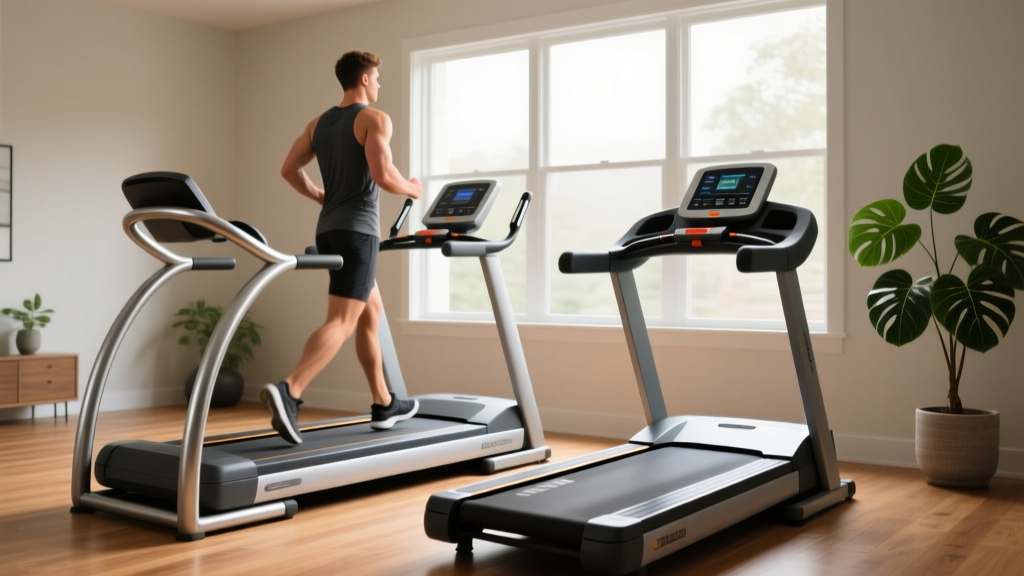
Curved vs Motorized: A Beginner's Guide to Treadmill Uphill Walking
Master treadmill uphill walking with our beginner guide comparing curved manual vs motorized treadmills. Find the best fit for your home gym routine.

The Rise of Treadmill Uphill Walking
Over the past few years, treadmill uphill walking has transformed from a niche bodybuilding warm-up into a mainstream fitness staple. Driven by viral routines like the 12-3-30 method, beginners are flooding home gyms to capitalize on the low-impact, high-yield benefits of incline training. According to the Centers for Disease Control and Prevention (CDC), brisk walking on an incline significantly elevates heart rate and improves cardiovascular health without the repetitive joint pounding associated with running.
However, as you shop for equipment in 2026, you will face a critical fork in the road: should you invest in a self-powered curved manual treadmill, or a traditional motorized treadmill with a mechanical lift? Both facilitate treadmill uphill walking, but they do so through entirely different biomechanical mechanisms. This step-by-step guide will break down the engineering, the costs, and the exact execution required for both machines so you can make an informed decision.
Understanding the Contenders: How They Create Incline
Curved Manual Treadmills: The Biomechanical Incline
Curved treadmills do not have an incline button. Instead, the deck is shaped like a shallow 'U'. The 'uphill' effect is generated by your own body weight and the physics of the concave surface. To walk uphill on a curved treadmill, you must position yourself on the steeper, front third of the curve. The deeper you step into the front arc, the more resistance you encounter, naturally simulating a steep hill climb.
Top 2026 Models & Pricing:
- Assault Fitness AirRunner Elite: ~$3,499. The gold standard for durability with a 3-year belt warranty.
- TrueForm Trainer: ~$4,995. Features a lower profile curve, ideal for shorter users focusing strictly on walking.
- Sunny Health & Fitness Auto-Incline Curved: ~$899. A budget-friendly entry point, though the slat belt requires more frequent lubrication.
Motorized Treadmills: The Mechanical Incline
Motorized treadmills use a secondary lift motor to physically raise the front of the running deck. When you press the 'Incline' button, a gear-driven actuator pushes the deck upward, creating a literal hill. The walking belt is driven continuously by the main drive motor, meaning you only need to keep up with the belt rather than power it yourself.
Top 2026 Models & Pricing:
- NordicTrack Commercial 1750 (2026 Ed.): ~$2,299. Features a -3% to 15% incline range and a robust 3.5 CHP motor.
- Sole F80: ~$1,999. Known for its heavy-duty frame and 15% max incline, excellent for dedicated walkers.
- Horizon 7.4: ~$1,199. A budget pick that offers a 15% incline, though the 2.5 CHP motor may run warm during extended 60-minute incline sessions.
Head-to-Head Comparison Matrix
| Feature | Curved Manual Treadmill | Motorized Incline Treadmill |
|---|---|---|
| Incline Mechanism | Body positioning on the concave arc | Motorized lift actuator (deck raises) |
| Caloric Expenditure | Up to 30% higher (self-powered resistance) | Standard incline burn (dependent on grade) |
| Max Incline Grade | Variable (infinite based on user stride) | Fixed (usually 12% to 15% max) |
| Joint Impact | Very low (shock-absorbing slat belts) | Low to Moderate (depends on deck cushioning) |
| Maintenance Needs | High (slat belt alignment and waxing) | Low (silicone lubrication every 150 miles) |
| Average Cost (2026) | $2,500 - $5,000+ | $1,200 - $3,000 |
Step-by-Step: Your First Treadmill Uphill Walking Routine
Whether you choose a curved or motorized machine, proper execution is vital to prevent injury and maximize glute activation. The American Council on Exercise (ACE) emphasizes that form degradation on an incline completely negates the posterior chain benefits. Follow this beginner-friendly protocol:
- The Flat Warm-Up (5 Minutes): Start completely flat at a leisurely 2.5 mph. Focus on a heel-to-toe foot strike and swinging your arms naturally. This lubricates the knee and ankle joints.
- The Ascent (15 Minutes):
- On a Motorized Treadmill: Raise the incline to 8% and set the speed to 3.0 mph. Every 3 minutes, increase the incline by 2% until you hit 12%.
- On a Curved Treadmill: Keep your speed around 3.0 mph, but consciously shift your body weight forward, stepping onto the steeper front third of the curve to increase the drag.
- The Form Check: Look straight ahead, not down at the console. Your torso should have a slight forward lean originating from the ankles, not a hunched bend at the waist. Do not hold the handrails. Holding the rails reduces caloric burn by up to 20% and forces your spine into an unnatural extension.
- The Cooldown (5 Minutes): Drop the motorized incline back to 0% (or step back to the flat rear-third of the curved belt) and walk at 2.0 mph to flush lactic acid from the calves.
Critical Failure Modes & Beginner Mistakes
As a domain expert reviewing hundreds of home gym setups, I see the same equipment failures and user errors repeatedly. Avoid these pitfalls:
1. The 'Handrail Dependency' Trap
Beginners often set the motorized treadmill to a 15% incline at 3.5 mph, realize they cannot keep up without gasping, and then grip the handrails, leaning backward. This 'water-skiing' posture completely unloads the glutes and hamstrings, transferring dangerous shear force to the lower lumbar spine. If you must hold on, the speed or incline is too high. Drop the incline to 10% and let your arms swing freely.
2. Motor Burnout on Budget Motorized Treadmills
Walking on a steep incline requires massive torque. If you purchase a budget motorized treadmill with a 2.0 CHP (Continuous Horsepower) motor and routinely walk at a 12% incline, the motor will draw excessive amperage. Over 6 to 12 months, this will overheat and fry the lower control board. Rule of Thumb: If your primary goal is treadmill uphill walking, never buy a motorized treadmill with less than a 3.0 CHP motor. Ignore 'Peak HP' marketing numbers; only CHP matters for sustained incline loads.
3. Overstriding on Curved Treadmills
On a curved manual treadmill, taking excessively long strides causes your heel to strike the upward slope of the front arc, acting as a braking mechanism. This causes the belt to stutter and places immense strain on the shins (anterior tibialis). Focus on a high cadence with short, quick steps, landing flat-footed in the 'sweet spot' of the curve.
'The most common mistake I see with incline walking is the illusion of effort. People grip the rails and lean back, thinking they are climbing a mountain, when biomechanically, they are just doing a supported, flat-ground shuffle.' — Biomechanics Research Summary, National Institute on Aging (NIA)
The Final Verdict: Which Should You Buy?
Your choice between a curved manual treadmill and a motorized treadmill ultimately depends on your budget, space, and specific fitness goals.
Choose a Curved Manual Treadmill if: You want a zero-electricity, eco-friendly machine that forces superior running and walking mechanics. It is the ultimate tool for athletic conditioning and posterior chain development, provided you have the budget ($3,000+) and the discipline to endure the initial calf-adaptation phase.
Choose a Motorized Treadmill if: You prefer a guided, predictable workout where you can precisely dial in a 12% grade and 3.0 mph speed while watching a tablet. It is generally more forgiving for absolute beginners, older adults, or those recovering from Achilles injuries, and offers a wider variety of entry-level price points ($1,200 - $2,500).
By understanding the mechanical differences and respecting the biomechanics of the incline, your treadmill uphill walking routine will become a sustainable, joint-friendly cornerstone of your 2026 fitness journey.
More gear to consider
All reviews
Best Folding Treadmill for Stomach Fat & Small Spaces (2026)
Air Bike Care: Assault vs Echo & The Amazon Treadmill Dad Actor Name

True Cost of a Treadmill That Connects to Apple Watch: Belt Care

Treadmill Motor Size Guide: York Millennium Treadmill HP Analysis
Running 400 m on a Treadmill: Motor Size & Horsepower Guide
