Standard Size of a Treadmill: Curved vs Motorized
Comparing the standard size of a treadmill across curved manual and motorized models. Discover exact dimensions, pricing, and spatial needs.

The Spatial Dilemma: Rethinking Your Home Gym Footprint
When designing a home gym in 2026, spatial efficiency is just as critical as performance. For decades, the industry baseline has been defined by the standard size of a treadmill, typically hovering around 77 inches long by 35 inches wide. However, the explosive growth of curved manual treadmills has disrupted this baseline, forcing buyers to reconsider how footprint, biomechanics, and room clearance intersect. If you are torn between a traditional motorized workhorse and a sleek, self-powered curved runner, understanding the physical and mechanical differences is paramount. This head-to-head comparison breaks down exact dimensions, real-world pricing, and long-term maintenance to help you choose the right machine for your space and stride.
The Baseline: Motorized Treadmill Dimensions and Clearance
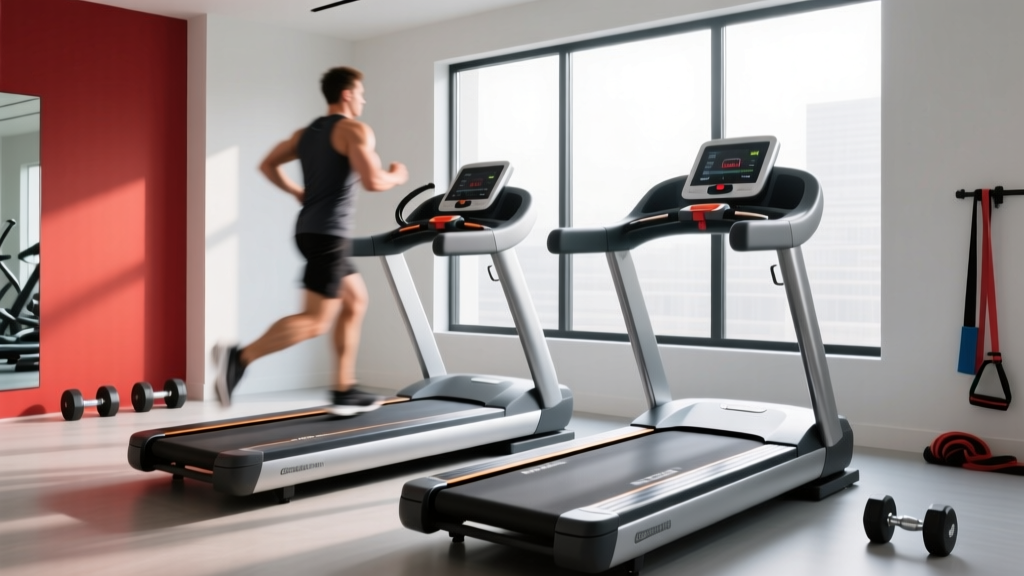
When evaluating the standard size of a treadmill, most buyers picture a motorized model like the Sole F80 or the NordicTrack Commercial series. These machines require a substantial footprint, largely due to the motor housing, extended console masts, and the need for a long, flat running deck to accommodate incline mechanisms.
- Average Length: 78 to 84 inches (motor housing adds 6-10 inches behind the user).
- Average Width: 34 to 39 inches (wide side rails and console bases).
- Average Height: 60 to 65 inches (tall uprights for interactive touchscreens).
- Weight: 200 lbs to 350 lbs (heavy steel frames and large DC/AC motors).
The Challenger: Curved Manual Treadmill Footprints
Curved manual treadmills, such as the AssaultRunner Elite or the TrueForm Trainer, strip away the motor, the incline mechanism, and the bulky console mast. Because the user powers the belt, the machine can be significantly more compact. The standard size of a treadmill is effectively reduced without sacrificing the running surface area, thanks to the concave, slatted belt design that naturally centers the runner.
- Average Length: 70 to 76 inches (no rear motor housing required).
- Average Width: 33 to 36 inches (streamlined side rails).
- Average Height: 60 to 64 inches (low-profile handlebars and minimal displays).
- Weight: 150 lbs to 280 lbs (lighter, but still anchored by heavy flywheels and steel frames).
By saving up to 12 inches in length and eliminating the need for a massive rear safety clearance zone (since the belt only moves when you push it), curved treadmills can fit into tight apartments or low-ceiling basements where motorized units would feel oppressive or violate safety margins.
Head-to-Head Spec Matrix: 2026 Market Leaders
To understand how these dimensions translate to real-world purchasing, we compared two top-tier motorized models against two elite curved manual treadmills currently dominating the 2026 market.
| Model | Type | Dimensions (L x W x H) | Belt Width | Weight | Est. Price (2026) |
|---|---|---|---|---|---|
| Sole F80 | Motorized | 82.5" x 37" x 63" | 22" | 280 lbs | $1,199 |
| NordicTrack 1750 | Motorized | 81" x 39" x 65" | 22" | 340 lbs | $1,999 |
| AssaultRunner Elite | Curved Manual | 76" x 33" x 64" | 26" (usable) | 210 lbs | $3,299 |
| TrueForm Trainer | Curved Manual | 72" x 34" x 62" | 27" (usable) | 245 lbs | $4,495 |
Note: Curved treadmills do not have a traditional 'belt width' measurement, but the usable running surface between the slats often feels wider due to the absence of restrictive side motor covers.
Biomechanics: How Size and Shape Alter Your Stride
The physical dimensions of a treadmill dictate more than just room layout; they fundamentally alter your biomechanics. As noted in research published by the American College of Sports Medicine (ACSM), running mechanics shift significantly when transitioning from a motorized, flat belt to a non-motorized, curved surface.
The Stride Length Factor
On a standard motorized treadmill with a 55-inch belt, taller runners (over 6'1") often experience 'stride clipping,' where they subconsciously shorten their gait to avoid stepping on the front motor cowl or falling off the back. The standard size of a treadmill restricts natural sprinting mechanics. Conversely, curved treadmills feature an infinite loop design. Because there is no front motor housing to kick, and the concave shape naturally catches your foot regardless of where you strike, runners can open up their stride fully, even on a physically shorter 72-inch frame.
Energy Expenditure and Joint Impact
Curved treadmills require the user to overcome the inertia of the heavy slatted belt. Studies show that running on a curved manual treadmill increases caloric expenditure by up to 30% compared to a motorized treadmill at the same perceived pace. Furthermore, the thick vulcanized rubber slats on models like the TrueForm provide superior shock absorption compared to the standard phenolic decks found on sub-$1,500 motorized units, reducing peak tibial impact forces by an estimated 15-20%.
'The lack of a motorized pace-setter forces the runner to rely entirely on proprioception and posterior chain engagement. You aren't just being carried along; you are actively pulling the belt beneath you, which drastically increases hamstring and glute activation.' — Biomechanics Analysis, Garage Gym Reviews Lab
Long-Term Failure Modes & Maintenance Edge Cases
When investing thousands of dollars, understanding how these machines fail is just as important as their dimensions. Based on Consumer Reports treadmill reliability data and long-term user telemetry, here is what breaks down in the real world.
Motorized Treadmill Vulnerabilities
- Incline Motor Burnout: Frequent use of high-incline intervals (10-15%) puts immense strain on the secondary incline motor, often leading to gear stripping or electrical failure within 3 to 5 years.
- Deck Warping and Belt Fraying: If the user neglects to lubricate the silicone deck every 150 miles, friction builds up, drawing excess amps through the main drive motor and eventually tripping the thermal breaker or melting the belt edges.
- Console Electronics: Large HD touchscreens are prone to software bricking, Wi-Fi module failures, and dead pixels, often requiring expensive proprietary replacement parts.
Curved Manual Treadmill Vulnerabilities
- Slat Belt Tensioning: Over time, the heavy rubber slats can stretch or the Kevlar guide ropes can lose tension, causing the belt to track off-center and grind against the side rails. This requires manual hex-key tensioning every 6-12 months.
- Bearing Wear: The front and rear axles house heavy-duty ball bearings that support the user's dynamic impact. If dust and pet hair infiltrate the axle seals, the bearings will pit and create a loud, rhythmic clicking sound that requires a full teardown to replace.
- Urethane Degradation: Cheaper curved models use low-grade plastics for the slats, which can crack under the repetitive impact of heavy runners (220+ lbs) in dry, climate-controlled environments.
The Verdict: Which Footprint Fits Your 2026 Home Gym?
Choosing between these two categories ultimately comes down to a triad of space, budget, and training intent.
Choose a Motorized Treadmill if: You have a dedicated room with at least 14 feet of linear clearance, you prefer set-and-forget pace control for long steady-state cardio, you want interactive programming, and your budget is capped around $1,500. The standard size of a treadmill in this category demands space, but rewards you with automated convenience.
Choose a Curved Manual Treadmill if: You are dealing with tight spatial constraints, low ceilings, or open-concept living spaces where a massive console mast would block sightlines. If you prioritize HIIT, sprint mechanics, and posterior chain development, and you have a budget exceeding $3,000, the compact footprint and superior biomechanics of a curved runner make it the ultimate 2026 home gym upgrade.
Frequently Asked Questions
Can I fold a curved manual treadmill to save space?
No. Because of the rigid, concave steel frame required to support the curved running track, curved treadmills do not fold. However, their inherently shorter length (often under 76 inches) means they consume less floor space than folded motorized units that still protrude 30+ inches into the room.
Do curved treadmills require a dedicated electrical circuit?
No. Curved manual treadmills are entirely self-powered. They do not need to be plugged into a wall, meaning you can place them anywhere in your home, garage, or even a covered patio, completely eliminating the need for 20-amp dedicated circuits required by high-horsepower motorized treadmills.
More gear to consider
All reviews
Swimmers Treadmill vs Stationary Bikes: Upright, Recumbent & Spin

Treadmill Interval Workout Noise: Troubleshooting & Cardio Comparison
Beyond Centr Treadmill Reviews: Stair Climber Setup Guide

Do You Need a Subscription for NordicTrack Treadmills? Compact Cardio

Stair Climber vs 5 mph on Treadmill: Beginner Home Guide