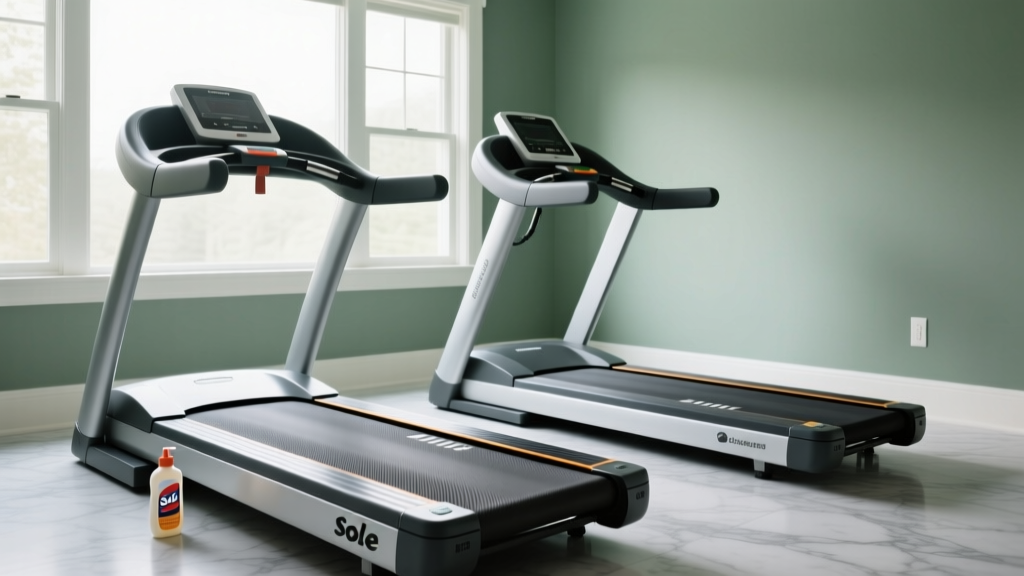
Curved Manual vs Motorized Treadmill: Sole Treadmill Lube & Care
Compare curved manual vs motorized treadmills. We analyze biomechanics, hidden maintenance costs, Sole treadmill lube requirements, and 10-year ownership.

The Biomechanical and Mechanical Divide
When outfitting a home gym in 2026, the debate between a curved manual treadmill and a traditional motorized treadmill extends far beyond aesthetics or upfront pricing. It is fundamentally a choice between two entirely different mechanical ecosystems. Motorized treadmills rely on high-torque continuous duty (CHP) motors, MDF or phenolic decks, and polyester belts that require constant friction management. Curved manual treadmills, conversely, utilize a slat-belt design resting on dozens of sealed roller bearings, driven entirely by the user's biomechanics.
Understanding this mechanical divide is critical for long-term ownership. While a motorized treadmill demands rigorous chemical maintenance to prevent motor burnout, a curved manual treadmill demands mechanical vigilance to prevent bearing seizure. This guide dissects the hidden costs, maintenance realities, and physiological outputs of both systems to help you make an informed investment.
The Maintenance Showdown: Deck Friction and Sole Treadmill Lube
The most significant differentiator in day-to-day ownership is maintenance. Motorized treadmills generate immense heat and friction between the belt and the deck. If this friction is not mitigated, the motor must draw higher amperage to maintain speed, eventually leading to overheated control boards, warped decks, and premature motor failure.
Maintenance Alert: The Chemistry of Deck Lubrication
When maintaining a motorized deck, using the correct Sole treadmill lube (or an exact 100% silicone equivalent) is non-negotiable. Petroleum-based lubricants, WD-40, or generic silicone sprays with propellants will destroy the polymer backing of your belt and degrade the deck's wax coating. According to Sole Fitness maintenance guidelines, you should apply 100% pure liquid silicone lube every 150 miles or every three months. A standard 4oz bottle of Sole treadmill lube costs around $12 and can last up to two years, making it one of the cheapest insurance policies for your machine's motor.
Curved Treadmill Maintenance: The Slat Belt Reality
Curved manual treadmills like the Woodway Curve or the Assault AirRunner completely eliminate the need for deck lubrication. Because the vulcanized rubber slats glide over precision roller bearings rather than a solid deck, there is zero surface friction requiring chemical intervention. However, this does not mean they are maintenance-free. Over time, the sealed bearings can accumulate dust and degrade, and individual rubber slats can crack under heavy, repetitive impact. While you will never need to buy Sole treadmill lube for a curved machine, replacing a damaged slat belt on a premium curved treadmill can cost upwards of $600 to $900, compared to a $50 replacement belt for a standard motorized unit.
Financial Breakdown: Upfront Costs vs. 10-Year Ownership
As of 2026, the market has seen a surge in mid-tier curved treadmills, slightly narrowing the gap with premium motorized models. However, the 10-year total cost of ownership (TCO) tells a different story.
| Feature / Cost Factor | Premium Motorized (e.g., Sole F80) | Premium Curved Manual (e.g., Woodway Curve) |
|---|---|---|
| Average 2026 Retail Price | $1,199 - $1,499 | $6,200 - $6,800 |
| Belt / Deck Maintenance | Requires Sole treadmill lube (100% silicone) every 3 months. | Zero deck lube. Occasional bearing inspection. |
| Belt Replacement Cost | $45 - $75 (User installable) | $600 - $950 (Often requires tech service) |
| Motor / Electronics Repair | High risk post-warranty ($250+ for control boards) | N/A (No drive motor; minimal electronics) |
| Estimated 10-Year TCO | ~$1,800 (Including lube, belts, potential motor repair) | ~$7,200 (Including potential slat belt replacement) |
Caloric Expenditure and Muscle Activation
Beyond the mechanics of Sole treadmill lube and roller bearings, the physiological output of these machines differs drastically. Because a curved manual treadmill requires the user to overcome the inertia of the belt and the slight upward incline of the curve, it demands significantly more posterior chain engagement (glutes and hamstrings).
Research published in the Journal of Strength and Conditioning Research demonstrates that running on a non-motorized curved treadmill elicits a higher heart rate, greater oxygen consumption (VO2), and a higher rating of perceived exertion (RPE) compared to running at the exact same speed on a motorized treadmill. Users typically burn up to 30% more calories per mile on a curved manual machine.
The Biomechanical Trade-Off
While the caloric burn is superior on a curved treadmill, the learning curve is steep. Motorized treadmills enforce a strict cadence; if you slow down, the belt pushes you off the back. Curved treadmills dictate that you are the motor. If your form breaks down, the machine slows down. For high-intensity interval training (HIIT) or sprint intervals, the curved treadmill is unparalleled because there is no motor lag when transitioning from a walk to an all-out sprint. However, for steady-state, low-impact walking or rehabilitation, a well-lubricated motorized treadmill offers a more consistent, forgiving stride.
Failure Modes and Edge Cases: What Actually Breaks?
To truly understand long-term ownership, we must look at the specific failure modes of both systems. Having serviced and reviewed dozens of cardio machines, here is what actually goes wrong in real-world home gym environments.
Motorized Treadmill Failure Modes
- Deck Warping & Heat Friction: If a user neglects to apply Sole treadmill lube or a 100% silicone equivalent, the friction generates extreme heat. This heat softens the MDF deck, causing it to warp. The belt then tracks to one side, fraying the edges and eventually snapping.
- Drive Belt Slippage: The small ribbed belt connecting the motor to the front roller stretches over time. If it begins to slip, you will feel a sudden 'hesitation' in the belt when your foot strikes the deck.
- Capacitor Failure: Power surges or continuous high-amp draw (often caused by a dry deck) will blow the motor control board capacitors. The machine will turn on, but the belt will not move.
Curved Manual Treadmill Failure Modes
- Bearing Seizure: The Woodway slat belt technology relies on over 100 individual roller bearings. In humid or dusty environments, these bearings can seize, creating a 'dead spot' on the track that feels like a bump with every stride.
- Slat Delamination: Dropping heavy dumbbells or kettlebells onto the rubber slats can cause the vulcanized rubber to separate from the internal Kevlar or steel reinforcement cord.
- Frame Flex: Cheaper, sub-$2,000 curved manual treadmills often lack the structural rigidity of premium models. Over time, the lateral frame supports can flex and develop stress fractures near the rear axle mounts.
Pro-Tip: The 'Ribbon Test' for Motorized Decks
Not sure if your motorized treadmill needs Sole treadmill lube? Perform the ribbon test. Take a standard piece of paper or a thin ribbon and slide it under the belt. If it slides through effortlessly with slight resistance, your deck is adequately lubricated. If it catches, tears, or requires forceful pulling, your deck is bone-dry and you are actively damaging your motor. Apply 1/2 oz of pure silicone lube immediately.
The Verdict: Which Machine Belongs in Your Home Gym?
Choosing between a curved manual treadmill and a motorized treadmill ultimately comes down to your training style, budget, and willingness to perform routine maintenance.
Choose a Motorized Treadmill If:
- You prioritize budget and tech integration: Premium motorized models like the Sole F80 or NordicTrack Commercial series offer expansive HD touchscreens, incline/decline capabilities, and automated training programs for a fraction of the cost of a curved treadmill.
- You do a lot of walking or steady-state jogging: The consistent pace enforced by the motor is ideal for zone-2 cardio, reading, or watching TV while exercising.
- You don't mind basic chemical maintenance: Remembering to apply Sole treadmill lube every few months is a minor chore that guarantees the longevity of a $1,500 machine.
Choose a Curved Manual Treadmill If:
- You are a sprinter or CrossFit athlete: The ability to instantly change speeds without waiting for a motor to catch up makes curved treadmills the gold standard for HIIT and sprint intervals.
- You want maximum caloric burn in minimal time: The 30% increase in energy expenditure means you can finish your daily cardio requirement in significantly less time.
- You hate deck lubrication and motor repairs: While the upfront cost is steep, the complete absence of a drive motor and the need for deck lubrication means you will never deal with blown capacitors or friction-burned decks.
Both platforms offer exceptional cardiovascular benefits, but they demand different relationships with the user. Whether you are meticulously applying Sole treadmill lube to your motorized deck to ensure a whisper-quiet morning run, or pushing through the heavy resistance of a curved slat belt for a brutal sprint session, understanding the mechanics of your machine is the key to a lifetime of uninterrupted training.
More gear to consider
All reviews
Portable Cardio: What's a Good Incline for Treadmill Walking Pads?

What Treadmill MPH Do You Need? Under Desk Office Budget Breakdown

NordicTrack Solaris Treadmill vs Stair Climber: Home Guide
Best Folding Treadmill for Small Spaces: 2026 Treadmill Band Review

T6.5s Treadmill Buying Guide: 2026 Feature Comparison & Alternatives
