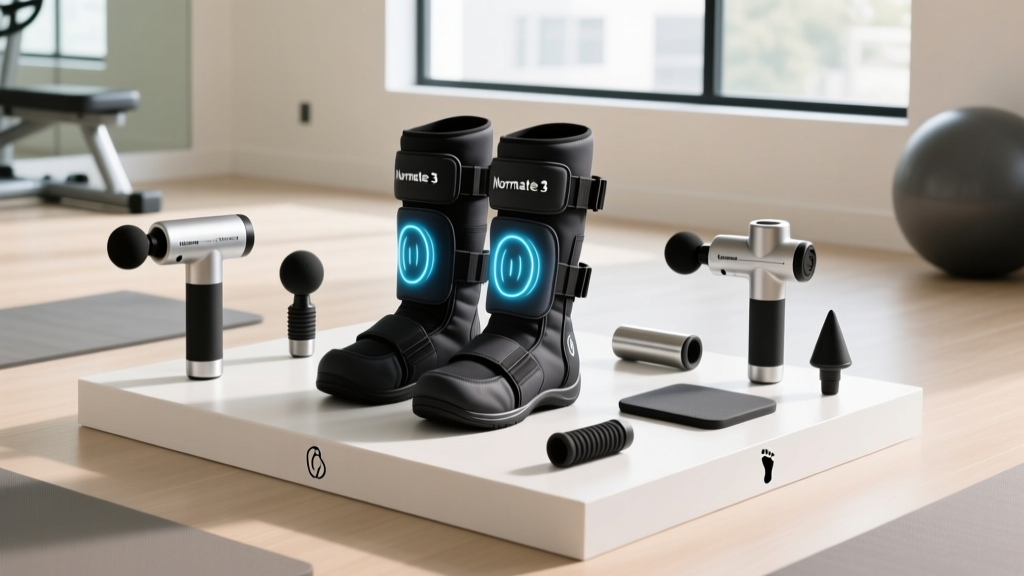
Compression Boot Troubleshooting & Shaper Image Massage Gun Mistakes
Fix common compression boot mistakes, troubleshoot pneumatic recovery systems, and learn how to pair them with a shaper image massage gun for optimal results.

The Reality of Pneumatic Compression: Why Your Boots Aren't Working
Pneumatic compression boots have transitioned from elite sports science labs to mainstream home gyms. In 2026, systems like the Normatec 3 ($999), Hyperice Recovery System ($899), and Therabody RecoveryAir ($800) dominate the market, promising accelerated venous return and reduced delayed onset muscle soreness (DOMS). However, a widespread review of user recovery data reveals a frustrating trend: most athletes are using these expensive recovery systems incorrectly, leading to suboptimal results, hardware degradation, and even mild tissue fatigue.
Intermittent pneumatic compression (IPC) works by utilizing sequential pulsing to mimic the muscle pump, clearing metabolic waste like lactate and creatine kinase from the lower extremities. According to research published in the National Institutes of Health (NIH), IPC significantly enhances blood flow and reduces recovery time, but only when pressure gradients and timing are calibrated to the individual's limb volume and recovery needs. This troubleshooting guide breaks down the most critical compression boot mistakes and explores how to integrate localized percussive therapy to fill the gaps in your recovery stack.
Top 4 Compression Boot Mistakes (And How to Fix Them)
1. Incorrect Sizing and Zipper Strain
The most common hardware failure in pneumatic boots is a blown YKK zipper or a torn internal TPU bladder. This almost always stems from improper sizing. If your calf circumference exceeds 18 inches, standard boots will overstretch the internal baffles. The Fix: Measure your inseam and widest calf point. If you are on the borderline between sizes, always size up and use the velcro overlap straps to secure the fit. Never force a zipper over a swollen calf immediately post-marathon; wait 20 minutes for initial edema to subside before booting up.
2. Pressure Calibration Errors (The 'More is Better' Myth)
Many users immediately crank their compression boots to the maximum setting (often 100-120 mmHg), assuming higher pressure equals faster recovery. This is a critical error. Excessive pressure can temporarily occlude superficial lymphatic vessels, which operate at much lower pressure thresholds than the venous system.
Expert Calibration Guide:• Lymphatic Flush (Active Recovery): 30-50 mmHg. Gentle, continuous sequential squeezing.
• Venous Return (Post-Heavy Lift): 60-80 mmHg. Firm pulsing to move deoxygenated blood.
• Deep Tissue Compression (Travel/Edema): 90-110 mmHg. Maximum setting, reserved for severe fluid pooling.
3. Timing and Frequency Overload
Leaving compression boots on for 90+ minutes daily can cause 'tissue fatigue' and skin maceration due to trapped heat and moisture. The sweet spot for standard IPC therapy is 30 to 45 minutes per session. If you are doing two-a-day training sessions, limit your boot time to 30 minutes per session, ensuring you elevate the legs at a 45-degree angle to maximize gravity-assisted drainage.
4. Using Boots on Acute Injuries
Compression boots are contraindicated for acute strains, tears, or suspected deep vein thrombosis (DVT). The mechanical shearing force of the sequential pulses can exacerbate fresh muscle tears or dislodge a clot. Always use localized cryotherapy (ice) for the first 72 hours of an acute injury before introducing pneumatic compression.
When Boots Fail: Integrating a Shaper Image Massage Gun
While premium pneumatic systems excel at global circulation and flushing metabolic waste from the entire leg, they are entirely ineffective at breaking up localized myofascial adhesions or targeting deep, specific trigger points like the piriformis or the TFL (tensor fasciae latae). This is where percussive therapy becomes mandatory.
Many athletes searching for a shaper image massage gun (a common consumer misspelling of the popular Sharper Image brand) are actually looking for budget-friendly percussive alternatives to complement their high-end boot routine. In 2026, a standard Sharper Image (or 'shaper image') massage gun retails between $49 and $89. While it lacks the 16mm amplitude and 60 lbs of stall force found in a $599 Theragun PRO, it typically offers 10mm amplitude and 20-25 lbs of stall force.
'Percussive therapy has been shown to improve short-term range of motion and reduce perceived DOMS without the systemic fatigue associated with deep tissue manual massage.' - Journal of Sports Science & Medicine
The Troubleshooting Synergy: If your compression boots are leaving your legs feeling 'flushed' but you still have a stubborn knot in your upper glute or calf soleus, the boots cannot fix it. You must use a percussive device. The budget-friendly shaper image massage gun is perfectly adequate for superficial trigger point release on the calves and quads before you strap into your pneumatic boots for the systemic flush.
Troubleshooting Matrix: Boots vs. Percussive Therapy
| Recovery Issue | Compression Boot Solution | Massage Gun Solution |
|---|---|---|
| Heavy, swollen legs after long run | Use 60 mmHg for 45 mins with legs elevated. | Ineffective; avoid percussive on swollen tissue. |
| Localized knot in the calf soleus | Ineffective; boots cannot isolate trigger points. | Apply shaper image massage gun for 60s at 2400 RPM. |
| Stiff hip flexors / Piriformis | Boots do not cover the hip/glute region. | Use a high stall-force gun (or manual ball) on the glute. |
| Post-flight edema (ankle pooling) | Use 80 mmHg distal-to-proximal sequence for 30 mins. | Light sweeping strokes only; do not hammer joints. |
Hardware Troubleshooting: Hoses, Batteries, and Valves
Beyond user error, compression recovery systems are prone to specific hardware failures. Here is how to troubleshoot the physical equipment in 2026:
- Hose Connection Leaks: If one leg inflates but the other remains soft, check the quick-connect O-rings at the base of the control unit. Dust and sweat degrade the rubber O-rings over time. Wipe them with a damp cloth and apply a microscopic dab of silicone grease. Never use petroleum jelly, which will melt the TPU seals.
- Battery Degradation: Modern units use lithium-ion cells. If your Normatec or Hyperice unit dies at the 20-minute mark instead of the advertised 3 hours, the battery management system (BMS) has likely degraded due to being stored at 0% charge for months. Always store your recovery system at a 50% charge if not using it during the off-season.
- Stuck Solenoid Valves: If a specific chamber in the boot remains inflated and won't release air, the internal solenoid valve is likely stuck due to moisture ingress. Turn the unit off, manually massage the air out of the stuck chamber, and run a 'dry cycle' (boots unplugged from the hose) to let the compressor clear internal condensation.
Expert Recovery Protocol: Combining Modalities
To maximize your investment in both pneumatic and percussive tools, follow this sequenced troubleshooting protocol after a high-volume leg day:
- Step 1: Localized Percussive (5 Minutes): Before putting on the boots, use your shaper image massage gun (or equivalent percussive tool) on the calves, quads, and hamstrings. Use a dampener head at 2000 RPM to relax the superficial fascia and prep the muscle bellies for fluid movement.
- Step 2: Hydration & Electrolytes: Drink 16oz of water with 500mg of sodium. Pneumatic compression moves fluid; if you are dehydrated, you will experience cramping as blood volume shifts.
- Step 3: Pneumatic Flush (30 Minutes): Strap into the compression boots. Set the pressure to 60 mmHg. Ensure the distal chambers (ankles) inflate first, followed sequentially by the calves and thighs. Elevate your legs on a couch or wedge pillow.
- Step 4: Active Mobility (10 Minutes): Immediately after removing the boots, perform 10 minutes of active mobility (e.g., 90/90 hip switches, deep squat holds) to lock in the newly acquired range of motion while the tissues are highly perfused.
By understanding the mechanical limitations of your gear and correcting these common calibration and usage errors, you can transform your recovery stack from an expensive placebo into a scientifically validated performance enhancer.
More gear to consider
All reviews
Active Massage Gun vs Compression Boots: 2026 Recovery Review

Massage Gun Kohl's Comparison: Theragun vs Hyperice

Legiral Massage Gun Not Charging? Top Stretching Equipment Compared

Swiss Brand Pro Percussion Massage Gun vs. Stretching Equipment

Which Massage Gun Head to Use & Cupping Gear Maintenance