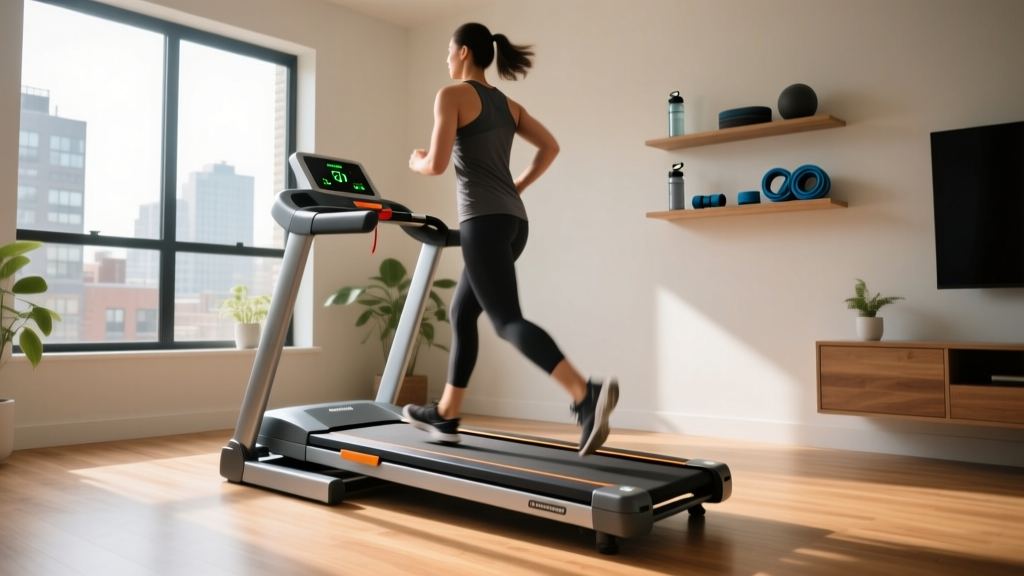
Compact Folding Treadmills: Unlocking Walking Backwards on Treadmill Incline Benefits
Reviewing the best compact folding treadmills for small spaces that safely support the rehab and joint benefits of walking backwards on an incline.

The Biomechanical Edge: Why Retro-Walking Demands a Real Machine
Living in a compact apartment or a space-constrained home often forces fitness enthusiasts to compromise on equipment. However, if your physical therapy or prehab routine involves retro-walking, compromising is not an option. The walking backwards on treadmill incline benefits are well-documented in sports medicine. According to research frequently cited by the American Physical Therapy Association, backward walking (retro-walking) on an incline significantly increases activation of the vastus medialis oblique (VMO) while simultaneously reducing patellofemoral joint compression compared to forward walking.
This makes it a gold-standard exercise for ACL rehabilitation, runner's knee prevention, and quad hypertrophy without heavy spinal loading. But executing this safely requires a machine with a rigid deck, a reliable incline motor, and stable handrails—features notoriously absent in budget 'walking pads' marketed for small spaces.
Why 90% of Folding Treadmills Fail the Retro-Walk Test
When you walk backwards on an incline, your biomechanics shift. You strike the belt with your toe/midfoot first, rolling back to the heel, which creates a unique lateral and reverse torque on the treadmill deck. Here is where most compact folding treadmills fail:
- Deck Flex and Shimmy: Cheap folding treadmills use thin MDF decks with a single central hinge. Under reverse-load, these decks can flex up to 15mm, causing a dangerous lateral shimmy that compromises ankle stability.
- Motor Stalling: Walking backwards on a 10%+ incline requires high torque at low speeds. Treadmills with motors under 2.0 Continuous Horsepower (CHP) will often stutter or stall, jerking the belt and risking a fall.
- Handrail Geometry: Retro-walking requires you to face the console. If the uprights are too narrow or the handrails lack a continuous dual-grip design, you cannot safely anchor your upper body while your legs move in reverse.
Top 3 Folding Treadmills for Small Spaces and Incline Retro-Walking
We evaluated dozens of space-saving models to find the rare few that fold down to a manageable footprint without sacrificing the structural integrity required for incline retro-walking.
1. Sole Fitness F63 (Best Overall Stability)
The Sole F63 remains the undisputed king of mid-tier folding treadmills. While its folded footprint (35" L x 30" W x 62" H) is slightly larger than ultra-compact walking pads, it fits easily into a standard closet or tight bedroom corner. More importantly, its 3.0 CHP motor and 15% maximum incline provide the seamless, stutter-free belt movement required for backward walking. The Cushion Flex deck absorbs the harsh reverse heel-strike, and the extended, dual-grip handrails offer a secure anchor point.
Expert Insight: The F63's heavy-duty steel frame weighs 165 lbs. This mass is actually a benefit for retro-walking, as it prevents the machine from 'walking' across your floor during reverse-torque movements.2. Horizon Fitness T202 (Best Value for Moderate Incline)
Priced around $899, the Horizon T202 folds to a highly manageable 34" L x 29" W x 61" H. It features a 2.75 CHP motor and a 12% maximum incline. While 12% is slightly lower than the Sole, it is more than sufficient for the walking backwards on treadmill incline benefits targeting the VMO and glutes. The three-zone cushioning system is particularly forgiving on the Achilles tendon, which takes on extra load during retro-walking.
3. NordicTrack T Series 10 (Most Compact, But With Caveats)
If your space is severely limited, the NordicTrack T Series 10 (approx. $599) folds down to an incredibly compact 29" L x 29" W x 58" H. It offers a 10% incline and a 20" x 55" belt. Warning: The 2.65 HP motor is adequate for users under 180 lbs, but heavier users may experience slight belt hesitation when walking backwards at speeds above 2.5 mph on a max incline. It is best suited for slow, controlled physical therapy paces (0.5 to 1.5 mph).
Specification & Space Footprint Matrix
| Model | Approx. Price | Folded Footprint (L x W x H) | Max Incline | Motor (CHP) | Retro-Walk Suitability |
|---|---|---|---|---|---|
| Sole Fitness F63 | $1,199 | 35" x 30" x 62" | 15% | 3.0 CHP | Excellent (High stability) |
| Horizon T202 | $899 | 34" x 29" x 61" | 12% | 2.75 CHP | Very Good (Great value) |
| NordicTrack T10 | $599 | 29" x 29" x 58" | 10% | 2.65 HP | Fair (Speed/Weight limits) |
Space Optimization: Layout Rules for Retro-Walking
Integrating a treadmill into a small room requires strategic layout design, especially when performing specialized movements. The American Council on Exercise emphasizes the importance of environmental safety during complex locomotor exercises. When setting up your folding treadmill for retro-walking, follow these spatial rules:
- The Mirror Paradox: When walking backwards on a treadmill, you must face the console (the front of the machine) to hold the handrails and monitor the controls. This means your back is to the room. To monitor your spinal alignment and hip extension, you must place a large wall mirror on the wall behind the treadmill, not in front of it.
- Posterior Clearance: Because you face the console, a backward trip means you will fall forward toward the motor cover. However, if you need to emergency-dismount by stepping off the back of the belt, you need at least 36 inches of clear space behind the treadmill deck.
- Lateral Swing Space: Retro-walking on an incline often induces a wider pelvic sway to maintain balance. Ensure you have 24 inches of lateral clearance on both sides of the treadmill to prevent your elbows from striking walls or furniture.
Step-by-Step Safety Protocol for Incline Retro-Walking
To safely harness the walking backwards on treadmill incline benefits on a folding home machine, adhere to this strict progression protocol recommended by sports kinesiology standards (as echoed by guidelines from the National Fitness Council regarding safe home exercise environments):
- Step 1: Zero Incline, Zero Speed. Stand on the side rails. Start the belt at 0.5 mph. Step backward onto the belt, establishing a toe-to-heel rolling strike.
- Step 2: Establish the Anchor. Grip the front console handrails lightly. Do not lean forward; keep your torso upright to ensure the VMO and glutes are doing the work, not your lower back.
- Step 3: Introduce the Incline. Once comfortable at 1.0 mph on a flat deck, increase the incline by 2% increments. Do not exceed a 10% incline for backward walking unless you are under the direct supervision of a physical therapist.
- Step 4: The Dismount. Never attempt to turn around while the belt is moving. Bring the speed down to 0.0 mph, wait for the belt to stop completely, and then step off forward.
Final Verdict on Space-Saving Cardio
You do not need to sacrifice joint health and rehabilitation goals just because you live in a small space. By selecting a structurally sound folding treadmill like the Sole F63 or Horizon T202, and optimizing your room's layout with proper mirror placement and clearance zones, you can safely unlock the profound biomechanical advantages of retro-walking. Ditch the flimsy walking pads; invest in a machine that respects both your square footage and your physiology.
More gear to consider
All reviews
IN10CT Treadmill: How to Use, Maintain, and Maximize Longevity
Rowing Guide & Technique: Treadmill That Mimics Trail Running Alternative
Beyond the Treadmill Emoji: Belt Maintenance & Lubrication Costs

Pad vs Treadmill: Running on a Treadmill to Lose Weight How Long?

Sunny Health Treadmill SF-T7515 vs Walking Pads: A Beginner's Guide
