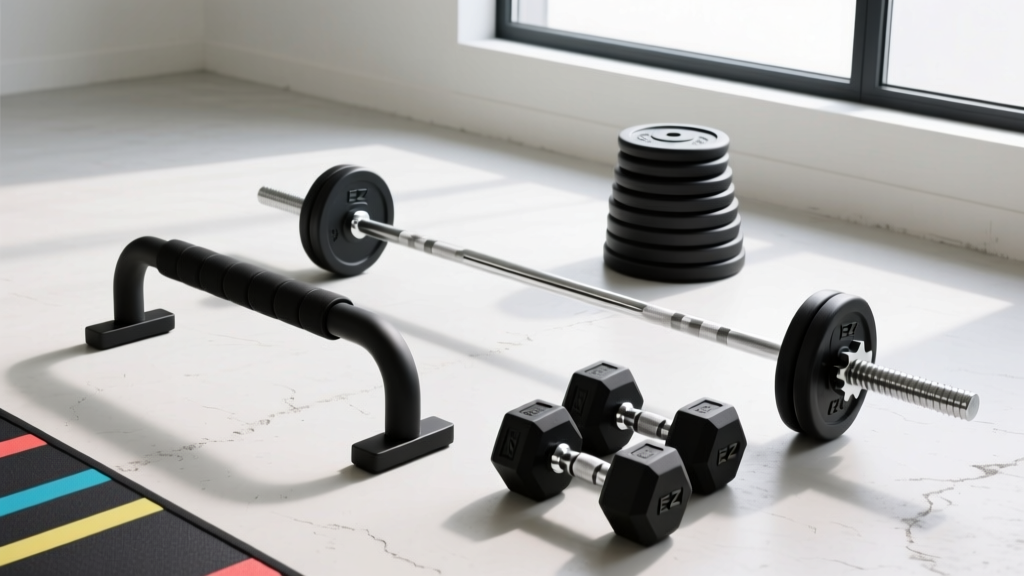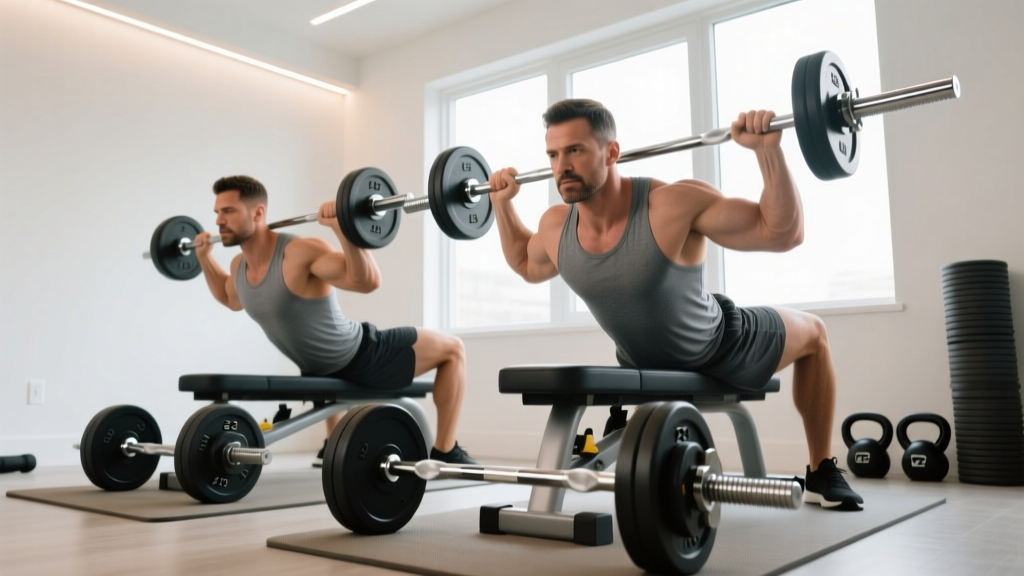
Close Grip Incline Dumbbell Press: EZ Curl Bar vs Straight Bar
Discover how to replicate the close grip incline dumbbell press in small gyms. We compare EZ curl bar vs straight bar for space, biomechanics, and storage.

The Spatial Problem with the Close Grip Incline Dumbbell Press
When designing a compact home gym under 50 square feet, space optimization is a ruthless math problem. The close grip incline dumbbell press is a premier movement for targeting the clavicular head of the pectoralis major (upper chest) and the lateral head of the triceps. However, executing this movement properly requires a pair of heavy dumbbells—typically 50 to 90 lbs per hand for intermediate lifters. Accommodating a full 5-to-90 lb hex dumbbell set demands a 3-tier rack spanning roughly 42 inches wide and 28 inches deep, devouring precious floor space.
To maintain a minimalist layout without sacrificing upper-body development, lifters often pivot to barbell alternatives. But this raises a critical biomechanical and spatial question: to replicate the close grip incline dumbbell press, should you load up a standard Olympic straight bar, or utilize an EZ curl bar? As of 2026, with compact 49-inch power racks dominating the home gym market, the answer involves a deep dive into wrist kinematics, rack footprint, and storage logistics.
Footprint & Layout: Straight Bar vs. EZ Curl Bar Dimensions
Before analyzing muscle activation, we must address the physical constraints of your equipment layout. A standard Olympic straight bar requires significant lateral clearance, whereas an EZ curl bar is specifically designed for confined spaces.
| Equipment Metric | Standard Olympic Straight Bar | Olympic EZ Curl Bar (e.g., Rogue Curl Bar) |
|---|---|---|
| Total Length | 86 inches | 47.25 inches |
| Weight | 44 lbs (20 kg) | 30 lbs (13.6 kg) |
| Shaft Diameter | 28.5 mm - 29 mm | 28 mm |
| Max Sleeve Capacity | ~400+ lbs | ~250 lbs (shorter sleeves) |
| Rack Compatibility | Requires 72"+ wide racks or external J-cups | Fits perfectly inside 49" wide compact racks |
| Avg. 2026 Price | $200 - $295 | $165 - $245 |
From a purely spatial perspective, the EZ curl bar is the undisputed champion for small home gyms. Its 47.25-inch length allows you to unrack and rerack the bar safely inside the uprights of a compact squat stand (like the Rep Fitness PR-1100 or Rogue SML-1), eliminating the need to walk the bar out into a cramped room.
Wrist Kinematics: Replicating the Dumbbell Press
The primary advantage of the close grip incline dumbbell press is the freedom it gives your wrists. Dumbbells allow a neutral or semi-pronated grip, keeping the humerus tucked at a natural 45-degree angle and minimizing anterior deltoid strain. When you swap dumbbells for a barbell, your hand position becomes fixed. This is where the choice of barbell dictates joint health.
The Straight Bar Failure Mode
Using a straight bar for a close-grip press (hands placed 12 to 16 inches apart) forces the forearms into extreme, locked pronation. According to biomechanical analyses of pressing movements, this fixed pronated position combined with a narrow grip induces severe ulnar deviation at the wrist joint during the eccentric loading phase. Over time, this edge case frequently leads to medial epicondylitis (golfer's elbow) and radioulnar joint impingement, completely defeating the purpose of the exercise.
The EZ Curl Bar Advantage
The EZ curl bar features angled shaft bends—typically set at 120-degree and 140-degree cambers. By gripping the innermost or second-innermost knurled sections, your hands are placed roughly 14 inches apart in a semi-supinated position. This perfectly mimics the natural converging arc and neutral wrist alignment of the close grip incline dumbbell press. You achieve the exact same triceps and upper-chest isolation without the connective tissue tax.
Expert Layout Tip: When setting up your adjustable bench (such as the Rep AB-3100 2.0) inside a compact rack for incline EZ bar presses, angle the bench to exactly 30 degrees rather than 45 degrees. A 30-degree incline shifts the bias slightly more toward the upper pecs while allowing the EZ bar to clear your chin comfortably at the bottom of the range of motion in a tight rack.
Step-by-Step: Executing the EZ Bar Incline Press
To properly substitute the dumbbell variation with an EZ curl bar in a space-restricted layout, follow this execution protocol:
- Setup: Set your adjustable bench to a 30-degree incline. Position it centrally within your power rack.
- Grip Selection: Grasp the innermost angled knurls of the EZ curl bar. Your hands should be roughly 12-14 inches apart.
- Unracking: Because the bar is short, you will likely unrack it with your arms already partially extended. Keep your elbows tucked close to your ribcage.
- The Descent: Lower the bar toward your upper sternum (just below the clavicle). Your elbows should track at a 45-degree angle, not flared out to 90 degrees.
- The Press: Drive the bar up and slightly back toward your face, focusing on triceps extension and upper chest contraction. Do not lock out aggressively to save elbow cartilage.
Tensile Strength and Plate Math for Small Gyms
A common concern when downsizing from a straight bar to an EZ curl bar is tensile strength and sleeve capacity. Standard Olympic bars boast a tensile strength of 190k to 215k PSI. Most high-quality EZ curl bars, like the Rogue Curl Bar, sit around 160k PSI. While 160k PSI is inadequate for heavy back squats, it is more than sufficient for the close grip incline dumbbell press alternative, where loads rarely exceed 185 lbs for advanced naturals.
Furthermore, the shorter sleeves of an EZ curl bar (typically 7 to 8 inches compared to 16 inches on a straight bar) force you to optimize your plate collection. To maximize loading capacity without buying expensive, space-hogging bumper plates, invest in a set of calibrated steel plates and fractional change plates. This keeps your weight storage footprint minimal while allowing precise progressive overload.
Space-Saving Storage Solutions
If you opt to keep both a straight bar and an EZ curl bar in your home gym, floor stands are a waste of square footage. To maintain an optimized layout, utilize vertical wall space.
- Wall-Mounted Hangers: The Rogue 3-Bar Hanger ($45) mounts directly to your wall studs or rack uprights, storing your EZ bar, straight bar, and trap bar with zero floor footprint.
- Vertical Barbell Holders: If you cannot drill into walls, a vertical barbell caddy (like the Titan Fitness 10-Bar Vertical Storage Rack) tucks neatly into a 12x12 inch corner footprint.
Final Verdict: Which Bar Wins for Compact Gyms?
If your primary goal is to replicate the biomechanics of the close grip incline dumbbell press while adhering to strict space optimization principles, the EZ curl bar is the definitive winner. It fits seamlessly inside narrow 49-inch squat racks, eliminates the severe wrist impingement associated with narrow straight-bar pressing, and provides a semi-supinated grip that perfectly mirrors the dumbbell variation. Reserve your straight bar for heavy flat benching and squats, and let the EZ curl bar handle your space-saving, joint-friendly incline triceps work.
For more in-depth analysis on barbell variations and joint mechanics, resources like BarBend's comprehensive barbell guides offer excellent visual breakdowns of grip widths and pressing angles.
More gear to consider
All reviews
Barbell Collar Setup: Safe Racks and Calves Workout with Dumbbells
Cast Iron vs Competition Kettlebells & Chest Supported Dumbbell Row

Neoprene Dumbbells & The Black Dumbbell Bracelet: 2026 Guide

Kettlebell Value: Water Bottle Shaped Like Dumbbell vs Real Iron

Senior Dumbbell Storage & Seated Dumbbell Exercises for Seniors PDF Guide