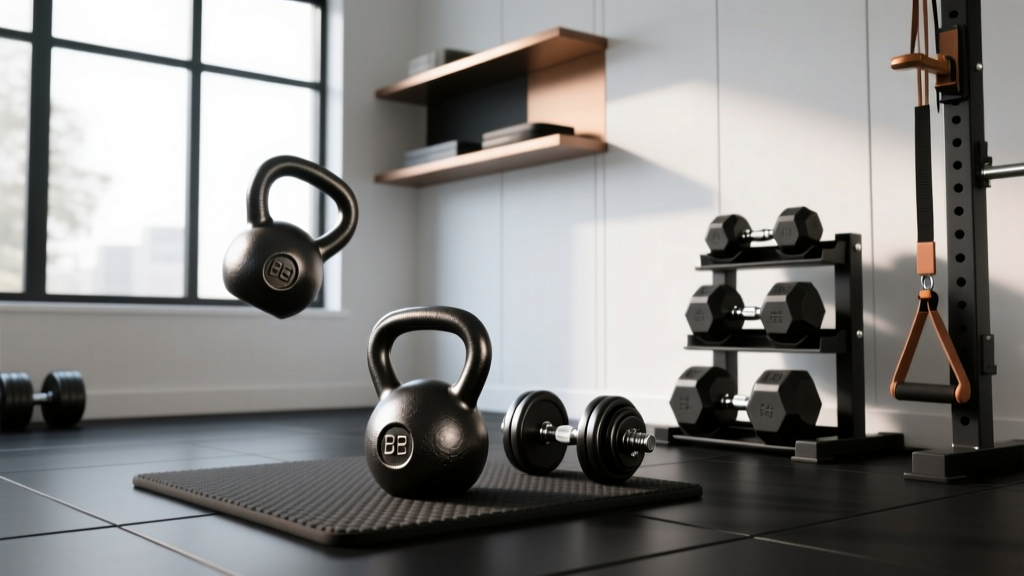
Space Layouts: Kettlebells vs Dumbbell Workouts for Arms and Chest
Discover how cast iron vs competition kettlebells compare for space-optimized home gyms, upgrading your dumbbell workouts for arms and chest.

The Footprint Dilemma: Rethinking the Home Gym Layout
As home gym real estate becomes increasingly precious in 2026, lifters are constantly searching for ways to maximize training variety while minimizing square footage. A standard 5-to-50-pound rubber hex dumbbell set, complete with a three-tier A-frame rack, demands roughly 24 square feet of total spatial clearance when factoring in user movement. For apartment dwellers or garage gym owners sharing space with vehicles, this footprint is often untenable. Consequently, many are turning to kettlebells as a high-density alternative. However, transitioning away from traditional dumbbell workouts for arms and chest requires careful equipment selection. The debate between cast iron and competition kettlebells is no longer just about sport-specific performance; it is fundamentally a question of spatial geometry, metallurgy, and ergonomic adaptation.
The Spatial Mathematics: Dumbbells vs. Kettlebells
Traditional Dumbbell Set (5-50 lbs, 10 pairs): Requires a 48" W x 24" D rack. With necessary pull-clearance, the spatial cost is 24 sq. ft.
Curated Kettlebell Set (8kg, 12kg, 16kg, 20kg, 24kg): When paired with a wall-mounted steel shelf bolted to 16" on-center studs, the floor footprint is 0 sq. ft., projecting only 12 inches from the wall.
Space Saved: Up to 24 square feet of usable floor space, allowing for dedicated stretching zones or additional cardio equipment.
Cast Iron Kettlebells: The Space-Saving Workhorse
When optimizing for physical volume, cast iron kettlebells are the undisputed champions. Unlike their competition counterparts, cast iron bells scale in physical dimensions relative to their mass. An 8kg cast iron bell is significantly smaller in diameter and height than a 24kg bell. This tapering geometry allows for tighter storage configurations and nested stacking in corner layouts.
Metallurgy, Grip, and Pricing
Modern cast iron kettlebells, such as the Rogue Powder Coat Kettlebells or REP Fitness KG1 Series, are gravity-cast from a single piece of iron and finished with a textured powder coat. This finish is critical for arm and chest isolation exercises, as it provides a secure grip without the need for excessive chalk, which can ruin indoor flooring. Pricing in 2026 remains highly competitive, generally hovering between $1.50 and $2.20 per pound.
However, the spatial advantage comes with an ergonomic edge case: the handle-to-bell clearance (the 'window') shrinks on lighter weights. During exercises like the kettlebell chest fly, an 8kg cast iron bell may pinch the wrist if the user has thick forearms, requiring a slight modification in grip placement compared to a dumbbell.
Competition Kettlebells: The Uniformity Trap for Small Gyms
Competition kettlebells are engineered for the sport of kettlebell lifting, governed by strict dimensional standards. Whether you are holding an 8kg or a 32kg bell, the dimensions remain identical: 280mm in height, 210mm in width, and a 35mm handle diameter. This uniformity ensures that muscle memory and technique remain consistent across different loads during high-repetition snatch or jerk sets.
The Spatial and Financial Drawbacks
From a space optimization perspective, competition bells are highly inefficient for general home gyms. Because the physical size never changes, lighter weights (8kg to 14kg) are hollow and filled with steel shot or tungsten to reach the target mass. This means an 8kg competition bell takes up the exact same volume on your storage rack as a massive 32kg bell, completely negating any space-saving benefits. Furthermore, the internal steel shot in cheaper models can shift or rattle over time if the internal welds fail—a known failure mode in budget brands.
Financially, the precision machining and hollow-core construction push the cost to $3.50 to $5.00 per pound. Unless you are specifically training for kettlebell sport, allocating this budget and spatial footprint is difficult to justify for a compact home gym.
"The 35mm handle diameter of a competition bell is notably thicker than a standard adjustable dumbbell handle (usually 28mm-32mm). When adapting arm isolation movements, this thicker grip drastically increases forearm and brachioradialis activation, which can prematurely fatigue your grip before your biceps reach true muscular failure."
Adapting Dumbbell Workouts for Arms and Chest to Kettlebells
Many lifters hesitate to ditch their dumbbells, fearing they will lose the ability to perform targeted hypertrophy work. With a set of cast iron kettlebells and a space-saving wall rack, you can seamlessly translate your favorite dumbbell workouts for arms and chest into highly effective kettlebell variations.
Chest Hypertrophy: The Squeeze Press and Floor Fly
- The Kettlebell Squeeze Press: Lying on the floor or a bench, press two kettlebells upward while actively crushing them together. The medial force vector creates immense constant tension on the pectoralis major, mimicking a cable crossover but requiring only 4 square feet of floor space.
- Alternating Floor Flyes: Cast iron bells are ideal here. Their compact shape on lighter weights (12kg-16kg) allows for a deep stretch at the bottom of the movement without the bulky heads of rubber hex dumbbells hitting the floor prematurely.
Arm Isolation: Biceps and Triceps
- Horn Bicep Curls: Instead of gripping the handle, grip the 'horns' (the sides of the bell window) of a single cast iron kettlebell. This neutral grip position heavily targets the brachialis and brachioradialis, adding thickness to the arm profile while reducing wrist strain.
- Overhead Tricep Extensions: Hold a single kettlebell by the handle upside down (bottoms-up) or by the horns. The offset center of mass forces the triceps to stabilize the load throughout the entire range of motion, providing a stimulus that traditional dumbbells simply cannot match.
Specification Matrix: Cast Iron vs. Competition
| Feature | Cast Iron Kettlebells | Competition Kettlebells |
|---|---|---|
| Dimensions | Scales with weight (Compact) | Uniform (280x210mm, 35mm handle) |
| Avg. Cost (2026) | $1.50 - $2.20 / lb | $3.50 - $5.00 / lb |
| Space Efficiency | High (Nested stacking possible) | Low (Fixed large footprint) |
| Best For | Hypertrophy, General Fitness, Small Gyms | Kettlebell Sport, Technical Snatches/Jerks |
| Arm/Chest Adaptation | Excellent (Thinner handles on light bells) | Poor (35mm grip causes forearm fatigue) |
Designing the Space-Optimized Storage Layout
To fully realize the spatial benefits of cast iron kettlebells, you must abandon floor stands. The optimal layout for a compact home gym utilizes vertical wall space. Here is the step-by-step framework for installing a high-density kettlebell storage system:
- Locate the Studs: Use a magnetic stud finder to locate wooden wall studs, typically spaced 16 inches on-center (OC). Never mount heavy iron storage to drywall alone.
- Select a Heavy-Duty Shelf: Purchase a steel wall-mounted kettlebell rack rated for at least 300 lbs. Brands like Rep Fitness and Franklin Sports offer 36-inch wide wall shelves that hold up to 5 bells comfortably.
- Calculate the Load Path: A 5-bell set (8kg to 24kg) weighs roughly 154 lbs. The steel rack weighs 30 lbs. Total static load is 184 lbs. Ensure your lag bolts (minimum 3/8" x 3") penetrate the center of the studs by at least 2 inches.
- Positioning for Ergonomics: Mount the shelf at waist height (approx. 36 inches from the floor). This allows you to safely deadlift the bells off the rack for heavy swings or presses without bending into an awkward, hazardous squat position to retrieve them from a low floor stand.
Final Verdict: Optimize Your Space, Elevate Your Training
If your primary goal is space optimization without sacrificing the ability to perform rigorous dumbbell workouts for arms and chest, cast iron kettlebells are the superior investment. They offer a variable footprint that shrinks alongside your lighter weights, a more ergonomic grip for isolation movements, and a price point that leaves room in the budget for other space-saving gear like resistance bands or a foldable bench. Competition bells have their place on the competition platform, but for the modern, space-conscious home gym, cast iron reigns supreme. For further reading on equipment biomechanics, consult the extensive gear breakdowns on BarBend's kettlebell guides or review the dimensional specifications directly from Rogue Fitness.
More gear to consider
All reviews
EZ Bar vs Straight Bar Value & Dumbbell Chest Exercises at Home

Best Adjustable Dumbbells for CrossFit Dumbbell Workouts (2026)
Mistakes Upgrading Past 65lb Dumbbells: Olympic vs Standard Plates
Rubber Hex vs Urethane Dumbbells for Dumbbell Pec Flys: Value Guide

Loadable Dumbbells: 2026 Lats Workout at Home With Dumbbells Analysis
