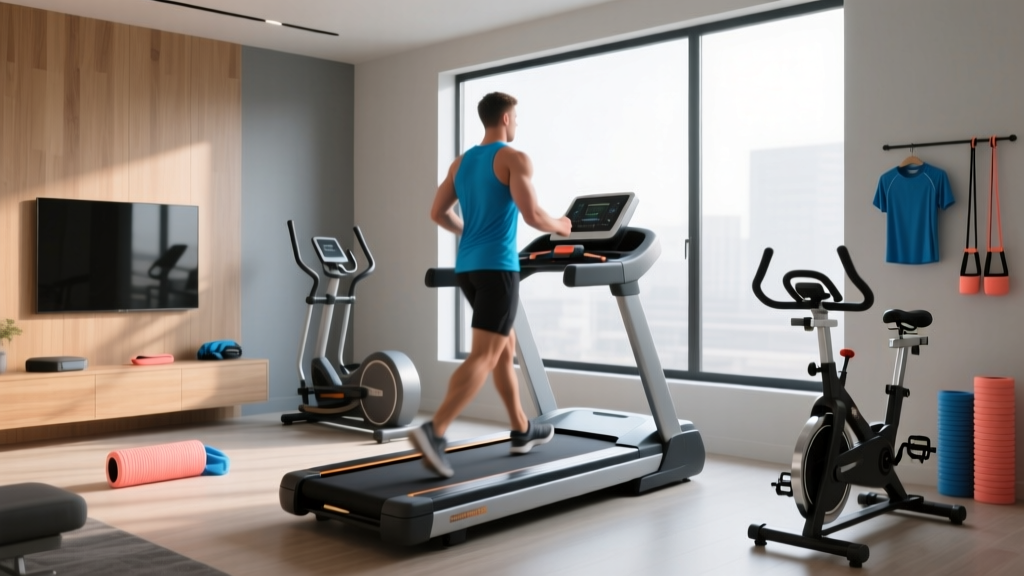
Cardio Noise Comparison & Finding a Good Incline for Treadmill
Compare cardio machine noise levels and learn how finding a good incline for treadmill walking creates a quiet, apartment-friendly home gym setup.

The Beginner’s Guide to Apartment-Friendly Cardio
Building a home gym in a shared living space, apartment, or multi-story house introduces a unique challenge that most buying guides ignore: acoustics. While you might be focused on screen size or motor horsepower, your downstairs neighbors are only concerned with one thing—structure-borne noise. In 2026, with more people than ever working out at home, understanding the decibel (dB) output of your equipment is just as critical as its footprint.
This guide breaks down the real-world noise levels of the most popular cardio machines. More importantly, we will tackle the loudest offender in the room—the treadmill—and provide a step-by-step framework for finding a good incline for treadmill workouts that maximizes caloric burn while keeping your floor joists completely silent.
Cardio Machine Noise Level Comparison Matrix
Not all cardio machines are created equal when it comes to acoustic output. Airborne noise (the sound you hear in the room) is different from structure-borne noise (the low-frequency thumping that travels through walls and floors). Below is a comparison of popular 2026 models and their acoustic profiles.
| Machine Type | Popular 2026 Model | Airborne Noise (dB) | Structure-Borne Risk | Avg. Price Range |
|---|---|---|---|---|
| Magnetic Spin Bike | Schwinn IC4 / Bowflex C6 | 40 - 50 dB (Quiet) | Extremely Low | $900 - $1,100 |
| Elliptical | Sole E35 | 50 - 60 dB (Moderate) | Low | $1,200 - $1,500 |
| Rowing Machine | Concept2 RowErg | 55 - 65 dB (Moderate) | Low-Medium | $1,100 - $1,250 |
| Air Bike | Rogue Echo Bike | 70 - 82 dB (Loud) | Low | $1,100 - $1,300 |
| Treadmill (Running) | NordicTrack Commercial 1750 | 75 - 85 dB (Loud) | Extremely High | $1,800 - $2,500 |
| Treadmill (Incline Walk) | Sole F63 | 55 - 65 dB (Moderate) | Medium | $1,199 - $1,399 |
According to the Centers for Disease Control and Prevention (CDC), prolonged exposure to noise above 70 dB can begin to impact hearing and significantly elevate stress levels. While an air bike like the Rogue Echo is fantastic for HIIT, its 80+ dB fan noise makes it a poor choice for early morning workouts in an apartment. Treadmills, however, present a dual threat: loud motor noise combined with severe impact vibrations.
Why Treadmills Are the Loudest (And How to Fix It)
To solve the treadmill noise problem, we must understand the physics of a footstrike. When you run on a flat treadmill, you experience a "flight phase" where both feet leave the belt. When you land, your body absorbs an impact force equal to 2.5 to 3 times your body weight. This kinetic energy transfers directly through the treadmill deck, into the motor housing, and down into your floor joists, creating a low-frequency "thump" that easily penetrates drywall and concrete.
The solution is not necessarily buying a more expensive machine with "whisper-quiet" marketing. The solution is altering your biomechanics by eliminating the flight phase entirely. This is where determining a good incline for treadmill walking becomes your secret weapon for a silent, high-yield workout.
"By increasing the incline and reducing the speed, you shift the cardiovascular demand to your glutes and hamstrings while keeping at least one foot on the belt at all times. This reduces impact force by up to 60%, virtually eliminating structure-borne noise."
Step-by-Step: Finding a Good Incline for Treadmill Quiet Walking
If you want to maintain excellent cardiovascular health—which the American Heart Association recommends at a minimum of 150 minutes of moderate-intensity aerobic activity per week—without angering your neighbors, follow this step-by-step protocol.
Step 1: Establish Your Baseline Speed (2.5 to 3.2 MPH)
Start by setting your treadmill speed between 2.5 and 3.2 MPH. This is a brisk walking pace for most adults. At this speed, it is biomechanically impossible to enter a flight phase. You are forced into a heel-to-toe or midfoot walking stride, which drastically reduces the acoustic signature of your footfalls.
Step 2: Dial in the "Sweet Spot" Incline (8% to 12%)
A good incline for treadmill routines aimed at noise reduction and high caloric burn sits between 8% and 12%.
- 8% Incline: Ideal for beginners or active recovery days. Elevates the heart rate into Zone 2 (fat-burning) without causing excessive calf strain.
- 10% Incline: The optimal middle ground. Mimics the effort of a light jog on a flat surface but with zero impact noise.
- 12% to 15% Incline: Best for advanced users seeking high-intensity muscular endurance. Note that at 15%, users tend to lean heavily on the handrails, which defeats the purpose of the workout. Avoid holding the rails to maintain proper core engagement.
Step 3: Optimize Your Footwear and Strike
Even when walking, hard rubber soles can create a "slapping" sound against the PVC belt. Wear running shoes with plush, EVA-foam midsoles (like the Hoka Clifton 9 or Brooks Ghost 16). Furthermore, focus on a midfoot strike rather than a heavy heel strike. Imagine you are sneaking up on someone; this mental cue naturally softens your footfall and reduces belt noise.
💡 The Viral "12-3-30" Noise Factor
You have likely seen the viral 12-3-30 workout (12% incline, 3.0 MPH, for 30 minutes). From an acoustic perspective, this is the gold standard for apartment dwellers. Because the speed is capped at 3.0 MPH, the impact noise is negligible. However, ensure your treadmill's motor is rated for at least 2.5 Continuous Horsepower (CHP). Sustaining a 12% incline at heavy user weights can overheat weaker motors, creating a high-pitched whining noise that is just as disruptive as footfalls.
Soundproofing Your Cardio Zone: 3 Proven Methods
Even with the perfect incline and walking speed, treadmill motors and elliptical drive trains generate ambient vibration. To truly bulletproof your home gym against noise complaints, implement these three physical modifications:
- The 3/8" Vulcanized Rubber Mat: Do not use cheap PVC yoga mats. You need high-density rubber to decouple the machine from the floor. Purchase 3/8-inch thick horse stall mats (often found at farm supply stores for around $50 per 4x6 sheet). This mass absorbs low-frequency vibrations before they enter the subfloor.
- Anti-Vibration Isolation Pads: Place 4-inch elastomeric isolation pads (like those made by DiversiTech) directly under the treadmill's transport wheels and rear feet. This creates an air gap and a secondary dampening layer, reducing structure-borne noise by up to 85%.
- Strategic Placement: Never place a treadmill in the center of a room, where floor joists have the most "bounce" (deflection). Always push the machine against a load-bearing wall or directly over a support beam to minimize structural resonance.
Frequently Asked Questions (FAQ)
Will my downstairs neighbor hear my Peloton Tread if I run?
Yes. The Peloton Tread features a rigid slat belt and a heavy steel frame. Running on it generates significant low-frequency impact noise that easily travels through standard apartment flooring. If you live above others, stick to incline walking or switch to a magnetic resistance bike.
Does treadmill motor noise increase over time?
It can. If you fail to lubricate your treadmill belt every 150 miles (or every 3 months), the friction between the belt and the deck will force the motor to work harder. This results in a louder, strained motor hum and can eventually trip your circuit breaker. Use 100% silicone treadmill lubricant to keep the motor whisper-quiet.
Are manual treadmills quieter than motorized ones?
Curved manual treadmills (like the AssaultRunner) have no motor, eliminating airborne motor noise entirely. However, they require a midfoot running strike to keep the belt moving, which still produces high-impact, structure-borne thumping. For pure silence, a motorized treadmill set to a steep incline for walking remains the superior choice.
Final Thoughts on Quiet Cardio
You do not need to sacrifice your fitness goals to maintain peace in a shared living environment. By understanding the acoustic limitations of different machines and leveraging biomechanics—specifically by finding a good incline for treadmill walking—you can achieve elite cardiovascular conditioning in near-total silence. Pair your incline walking strategy with a high-density rubber mat, and your home gym will remain a sanctuary for you, and a non-issue for everyone else.
More gear to consider
All reviews
NordicTrack T6.5 Treadmill vs Rowing Machines: Cardio Showdown

Air Bike vs Assault Bike Guide & Precor Treadmill Maintenance

2026 Market Shift: Live Strong Treadmill vs Compact Portable Cardio

Treadmill Assembly: A Beginner's Step-by-Step Guide
Deer Run Treadmill Z10 & Motor Size Guide: What HP Do You Need?
