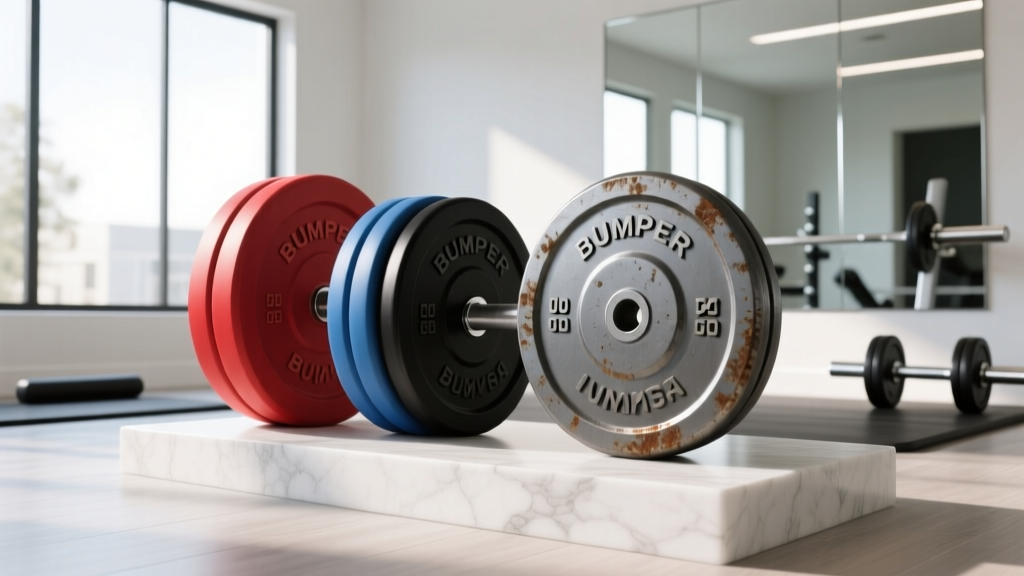
Bumper vs Iron Plates Value Guide: Beyond the Squat One Dumbbell Phase
Analyze the true cost of bumper vs iron plates in 2026. We break down price-per-pound, durability, and hidden fees to maximize your home gym budget.

The Transition: From Goblet Squats to Barbell Loading
Most home gym owners begin their leg training with limited equipment. It is incredibly common to squat one dumbbell using the goblet method for months before your leg strength outpaces your gear. Once you cross the threshold where a 50-pound or 70-pound dumbbell is no longer sufficient, the transition to barbell back squats and deadlifts becomes mandatory. This milestone triggers the most significant equipment debate in the fitness industry: should you invest in traditional cast iron plates or modern rubber bumper plates?
From a purely financial perspective, the choice is rarely straightforward. While iron plates boast a lower upfront cost, bumpers offer longevity and floor protection that can offset secondary expenses. In this 2026 budget breakdown, we analyze the exact price-per-pound (CPP) metrics, material failure modes, and hidden costs to help you allocate your home gym funds with absolute precision.
Material & Manufacturing: Why the Price Gap Exists
To understand the value proposition, you must understand the manufacturing realities of 2026. Cast iron plates are produced by pouring molten iron into sand molds. The process is cheap, but the resulting product is brittle and prone to surface oxidation (rust) if the enamel coating chips. According to equipment analysts at Garage Gym Reviews, the primary cost driver for iron is the raw material commodity price, which has stabilized around $1.50 to $2.20 per pound for consumer-grade imports.
Bumper plates, conversely, require vulcanized rubber molded around a forged steel hub. Virgin rubber bumpers (like the Rogue Echo series) demand high-grade synthetic materials and precise compression molding to ensure the steel insert does not pop out during repeated drops. Recycled rubber bumpers (like Hi-Temp plates) are cheaper to produce but suffer from a porous surface that degrades over time and emits a persistent odor. The manufacturing complexity inherently pushes the baseline CPP for bumpers to the $2.80 to $5.50 range.
2026 Cost Per Pound (CPP) Matrix
- Basic Cast Iron (Import): $1.40 - $1.80 / lb
- Premium Cast Iron (Machined/Deep Dish): $2.20 - $3.00 / lb
- Recycled Rubber Bumpers: $2.50 - $3.20 / lb
- Virgin Rubber Bumpers (Competition Grade): $4.50 - $7.00+ / lb
- Urethane Bumpers (Commercial): $8.00 - $12.00 / lb
Iron Plates: The Budget King's Pros and Cons
If your primary goal is static lifting—think heavy bench presses, strict rows, and controlled squats where the bar is gently racked—cast iron remains the undisputed value champion. A standard 260-pound set of Titan Fitness cast iron plates will cost roughly $450 in 2026, yielding a CPP of $1.73.
Where Iron Excels
- Dimensional Accuracy: Calibrated iron plates are incredibly thin, allowing you to load 500+ pounds on a standard barbell sleeve without running out of space.
- Zero Bounce: When deadlifting, iron plates dead-stop on the floor. There is no kinetic rebound, forcing you to generate pure concentric power from a static start.
- No Odor: Unlike recycled rubber, properly enameled iron will not off-gas volatile organic compounds (VOCs) into your basement or garage.
Failure Modes and Edge Cases
The critical failure mode for iron is edge chipping. If you drop a loaded barbell from shoulder height during a failed front squat, the cast iron can fracture. Furthermore, the enamel coating will inevitably scratch, exposing the raw iron to ambient humidity. If your gym is in an unclimate-controlled garage in a humid region, you will spend 15 minutes a month wire-brushing rust and applying 3-in-One oil.
Bumper Plates: When the Premium is Worth the Investment
As noted by the experts at BarBend, bumper plates are engineered for dynamic, high-impact Olympic weightlifting and CrossFit-style metcons. If your programming includes power cleans, snatches, or high-rep deadlifts where dropping the bar is a safety requirement, bumpers are not a luxury; they are a necessity.
Consider the Rogue Echo Bumper Plates. Priced around $3.40 per pound, a 260-pound set costs roughly $885. While this is nearly double the cost of basic iron, the value proposition shifts when you factor in equipment preservation.
The Hidden ROI of Bumpers
- Barbell Longevity: Dropping iron plates transfers massive shockwaves through the barbell shaft, eventually bending the steel or destroying the sleeve bushings. Bumpers absorb this kinetic energy, extending the life of your $300+ Olympic barbell.
- Floor Preservation: Replacing a shattered concrete garage floor or cracked rubber matting can cost upwards of $1,500. Bumpers act as a primary shock absorber.
- Noise Reduction: For home gym owners with neighbors or sleeping family members, the acoustic dampening of rubber is invaluable.
Head-to-Head Value Comparison
| Feature | Cast Iron Plates | Virgin Rubber Bumpers |
|---|---|---|
| Average CPP (2026) | $1.50 - $2.50 | $3.50 - $5.50 |
| Drop Tolerance | Low (Cracking risk) | High (10,000+ drop rating) |
| Barbell Sleeve Space | High (Thin profile) | Low (Thick profile, 45lb plates only) |
| Maintenance Required | Medium (Rust prevention) | Low (Occasional silicone spray) |
| Acoustic Impact | High (Loud clanking) | Low (Dull thud) |
The 3-Tier Buying Framework for Home Gyms
To maximize your budget, do not view this as a binary choice. The smartest home gym builders in 2026 use a hybrid loading strategy.
Tier 1: The Strict Budget (Under $350)
Strategy: 100% Cast Iron.
Best For: Powerlifters, bodybuilders, and those who strictly control their eccentrics. If you are upgrading from a routine where you squat one dumbbell and are moving to a basic 5x5 barbell program, buy used cast iron on local marketplaces. You can often find iron for $1.00/lb locally, completely bypassing the $150+ freight shipping fees that plague heavy online orders.
Tier 2: The Hybrid Approach ($400 - $600)
Strategy: 100 lbs of Bumpers + 150 lbs of Iron.
Best For: The general fitness enthusiast. Buy two 45lb bumper plates and a 10lb/25lb bumper pair for your dynamic drops and Olympic lifts. Fill the rest of the barbell sleeve with cheap cast iron change plates and 45s to reach your max working sets. This gives you the drop-protection of rubber where you need it, and the space-efficiency of iron where you don't.
Tier 3: The Olympic Drop Zone ($800+)
Strategy: 100% Virgin Rubber Bumpers.
Best For: CrossFit athletes, Olympic weightlifters, and commercial garage gyms. The premium paid for virgin rubber ensures exact weight calibration (within 1%) and a dead-bounce that won't roll away and smash your shins after a heavy clean and jerk.
Expert Warning on Floor Protection: Never assume bumper plates eliminate the need for a lifting platform. Dropping 300+ pounds repeatedly on bare concrete, even with premium bumpers, will eventually cause structural spalling. Always pair your plate investment with a minimum 3/4-inch thick horse stall mat over a plywood subfloor.
Hidden Costs: Shipping, Storage, and Floor Protection
When calculating your budget, the sticker price is only half the equation. Freight shipping for a 300-pound pallet of iron plates can easily add $120 to $200 to your total cost, depending on your proximity to the distributor's warehouse. Brands like Rogue and Titan often run "Free Shipping on Plates" promotions during Black Friday or New Year sales; timing your purchase around these events is a mandatory tactic for budget-conscious buyers.
Storage is another hidden variable. Iron plates can be stored on vertical A-frame racks or horizontal tree pegs cheaply. Bumper plates, however, degrade if stored vertically on their edges for long periods (the rubber can warp or the steel insert can separate). You must budget $80 to $150 for a dedicated horizontal bumper plate storage rack to protect your investment.
Frequently Asked Questions
Can I mix iron and bumper plates on the same barbell?
Yes, but with a strict rule: the bumper plate must be the closest to the barbell sleeve collar, and it must be a 45lb (20kg) plate. Never put a 10lb bumper plate on the bar and load it with heavy iron; the narrow surface area of the small bumper will cause it to fold and tear under the iron's weight.
Do bumper plates weigh less than iron plates?
No, a calibrated 45lb bumper weighs exactly the same as a 45lb iron plate. However, cheap, uncalibrated recycled bumpers can sometimes weigh 47 or 48 pounds, which throws off your progressive overload tracking.
Which is better for deadlifts?
For pure strength deadlifts, iron is superior because it does not bounce, forcing you to break the inertia from a dead stop. For high-rep metabolic conditioning deadlifts, bumpers are better as they allow for a controlled drop, saving your lower back from eccentric fatigue.
More gear to consider
All reviews
Olympic vs Standard Plates for Dumbbell Back Workouts at Home
Beyond 5 Pound Dumbbell Exercises: Barbell Weight and Knurling

Best Barbell Collars When Outgrowing Dumbbell Exercise for Upper Body

Quadriceps Dumbbell Workout Mistakes Using Neoprene Home Weights
How Heavy Are The Dumbbells You Lift TV Show? Kettlebell Value Guide
