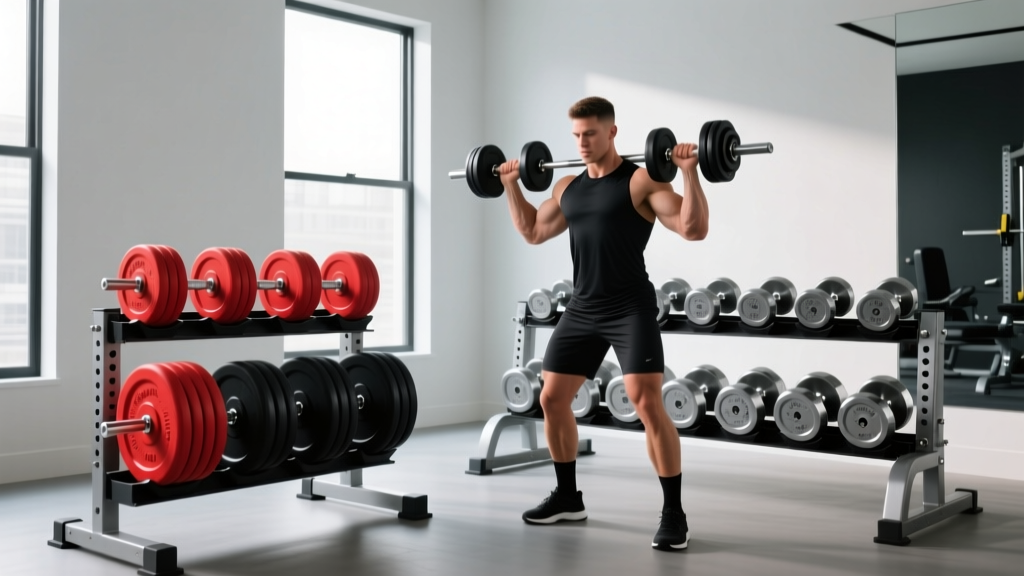
Bumper vs Iron Plates: Gym Layout & Dumbbell Front Shoulder Press
Optimize your home gym layout by comparing bumper vs iron plates. Learn how plate thickness impacts storage and dumbbell front shoulder press clearance.

The Spatial Geometry of Free Weights in Compact Gyms
As residential fitness spaces continue to shrink in 2026, the modern home gym is less about sprawling warehouse layouts and more about precision micro-design. When outfitting a 10x10 garage bay or a converted spare bedroom, every cubic inch matters. While most lifters debate the merits of bumper plates versus cast iron plates based purely on drop-tolerance or noise reduction, the true differentiator for compact spaces is spatial geometry. The physical dimensions of your weight plates dictate your storage footprint, your barbell sleeve capacity, and critically, your functional movement clearance.
According to comprehensive equipment analyses by Garage Gym Reviews, the variance in plate thickness can alter your gym's usable floor plan by up to 15%. This isn't just a storage problem; it directly impacts biomechanics. If you are executing a dumbbell front shoulder press inside a power rack or near a wall-mounted storage unit, the protrusion of your plate storage can severely compromise your elbow tracking and spinal alignment. Let us break down the exact mathematics of bumper vs. iron plates to help you engineer the ultimate space-optimized layout.
Dimensional Deep Dive: The Math of Plate Thickness
To understand layout constraints, we must first look at the raw dimensional data of standard 45lb (20kg) plates. Not all plates are created equal, and the width of a single plate compounds rapidly when loaded onto a barbell or stacked on a storage peg.
Cast Iron Plates: The Space-Saver's Dream
Standard machined Olympic cast iron plates, such as the Rogue Machined Olympic Plates, boast an incredibly dense profile. A 45lb iron plate typically measures between 1.30 and 1.50 inches in width. This high-density profile allows you to load massive weight onto a standard barbell sleeve while leaving ample room for collars, and it keeps wall-mounted storage pegs relatively flush to the wall.
Bumper Plates: The Volumetric Challenge
Bumper plates introduce significant volumetric bulk. While calibrated competition bumpers are relatively thin (approx. 2.15 inches for a 20kg plate), standard economy bumpers and recycled rubber 'Hi-Temp' plates are notoriously thick. A standard 45lb Echo-style bumper measures roughly 3.25 inches wide, while a recycled Hi-Temp bumper can swell to 3.75 inches. As noted by the equipment experts at BarBend, loading four Hi-Temp bumpers per side consumes over 30 inches of sleeve space—a physical impossibility on a standard Olympic barbell with 16.3-inch loadable sleeves.
Layout Insight: If your primary layout relies on horizontal barbell storage racks, a full set of iron plates (160 lbs per side) will extend roughly 10.5 inches from the collar. The same weight in standard bumpers will extend over 26 inches, potentially encroaching on walking paths or adjacent equipment zones.Movement Clearance: The Dumbbell Front Shoulder Press Test
Why does plate thickness matter for an exercise that doesn't even use a barbell? The answer lies in equipment integration and interior rack clearance. The dumbbell front shoulder press is a prime diagnostic test for spatial optimization.
When performing the dumbbell front shoulder press, proper biomechanics dictate that the lifter should sit on a bench set to 75-85 degrees (not a perfectly vertical 90 degrees, which can cause shoulder impingement). The elbows must track slightly forward of the frontal plane in the scapular plane (scaption). This requires significant lateral and posterior clearance.
The Rack Protrusion Problem
Consider a standard 24-inch deep power rack (e.g., a Rogue R-3). Many lifters utilize the rear uprights for horizontal plate storage pegs to save floor space. If you store 45lb bumper plates on these rear pegs, the plates (3.25 inches) plus the steel peg (3 inches) protrude 6.25 inches into the interior workspace of the rack.
In a 24-inch deep rack, this reduces your interior depth to just 17.75 inches. For a lifter over 5'10" performing the dumbbell front shoulder press, this lost depth forces the bench too far forward. The lifter's elbows may strike the front uprights or spotter arms at the bottom of the pressing movement, or they may be forced to lean forward, compromising lumbar stability. Iron plates, protruding only 4.3 inches total (peg + plate), preserve an additional 2 inches of vital interior clearance, allowing for an unobstructed, biomechanically sound pressing path.
Bumper vs. Iron: The 2026 Space Optimization Matrix
Use the following comparison matrix to determine which plate profile aligns with your specific square footage and layout constraints.
| Feature | Cast Iron Plates | Standard Bumper Plates | Competition Bumpers |
|---|---|---|---|
| Width (45lb/20kg) | 1.30" - 1.50" | 3.00" - 3.75" | ~2.15" |
| Storage Footprint | Minimal (High Density) | High (Requires deep trees) | Moderate |
| Cost per Pound (2026) | $1.50 - $2.20 / lb | $2.80 - $4.50 / lb | $6.00 - $9.00 / lb |
| Rack Interior Clearance | Excellent (Preserves depth) | Poor (Encroaches on space) | Fair |
| Floor Protection | None (Requires 3/4" rubber mats) | High (Safe for drops) | High (Dead bounce) |
| Best Layout Type | Micro-gyms, Wall-mounted pegs | Dedicated Olympic lifting zones | Competitive garage gyms |
Strategic Storage Configurations for Micro-Gyms
Once you have selected your plate type, the physical storage apparatus must be mapped to your gym's 'strike zones'—the areas where dynamic movements like the dumbbell front shoulder press, lateral raises, or kettlebell swings occur.
Vertical Wall Pegs vs. Horizontal A-Frames
For iron plate owners, vertical wall-mounted UHMW plastic pegs are the ultimate space hack. Because iron plates are thin, a 5-peg wall mount can hold over 300 lbs while protruding less than 6 inches from the wall. This keeps the floor entirely clear for dumbbell work and bench placements.
Conversely, if you must use thick bumper plates, wall pegs become a hazard. A 3.75-inch Hi-Temp bumper on a wall peg creates a blunt, protruding obstacle. In a tight layout, turning quickly with a heavy dumbbell could result in a shoulder or back impact against the stored bumpers. For bumper plates in compact spaces, a low-profile A-frame tree positioned in a dead corner is vastly superior. It centralizes the bulk vertically and keeps the lateral walls clear for movement.
Warning: Never place a horizontal plate tree directly behind an adjustable bench used for pressing movements. The lateral width of the tree base (often 24+ inches) will physically block the bench from sliding flush against a wall or rack, ruining your spatial geometry and forcing awkward equipment gaps.Final Blueprint: Choosing Your Plate Profile
The decision between bumper and iron plates in 2026 is no longer just about whether you plan to drop the barbell from overhead. It is a foundational layout decision.
- Choose Cast Iron if: Your gym is under 120 square feet, you utilize a shallow power rack (24" or 30" depth) for exercises like the dumbbell front shoulder press, and you rely on wall-mounted storage to maximize open floor space.
- Choose Standard Bumpers if: You have a dedicated 8x8 foot Olympic lifting platform, utilize a deep 43" squat rack, and prioritize noise reduction and floor protection over absolute spatial efficiency.
- Choose Competition Bumpers if: You require the drop-safety of rubber but possess the spatial constraints that demand a thinner, denser profile akin to iron.
By treating your weight plates as architectural elements rather than mere resistance tools, you can eliminate spatial friction, protect your biomechanics during complex presses, and build a home gym that feels twice its actual size.
More gear to consider
All reviews
Maintaining a Dumbbell and Kettlebell Set: Cast Iron vs Competition
Barbell Collar Comparison & Resistance Band Dumbbell Setup

Beyond Dumbbell Training for Beginners: Barbell Collars vs Clamps

Quadriceps Dumbbell Workout Mistakes Using Neoprene Home Weights
Barbell Collar & Clamp Comparison: Back and Bicep Dumbbell Security
