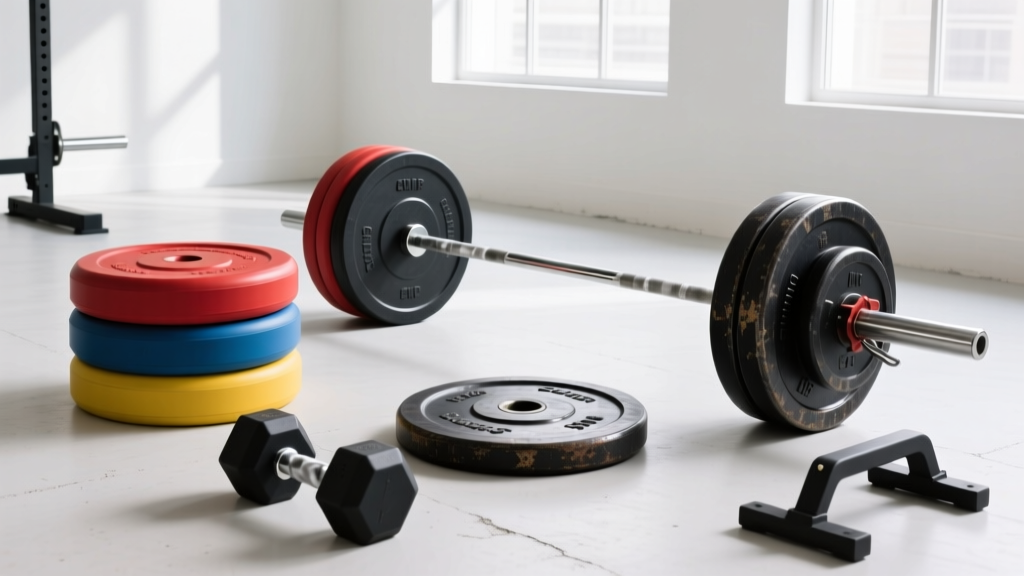
Bumper vs Iron Plates: Budgeting for Deadlifts & Dumbbell Pull Overs
Compare bumper vs iron plates for your home gym. We break down cost-per-pound, drop tolerance, and bench clearance for dumbbell pull overs.

The Core Dilemma: Cast Iron vs. Rubber Bumper Plates
Building a comprehensive free-weight setup in 2026 requires navigating a labyrinth of material choices, shipping surcharges, and space constraints. At the heart of this financial and logistical puzzle is the debate between cast iron plates and rubber bumper plates. While novice lifters often default to whichever option is cheapest, seasoned home-gym owners understand that the true value of a weight plate is dictated by its application, durability, and geometric footprint.
According to equipment analysts at BarBend, the divergence in manufacturing processes means you are paying for entirely different physical properties. Cast iron offers dense, compact weight, while bumpers provide drop-tolerance and acoustic dampening. But how do these differences impact your wallet and your training mechanics—especially for nuanced movements like dumbbell pull overs? Let us break down the budget, the biomechanics, and the hidden costs.
Cost-Per-Pound Analysis: Where Does Your Money Go?
When budgeting for a 300lb to 500lb plate set, the cost-per-pound (CPP) metric is your most vital tool. Pricing has stabilized in 2026 following the supply-chain anomalies of the early 2020s, but distinct tiers remain.
| Plate Type | Material / Composition | Average CPP (2026) | 300lb Set Estimate | Best Use Case |
|---|---|---|---|---|
| Standard Cast Iron | Grey Iron / Machined | $1.50 - $1.80 | $450 - $540 | Powerlifting, Bodybuilding, Compact Racks |
| Economy Bumper | Recycled Rubber / Crumb | $2.20 - $2.80 | $660 - $840 | Garage Gyms, Light Olympic Drops |
| Virgin Rubber Bumper | High-Density Virgin Rubber | $3.00 - $4.00 | $900 - $1,200 | CrossFit, Heavy Cleans, Commercial Use |
| Competition Urethane | Precision Urethane | $6.00 - $9.00+ | $1,800 - $2,700+ | Sanctioned Meets, Elite Facilities |
Exercise-Specific Value: Geometry and the Dumbbell Pull Over
Most buying guides focus exclusively on deadlifts and barbell drops when comparing bumpers to iron. However, plate geometry drastically affects isolation and accessory movements. A prime example is the dumbbell pull overs, a staple for latissimus dorsi and serratus anterior development.
The "Floor Clearance" Factor for Pull-Overs
According to exercise biomechanics guidelines from ACE Fitness, the efficacy of the pull-over relies on maximizing the eccentric stretch at the bottom of the movement. Many lifters use 20-inch Olympic loadable dumbbell handles to perform heavy dumbbell pull overs, either lying across a flat bench or directly on the floor.
Here is where the bumper vs. iron debate becomes highly technical:
- Cast Iron 10lb Plates: Typically measure around 1.2 to 1.5 inches in thickness. When loaded on a dumbbell handle and lowered to the floor or bench, the iron plate allows the handle to drop deeply, facilitating a maximum lat stretch.
- 10lb Bumper Plates: To maintain the standard 17.7-inch (450mm) IWF diameter, 10lb bumpers must be incredibly thick—often 2.2 to 2.8 inches. When performing dumbbell pull overs on the floor, the thick rubber edge will strike the ground up to 1.5 inches earlier than an iron plate, artificially shortening your range of motion and robbing you of the deep eccentric stretch.
Information Gain: If your programming heavily features floor-based or bench-based pull-overs using loadable handles, cast iron plates or specialized steel change plates offer vastly superior biomechanical value, ensuring your budget translates directly to muscular tension rather than wasted rubber thickness.
2026 Home Gym Budget Frameworks
To maximize your equipment budget, avoid the trap of buying a monolithic set of a single plate type. Instead, use a hybrid allocation strategy based on your specific training modalities.
Framework 1: The Power-Builder (70% Iron / 30% Bumper)
Budget Allocation: $600
The Strategy: Purchase 200lbs of cast iron plates (45s and 25s) for your heavy squats, bench presses, and dumbbell pull overs where compact size is mandatory. Supplement with two 15lb or 10lb virgin rubber bumpers for occasional barbell complexes or drop-sets where noise dampening is required.
Framework 2: The Functional Athlete (20% Iron / 80% Bumper)
Budget Allocation: $950
The Strategy: Invest in a full set of high-durometer (75+ Shore A) virgin rubber bumpers for Olympic lifts, snatches, and clean-and-jerks. Keep a pair of 5lb and 10lb cast iron fractional plates for micro-loading your bench press and ensuring clearance for floor-based accessory work.
Hidden Costs: Maintenance, Storage, and Flooring
The sticker price is only the first layer of your budget breakdown. Evaluating long-term value requires factoring in environmental and maintenance costs.
- Acoustic and Flooring Preservation: Dropping cast iron plates will eventually crack standard concrete garage floors and destroy cheap interlocking foam tiles. If you buy iron, you must budget an additional $300-$500 for 3/4-inch vulcanized rubber horse stall mats. Bumper plates, conversely, act as their own shock absorbers, potentially saving your subfloor.
- Oxidation and Rust: Raw or painted cast iron requires periodic maintenance. In humid environments, iron plates can oxidize, leaving rust residue on your hands and barbells. Bumper plates are impervious to moisture but are susceptible to UV degradation if stored in direct sunlight, leading to dry-rot and crumbling.
- The "Dead Bounce" Hazard: Cheap crumb-rubber bumpers have a high bounce rate, which can cause the barbell to rebound dangerously into the shins during deadlifts. High-quality iron plates or competition urethane bumpers exhibit "dead bounce," a crucial safety feature that justifies a higher initial investment.
"A smart home gym budget isn't just about the cost per pound; it's about the cost per training cycle. Equipment that limits your range of motion or damages your floor ends up costing twice as much in the long run." — FitGearPulse Editorial Team
Frequently Asked Questions (FAQ)
Can I mix bumper plates and iron plates on the same barbell?
Yes, but with strict caveats. You should never place a smaller-diameter iron plate on the outside of a bumper plate, as this concentrates all the drop force onto the iron plate, which can snap or chip. Always load the bumper plates on the inside, closest to the barbell collar, and use iron plates as outer change plates.
Are urethane plates worth the premium over rubber bumpers?
For 90% of home gym owners, no. Urethane is vastly more durable, odorless, and resistant to UV damage, but it commands a CPP of $6.00 or more. Virgin rubber bumpers (around $3.50 CPP) offer the best middle-ground value for intense daily training without the commercial-grade tax.
Why do 10lb bumper plates bend on the barbell?
This is a common failure mode known as the "taco effect." Because 10lb bumpers are thin in the center hub but thick at the edges, dropping a barbell loaded only with 10lb bumpers concentrates immense shear force on the rubber, causing it to warp or tear. Always pair 10lb bumpers with heavier 45lb bumpers or iron plates to distribute the impact force across a wider surface area.
More gear to consider
All reviews
Bumper vs Iron Plates: Care & Tricep Workouts with Dumbbells at Home

Are Iron Grip Dumbbells in KG or LBS? Adjustable Set Troubleshooting
Weighted Dumbbell Squats Setup: Collar & Clamp Comparison

Half Kneeling Single Arm Dumbbell Press: Urethane vs Rubber Hex Trends
Bumper vs Iron Plates for the Dumbbell Deadlift for Lower Back
