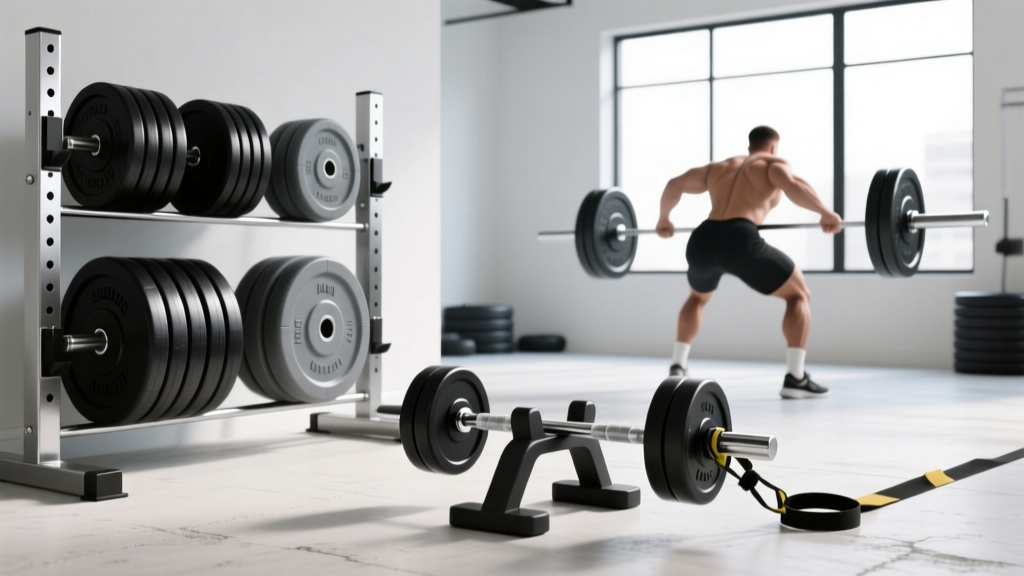
Bumper Plate vs Iron Plate: Space & Dumbbell RDL vs Barbell RDL
Optimize your gym layout. We compare bumper vs iron plates, storage footprints, and how they impact the dumbbell RDL vs barbell RDL.

The Volumetric Reality: Thickness, Sleeves, and Storage Footprints
Designing a high-performance home or garage gym in 2026 requires ruthless spatial efficiency. Every square inch of your lifting platform and storage zone must be justified. When evaluating the foundational hinge pattern—specifically the spatial and equipment trade-offs of the dumbbell RDL vs barbell RDL—your choice between bumper plates and cast iron plates dictates everything from your flooring layout to your weight storage footprint.
The most immediate difference between bumpers and iron is volumetric density. A standard 45lb Rogue Echo Bumper Plate is approximately 3.25 inches thick with a strict 450mm (17.7-inch) diameter. In contrast, a 45lb machined cast iron plate is roughly 1.3 inches thick, with a diameter that often hovers around 14.5 inches depending on the manufacturer. This 2.5x difference in thickness fundamentally alters how you layout your equipment storage.
Barbell Sleeve Capacity and Storage Racks
Because bumpers are exceptionally thick, a standard Olympic barbell sleeve (which typically offers 16.3 inches of loadable space) can only accommodate about 405 lbs of bumper plates before you run out of room for a spring collar. Iron plates, however, allow you to load upwards of 540 lbs on the same sleeve.
From a layout perspective, storing bumpers requires wider, specialized infrastructure. A standard 10-peg weight tree (with a base footprint of roughly 20x20 inches) can easily hold 500 lbs of iron plates. However, loading 500 lbs of bumpers onto a standard tree causes dangerous overhang and imbalance. Bumpers mandate wider A-Frame racks or vertical plate caddies (like the Rogue A-Frame, which demands a 30.5x30.5 inch floor footprint), consuming nearly 2.5 times more floor space than a traditional iron weight tree.
Drop Zones, Flooring, and Acoustic Layouts
Your plate choice directly dictates your flooring layout and acoustic dampening requirements. Bumper plates are engineered to be dropped. This allows you to utilize a simpler, lower-profile flooring setup—such as 3/4-inch vulcanized horse stall mats laid directly over sealed concrete. The footprint of your 'drop zone' can be tightly constrained to a 6x8 foot area immediately surrounding the barbell.
Cast iron plates, conversely, are unforgiving. Dropping iron plates on standard mats will eventually crack the concrete subfloor beneath due to the concentrated kinetic energy transfer. If you commit to an iron plate layout, you must either enforce strict, controlled eccentrics (no dropping) or invest in a raised, multi-layered platform featuring a crumb-rubber center and plywood border to disperse shock. This raised platform permanently claims a massive 8x8 or 8x10 foot footprint in your gym, severely limiting space optimization in smaller rooms.
Layout Warning: Never store bumper plates flat on their sides on the floor for extended periods. The continuous compression on the rubber matrix can cause permanent deformation and hub separation. Always utilize vertical gravity-based storage racks to maintain the structural integrity of your bumpers.The Hinge Equation: Dumbbell RDL vs Barbell RDL Spatial Needs
How does plate choice intersect with the biomechanics and spatial requirements of the dumbbell RDL vs barbell RDL debate? According to biomechanical analyses from Stronger By Science, the Romanian Deadlift requires a precise starting height to ensure optimal hamstring and glute engagement without forcing the lifter into excessive lumbar flexion.
The Barbell RDL Layout
When performing the barbell RDL, standard 450mm bumper plates place the barbell exactly 8.8 inches off the floor—the perfect mid-shin starting position for most lifters. If you use smaller-diameter cast iron plates (e.g., 25lb or 35lb plates that sit only 5 inches off the ground), you are forced to introduce block pulls or stack extra mats to elevate the bar. This introduces 'equipment clutter' to your layout, requiring you to store and move lifting blocks or heavy mat stacks between exercises.
Furthermore, the barbell RDL requires a 7-foot barbell clearance (approx. 86 inches wide) plus lateral swing radius for your arms and the bar's whip. This mandates a central, unobstructed layout in your gym.
The Dumbbell RDL Layout
The dumbbell RDL entirely eliminates the 7-foot barbell swing radius, allowing you to perform heavy hinge movements in tight corners or directly in front of a power rack. As noted in T-Nation's comprehensive hinge guides, dumbbells also allow for a more natural arm path and greater unilateral range of motion. However, the spatial tax is paid in the storage zone. Stocking heavy dumbbells (e.g., pairs ranging from 50 to 100 lbs) requires a massive 3-tier horizontal dumbbell rack. A rack of this size consumes a 44x28 inch footprint and costs significantly more per pound than barbell plates, making it a premium investment for space-constrained gyms.
2026 Cost, Dimension, and Layout Matrix
To help you finalize your gym's spatial blueprint, review the comparative data below based on current 2026 market averages for premium commercial-grade equipment.
| Metric | Standard Bumper Plates | Machined Iron Plates | Heavy Hex Dumbbells |
|---|---|---|---|
| Cost per Pound | $2.00 - $2.50 | $1.40 - $1.80 | $2.20 - $3.00 |
| 45lb Thickness | ~3.25 inches | ~1.30 inches | N/A (Variable) |
| Storage Footprint | Large (A-Frame / Wide Tree) | Compact (Standard 10-Peg Tree) | Massive (3-Tier Horizontal Rack) |
| Floor Protection | Standard 3/4" Mats | Raised Platform / No Drops | Standard 3/4" Mats |
| RDL Start Height | Perfect (8.8") | Requires Blocks (if <45lb) | Variable / Requires Blocks |
Failure Modes and Edge Cases in Plate Storage
When optimizing your layout, you must also account for the environmental failure modes of your chosen media. Space optimization is useless if your equipment degrades due to improper storage conditions.
- Bumper Hub Separation: In unclimate-controlled garages where temperatures swing drastically between summer and winter, the metal center hub of a bumper plate can expand and contract at a different rate than the surrounding rubber matrix. Over time, this leads to 'hub pop-out' during drops. To mitigate this, store bumpers indoors or in temperature-stabilized zones.
- Iron Oxidation and Spalling: Cast iron plates are highly susceptible to oxidation. If your gym layout places the weight tree near a garage door or an uninsulated exterior wall, ambient humidity will cause rapid rusting. This rust transfers to your barbell sleeves and floors. Iron plates require periodic maintenance with 3-in-One oil and should be kept on coated, scratch-resistant rack pegs.
- Dumbbell Rack Sagging: If you opt for the dumbbell RDL route and purchase a budget-tier 3-tier rack, the sheer static load of 100lb hex dumbbells will cause the lower steel crossbeams to bow over time. Always verify the rack's steel gauge (11-gauge or thicker is mandatory for heavy dumbbells) before allocating floor space to it.
The Final Layout Blueprint
Ultimately, the choice between bumpers and iron—and the parallel decision between the barbell RDL and dumbbell RDL—comes down to your available square footage and your tolerance for equipment maintenance. If you have a spacious 2-car garage and prioritize Olympic lifts alongside heavy barbell RDLs, bumper plates are mandatory, paired with a wide A-frame storage rack and standard mat flooring.
If you are building a dense, space-optimized apartment gym or basement setup where noise and spatial footprint are the primary constraints, machined iron plates paired with a compact weight tree and a strict 'no-drop' policy will save you massive amounts of volumetric space. Alternatively, if your layout lacks the 8-foot width required for barbell hinging, pivoting entirely to the dumbbell RDL allows you to tuck your lifting zone into a corner, provided you have the budget and floor space to accommodate a heavy-duty, 3-tier dumbbell rack.
More gear to consider
All reviews
Cast Iron vs Competition Kettlebells: Dumbbell Holds & Grip Guide

Smisko Dumbbell Trend & Cast Iron vs Competition Kettlebells (2026)

Barbell Collar & Clamp Types for Rows and Dumbbell Lifts for Back

Neoprene Dumbbells: Mnemonic Cholinergic Benefits & Home Guide

2026 Rack Trends: Storage and One-Arm Dumbbell Row Muscles Worked
