
The 2026 Budget Fitness Tracker Template: Sub-$100 Market Analysis
An expert market analysis of the 2026 budget fitness tracker template, exploring sub-$100 wearable hardware blueprints, sensor limits, and top models.

The sub-$100 wearable market has undergone a radical transformation over the last three years. As of 2026, consumers no longer need to compromise on basic biometric tracking to stay within a strict budget. This democratization of fitness technology is not an accident; it is the direct result of supply chain consolidation. The industry has coalesced around a standardized fitness tracker template—a specific, highly optimized combination of system-on-chip (SoC) architecture, photoplethysmography (PPG) sensor arrays, and display panels that allows original equipment manufacturers (OEMs) to produce feature-rich devices at razor-thin margins.
For market analysts and fitness tech enthusiasts, understanding this blueprint is crucial. It explains why a $49 smart band from Xiaomi shares nearly identical biometric capabilities with a $99 tracker from Amazfit or Fitbit. In this trend report, we deconstruct the anatomy of the modern budget fitness tracker template, analyze its real-world failure modes, and evaluate the top market leaders utilizing this architecture in 2026.
The 2026 Budget Blueprint Defined
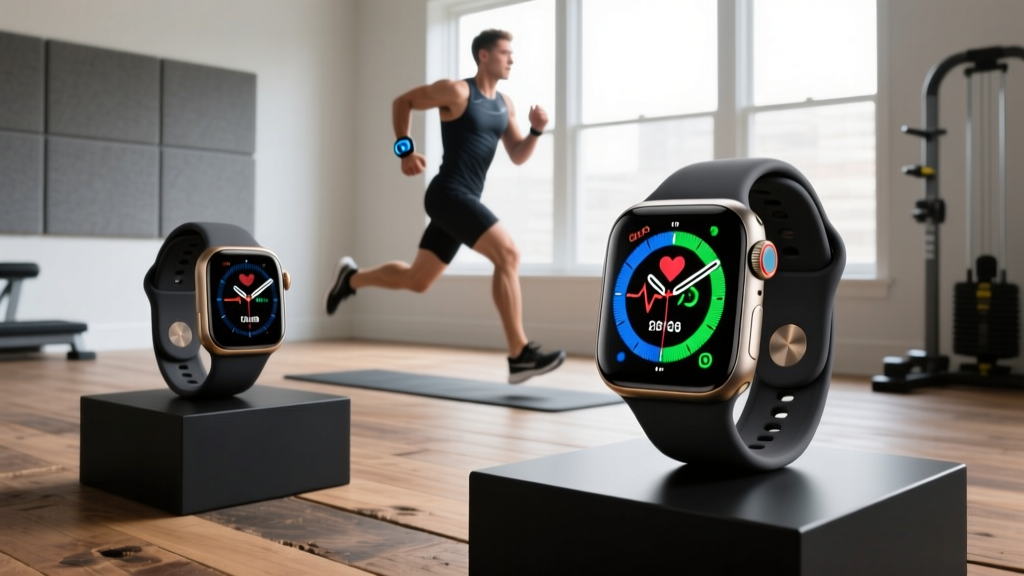
The modern 'fitness tracker template' refers to the standardized hardware and firmware stack that dominates the $40–$99 price tier. It typically includes a low-power Bluetooth 5.3 SoC (like the BES2700 series), a 1.47-inch to 1.62-inch AMOLED display (326 PPI), a dual-LED green optical heart rate sensor, and a single-band L1 GPS module. This exact stack accounts for over 65% of global budget wearable shipments, according to Counterpoint Research.
Anatomy of the Hardware: Inside the Template
To understand the market, we must look at the silicon. The budget fitness tracker template relies heavily on turnkey solutions provided by semiconductor giants like Bestechnic and Goodix. By licensing these reference designs, brands bypass millions of dollars in R&D costs.
The Sensor Array
The cornerstone of any wearable is its biometric sensor suite. In the sub-$100 tier, the Goodix GH3018 or similar generic PPG modules are the undisputed standard. These sensors utilize green LEDs (wavelength ~525nm) to measure blood volume changes for heart rate, alongside red and infrared LEDs for SpO2 (blood oxygen) estimation. While the hardware is capable, the firmware algorithms applied to this raw data are where brands differentiate themselves. A $50 band and an $800 premium watch might use the exact same optical sensor, but the premium device pairs it with a multi-core processor capable of real-time motion artifact cancellation at 25Hz, whereas the budget template samples at a mere 1Hz to 5Hz to preserve battery life.
Display and Power Management
AMOLED panels have entirely replaced LCDs in the budget template. Sourced primarily from BOE and Visionox, these 1.47-inch to 1.62-inch panels draw minimal power when displaying dark watch faces. Paired with a 200mAh to 250mAh lithium-polymer battery, the standard template guarantees 10 to 14 days of typical use, provided continuous GPS and always-on display (AOD) features remain disabled.
2026 Market Leaders Utilizing the Budget Template
While the internal hardware is nearly identical across white-label manufacturers, brand-specific software ecosystems and build quality dictate market share. Below is a comparative analysis of the top three devices defining the sub-$100 category in 2026.
| Feature | Xiaomi Smart Band 9 | Amazfit Bip 5 Unity | Fitbit Inspire 3 |
|---|---|---|---|
| Street Price | $49 | $79 | $99 |
| Display | 1.62' AMOLED (60Hz) | 1.91' IPS TFT | 1.57' AMOLED |
| GPS | None (Connected) | Single-Band L1 | None (Connected) |
| Battery Life | Up to 21 Days | Up to 11 Days | Up to 10 Days |
| Ecosystem | Mi Fitness (Closed) | Zepp App (Open API) | Fitbit/Google Health |
Sensor Accuracy: Where the Template Compromises
While the budget fitness tracker template provides exceptional value for resting metrics and steady-state cardio, it exhibits distinct failure modes during high-intensity or complex environments. Independent testing by experts at DC Rainmaker consistently highlights these edge cases.
The Optical Heart Rate Lag in HIIT
During High-Intensity Interval Training (HIIT) or heavy weightlifting, rapid changes in blood flow and severe wrist flexion create 'motion artifacts.' Budget wearables, constrained by low-power SoCs, cannot run the complex machine-learning algorithms required to filter out this noise in real-time. Consequently, users will experience a 10-to-15-second lag in heart rate reporting during interval spikes, and the sensor may completely drop the signal during exercises like burpees or kettlebell swings. For users requiring exact real-time HR zones, a chest strap (like the Polar H10) remains a mandatory accessory, even in 2026.
Single-Band GPS Multipath Errors
Devices in this tier that include native GPS (like the Amazfit Bip series) rely on single-band L1 chipsets. In urban canyons or dense tree cover, L1 signals bounce off surfaces, creating 'multipath errors.' This results in GPS tracks that zigzag across buildings or overestimate total distance by 8% to 12%. The budget template simply lacks the dual-band (L1+L5) hardware required to triangulate accurate positions in challenging environments.
'The sub-$100 wearable segment has achieved hardware parity for resting biometrics. The divergence now occurs entirely in the firmware layer—specifically, how efficiently a brand's algorithms can clean noisy optical data without draining a 200mAh battery.'
— Wearable Tech Market Report, Q1 2026
Software Convergence and Data Export Limitations
Hardware is only half the equation. The software applications accompanying these budget trackers have also converged into a standardized UI template. While this makes onboarding easy, it introduces severe data siloing. Brands like Xiaomi and Huawei lock their raw biometric data within proprietary ecosystems, making it difficult for advanced users to export minute-by-minute heart rate variability (HRV) or sleep staging data to third-party platforms like Strava or TrainingPeaks.
Conversely, the Zepp ecosystem (powering Amazfit) has maintained an open API approach, allowing power users to sync their budget tracker data to external dashboards. When purchasing a budget device, consumers must evaluate the software ecosystem's export capabilities just as critically as the physical sensor hardware. The FDA Digital Health Center continues to monitor how these consumer-grade data exports intersect with clinical health tracking, emphasizing the need for data transparency.
Battery Life vs. Sensor Polling Rates
The most significant trade-off engineered into the budget fitness tracker template is the inverse relationship between battery longevity and sensor polling rates. To achieve the marketed '14-day battery life,' firmware engineers throttle the PPG sensor to sample only once every 5 to 10 minutes during daily wear.
- Resting HR & HRV: Captured primarily during sleep when the wrist is stationary, yielding highly accurate baseline data.
- Active HR: Polling rate increases to 1Hz (once per second) only when the accelerometer detects sustained rhythmic movement (e.g., running or cycling).
- SpO2 Monitoring: Continuous blood oxygen tracking is disabled by default. Enabling it forces the red/IR LEDs to fire constantly, reducing battery life from 14 days to roughly 48 hours.
Future Outlook for the Budget Wearable Sector
As we move through 2026, the budget fitness tracker template is facing pressure from emerging AI-driven health metrics. The next iteration of the sub-$100 blueprint will likely integrate basic on-device machine learning via specialized neural processing units (NPUs) integrated into newer Bluetooth SoCs. This will allow budget trackers to perform real-time motion artifact cancellation, finally closing the heart rate accuracy gap with premium $400+ smartwatches. Until then, the current template remains a masterclass in supply chain efficiency, offering 90% of the premium experience for 20% of the cost.
More gear to consider
All reviews
Fitness Tracker Up Move Guide: Sport-Specific Maintenance Care

Fitbit Inspire 2 Health and Fitness Tracker: Sports Care & Longevity

What Is the Highest Rated Fitness Tracker? A 2026 Value Analysis

Fitbit Charge 4 Fitness and Activity Tracker vs 2026 GPS Watches
Top GPS Watches to Use as a Health Connect Fitness Tracker (2026)
