
Best Back Massager Gun for Home Gym Recovery 2026
Compare top percussive devices for back training recovery. We test stall force, reach, and amplitude to find the best back massager gun for your home gym.

The Biomechanical 'Reach' Problem in Back Training
When outfitting a home gym with back training equipment, most lifters focus entirely on the concentric phase: the lat pulldown machines, T-bar row stations, and pull-up rigs. However, the eccentric loading and micro-tearing of the latissimus dorsi, rhomboids, and erector spinae during heavy rows demand a dedicated recovery strategy. This is where a high-quality back massager gun becomes an essential piece of back training equipment for home gym ecosystems. Yet, the back presents a unique biomechanical challenge: the 'reach' problem.
Standard percussive therapy devices with straight, cylindrical handles force the user into extreme internal shoulder rotation and scapular protraction just to reach the contralateral lower lat. This not only causes rapid grip and rotator cuff fatigue but also severely limits the downward pressure required to achieve a therapeutic stall force on dense fascial tissue. According to research published in the National Library of Medicine, percussive therapy significantly improves muscle oxygenation and reduces delayed onset muscle soreness (DOMS), but only if the device can maintain consistent tissue contact without stalling out under pressure.
Home Gym Reality Check: If you are performing heavy seated cable rows or chest-supported T-bar rows, your thoracolumbar fascia will tighten significantly. A massage gun with less than 40 lbs of stall force will simply bounce off the erector spinae, providing superficial vibration rather than deep neuromuscular release.Head-to-Head Comparison Matrix (2026 Models)
To determine the most effective back massager gun for home gym recovery, we tested the three leading percussive devices, evaluating their stall force, amplitude, ergonomic grip configurations, and specialized attachment compatibility.
| Feature | Theragun PRO (5th Gen) | Hyperice Hypervolt 2 Pro | Bob and Brad X6 Pro |
|---|---|---|---|
| Stall Force | 60 lbs (Industry Leading) | 40 lbs | 40 lbs |
| Amplitude | 16 mm (Deep Tissue) | 14 mm (Moderate) | 12 mm (Superficial) |
| Grip Ergonomics | Patented Triangle Handle (4 grips) | Straight Handle (Requires Flex Head) | Extended Ergonomic Handle |
| Back-Specific Feature | Oscillating screen, multi-grip reach | Flex Head accessory ($49 extra) | Integrated Graphene Heat Pad |
| 2026 Retail Price | $599 | $449 (+ $49 accessory) | $169 |
Deep Dive: Performance on Latissimus Dorsi and Erector Spinae
Theragun PRO (5th Gen): The Triangle Grip Advantage
The Theragun PRO remains the gold standard for back recovery primarily due to its patented triangular handle. When attempting to treat the lower latissimus dorsi (near the iliac crest attachment) or the mid-trapezius, the triangle grip allows the user to switch between a power grip and a pinch grip without altering their shoulder mechanics. This ergonomic versatility reduces rotator cuff strain during the 2-to-3-minute treatment windows required for large muscle groups. Furthermore, its 60 lbs of stall force and 16mm amplitude ensure that the device will not stall out when pressing deeply into the thick, fibrous tissue of the thoracolumbar fascia after heavy deadlifts or T-bar rows.
Hyperice Hypervolt 2 Pro: Power Meets the Flex Head
Out of the box, the Hypervolt 2 Pro's straight handle makes it a suboptimal back massager gun. Reaching the rhomboids requires awkward wrist contortion. However, when paired with the Hyperice Flex Head attachment—a flexible, bendable neck that allows the percussion head to articulate around the scapula—it becomes a formidable tool. The 14mm amplitude is slightly less aggressive than the Theragun, making it preferable for lifters who are highly sensitive to deep percussive impact or those recovering from minor erector strains where 16mm might trigger a protective muscle guarding reflex.
Bob and Brad X6 Pro: The Budget Ergonomic Contender
For home gym owners on a strict budget, the Bob and Brad X6 Pro offers a compelling alternative. While its 12mm amplitude limits its ability to penetrate deep fascial adhesions in elite-level powerlifters, it compensates with an integrated graphene heating pad on the handle. Applying localized heat to the palm and wrist while treating the back increases local blood flow and promotes parasympathetic nervous system relaxation. The extended handle design provides an extra three inches of reach, making it significantly easier to target the lower traps without requiring a mobility partner.
"Vibration and percussive therapies have been shown to mitigate the effects of DOMS by altering the pain threshold and increasing local arterial blood flow, but the mechanical force must exceed the tissue's viscoelastic resistance to create lasting fascial deformation." — Journal of Sports Science & Medicine
Stall Force vs. Amplitude: What Actually Breaks Up Adhesions?
A common failure mode in home gym recovery routines is using a device with high amplitude but low stall force. When you press a low-stall-force gun into a dense muscle like the erector spinae, the motor stops. This turns a percussive tool into a static, vibrating lump. For back training equipment, where the muscles are broad, thick, and covered by multiple layers of fascia, stall force is the critical metric. You must be able to apply 30 to 45 pounds of manual pressure to effectively separate cross-linked collagen fibers in the lats without the device timing out or stalling.
Actionable Post-Row Back Recovery Protocol
Do not simply press the gun randomly against your back. Follow this targeted protocol immediately after heavy horizontal or vertical pulling sessions to maximize recovery and maintain shoulder health.
- Thoracolumbar Sweep (90 Seconds per side): Attach the Dampener or Large Ball head. Start at the posterior superior iliac spine (PSIS) and slowly sweep upward along the erector spinae, stopping at the T12 vertebrae. Apply moderate pressure (approx. 15 lbs). Do not percussion directly on the spine.
- Latissimus Dorsi Pinpoint (120 Seconds per side): Switch to the Cone attachment. Target the posterior axillary fold (where the lat ties into the armpit). Use short, 15-second holds on localized trigger points. Breathe deeply to allow the ribcage to expand and contract against the percussion.
- Rhomboid & Mid-Trap Release (60 Seconds per side): Use the Standard Ball. Reach across the body to the medial border of the scapula. Retract the shoulder blade slightly to expose the rhomboids, then apply the device. Avoid direct contact with the scapular bone.
Frequently Asked Questions (FAQ)
Can I use a back massager gun directly on my spine?
No. Never apply percussive therapy directly to the spinous processes of the vertebrae, the cervical spine (neck), or the scapular bones. The rapid percussive force can cause micro-fractures or severe periosteal bruising. Always target the muscle bellies and fascial sheaths adjacent to the bone.
Is a massage gun enough for back recovery, or do I need a foam roller?
They serve different purposes. A foam roller provides broad, global myofascial release and is excellent for general thoracic extension mobilization. A back massager gun provides localized, deep-tissue neuromuscular release. For optimal home gym recovery, use a foam roller for 3 minutes to warm the tissue, followed by the massage gun for targeted trigger point therapy.
Why does my shoulder hurt when using a massage gun on my back?
This is typically caused by the 'reach' problem mentioned earlier. Using a straight-handled device forces the shoulder into extreme internal rotation and elevation, impinging the supraspinatus tendon. Switching to a device with an ergonomic triangle grip or an articulating flex head will immediately relieve this secondary joint stress.
More gear to consider
All reviews
How to Use a Lat Pulldown Machine vs. Mounted Pull-Up Bars

How To Repair Percussion Instruments: A Technician’s Field Manual
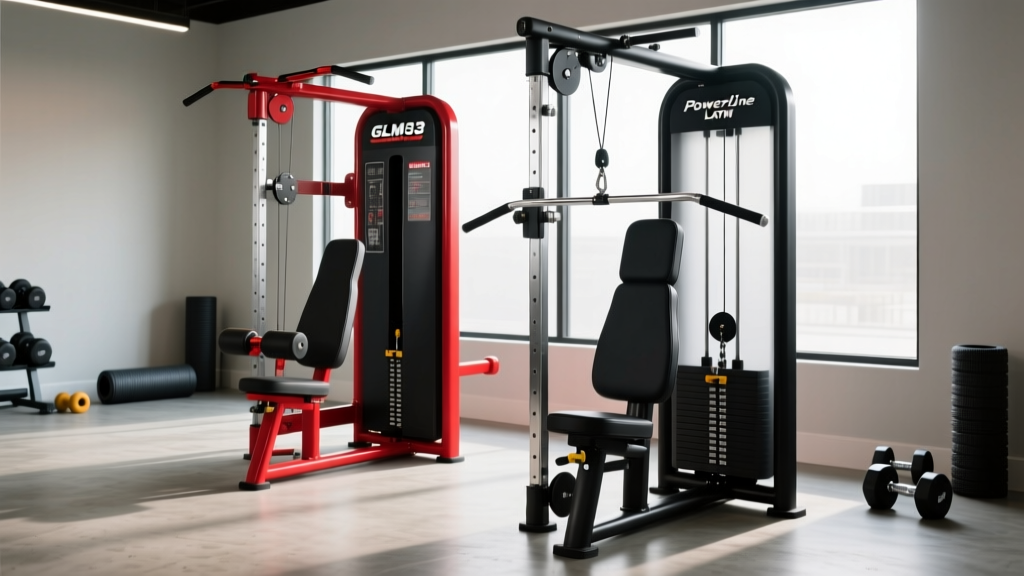
Body-Solid Lat Pulldown Machine Showdown: GLM83 vs LATM

Chest Supported Row & Lat Pulldown Machine PF Space Guide

Cybex Lat Pulldown Machine vs Rogue: Home Gym Showdown
