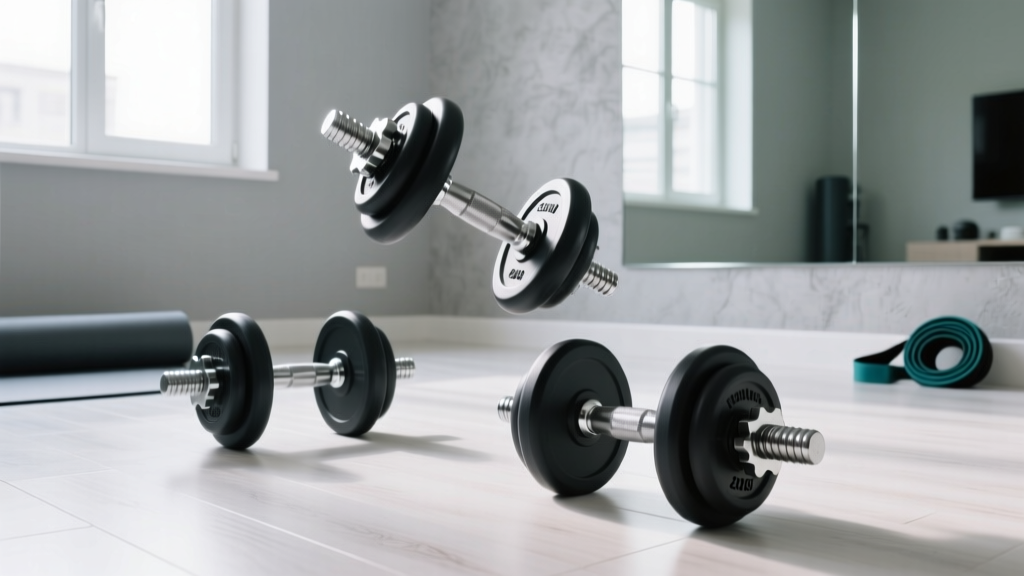
Best Adjustable Dumbbells for the Dumbbell Romanian Deadlift (2026)
Master the dumbbell Romanian deadlift with our step-by-step form guide and 2026 adjustable dumbbell comparison for home gyms.

The Biomechanics of the Dumbbell Romanian Deadlift
The dumbbell Romanian deadlift (RDL) is widely considered the king of posterior chain development. Unlike the conventional deadlift, which starts from a dead stop on the floor and incorporates significant quadriceps drive, the RDL begins from a standing position and relies almost entirely on the hip hinge. This places continuous, agonizing tension on the hamstrings and glutes through a deep stretch.
According to biomechanical analyses published in the National Library of Medicine, the RDL elicits significantly higher electromyographic (EMG) activation in the hamstrings compared to leg curls or good mornings. However, executing this movement correctly requires precise spatial awareness and the right equipment. For home gym owners in 2026, adjustable dumbbells are the most space-efficient solution, but not all adjustable models are created equal when it comes to the unique clearance and grip demands of the RDL.
Step-by-Step: Mastering the Hinge (Beginner Guide)
Before investing in gear, you must master the movement pattern. The American Council on Exercise (ACE) emphasizes that the RDL is a hip-dominant movement, not a squat. Follow this step-by-step protocol to build a bulletproof hinge:
- The Stance: Stand with your feet hip-width apart (not shoulder-width). This narrower stance is critical when using dumbbells to prevent the weights from colliding with your thighs during the descent.
- The Grip: Hold the dumbbells in front of your thighs with a neutral grip (palms facing your body) or a pronated grip (palms facing down). Neutral is generally easier on the wrists and shoulders.
- The Unlock: Slightly bend your knees (about 10-15 degrees). Lock this knee angle in place; it should not change during the set.
- The Hinge: Push your hips straight back toward the wall behind you. Imagine trying to close a car door with your glutes. Your torso will naturally tilt forward as your hips move back.
- The Descent: Keep the dumbbells hovering roughly one inch off your thighs and shins. As the National Strength and Conditioning Association (NSCA) advises, the bar path must remain perfectly vertical over your mid-foot.
- The Depth: Lower the weights until you feel a profound stretch in your hamstrings, typically just below the knee or at mid-shin. Do not round your lower back to go deeper.
- The Ascent: Drive your hips forward to return to the starting position, squeezing your glutes hard at the top. Do not hyperextend your lumbar spine.
⚠️ Common Beginner Failure Mode: The Squat-Hinge Hybrid
Beginners often bend their knees excessively, turning the RDL into a squat. This shifts the load from the hamstrings to the quads and lower back. The Fix: Record yourself from the side. If your hips move down instead of back, you are squatting. Focus exclusively on horizontal hip displacement.
Why Adjustable Dumbbells Change the RDL Game
Fixed hex dumbbells are excellent, but stocking a home gym with pairs ranging from 20 lbs to 80 lbs requires over $1,500 and a massive 6-foot rack. Adjustable dumbbells solve this, but the RDL introduces specific mechanical challenges:
- Overall Length: If a dumbbell is too long (over 14 inches), the ends will strike your thighs during the hinge, forcing you to alter your bar path or widen your stance unnaturally.
- Handle Clearance: Thick, caged handles can cause forearm fatigue before your hamstrings reach failure.
- Durability Under Fatigue: At the end of a grueling set of RDLs, beginners often drop the weights from the top position. Many adjustable dumbbells feature delicate dial mechanisms or plastic end-caps that shatter upon impact.
2026 Adjustable Dumbbell Comparison Matrix
Below is a data-driven comparison of the top adjustable dumbbells on the market, evaluated specifically for their suitability for the Romanian deadlift.
| Model | 2026 Price (Pair) | Overall Length | RDL Suitability | Drop Durability |
|---|---|---|---|---|
| Nuobell 80lb | $449 | 12.5 inches | Excellent (Compact) | Poor (Plastic caps) |
| PowerBlock Elite EXP | $399 (Base) | 12.0 inches | Good (Cage limits grip) | Excellent (Welded steel) |
| Bowflex SelectTech 552 | $349 | 15.7 inches | Fair (Too long for hinge) | Poor (Dial mechanism) |
| Core Home Fitness 552 | $299 | 14.2 inches | Good (Budget alternative) | Fair |
Deep-Dive Reviews: Top Picks for Hip Hinges
1. Nuobell 80lb Adjustable Dumbbells: The Biomechanical Favorite
The Nuobell 80lb set has dominated the 2026 home fitness market for one primary reason: it mimics the feel of a fixed iron dumbbell. With a 5.5-inch knurled steel handle and real iron plates that slide via a twisting mechanism, the overall length maxes out at a highly compact 12.5 inches. For the RDL, this is a massive advantage. You can maintain a narrow, hip-width stance without the dumbbell ends clipping your thighs.
The Edge Case (Warning): Nuobells feature plastic end-caps and internal plastic components that manage the weight stack. If you reach muscular failure on your 10th rep of an RDL and drop the dumbbells from waist height onto a rubber mat, the plastic end-caps are highly susceptible to cracking. Rule: You must gently set Nuobells down after every single RDL set.
2. PowerBlock Elite EXP: The Indestructible Workhorse
PowerBlock's caged, rectangular design is polarizing, but from a durability standpoint, it is unmatched. The welded steel cage and urethane-coated internal blocks mean you can drop these from a height of 4 feet without catastrophic failure. The 12-inch length provides excellent floor and thigh clearance during deep hinges.
The Edge Case (Grip Interference): The cage design restricts wrist supination and pronation. While the RDL is typically performed with a neutral grip (which fits perfectly inside the PowerBlock cage), if you have large hands, the internal dimensions can feel claustrophobic. Furthermore, the thick, blocky handle taxes the grip heavily. Expect your forearms to fatigue before your hamstrings do during high-rep RDL sets (12-15 reps). Using lifting straps is highly recommended when using PowerBlocks for RDLs.
3. Bowflex SelectTech 552: The Clearance Problem
The Bowflex 552 remains a staple in millions of home gyms, largely due to its accessible $349 price point and familiar dial system. However, for the Romanian deadlift, its 15.7-inch overall length is a significant biomechanical liability. When holding 50+ lb dumbbells at arm's length, the extra 3 inches of length on each side will inevitably collide with your thighs if you attempt a proper, narrow-stance hip hinge. This forces lifters to either widen their stance (which alters glute activation) or push the dumbbells away from their center of gravity (which places dangerous shear force on the lumbar spine).
"If you already own Bowflex 552s, perform your RDLs with a slightly wider, sumo-style stance to clear the dumbbell ends, or switch to single-leg RDLs where the longer shaft length is less obstructive."
Programming Your RDLs for Hypertrophy
Having the right adjustable dumbbells is only half the battle. To maximize hamstring hypertrophy, you must program the RDL correctly. Because the hamstrings are composed of a high percentage of fast-twitch muscle fibers, they respond best to moderate-to-heavy loads with controlled eccentrics.
The 4-Week RDL Progression Framework
- Week 1 (Acclimation): 3 sets of 8 reps. 3-second eccentric (lowering) phase. Leave 3 Reps in Reserve (RIR). Focus purely on the hip hinge and keeping the weights glued to your legs.
- Week 2 (Volume): 4 sets of 10 reps. 2-second eccentric. 2 RIR. Increase weight by 5-10 lbs per dumbbell.
- Week 3 (Intensity): 4 sets of 6-8 reps. 1 RIR. Heavy load. Use lifting straps if your grip fails before your posterior chain.
- Week 4 (Overreaching): 3 sets to technical failure. Stop the set the exact moment your lower back begins to round. Drop the weight by 20% and perform one final burnout set of 15 reps.
Frequently Asked Questions
Can I do Romanian deadlifts with one dumbbell?
Yes. The single-leg RDL (SLRDL) or the B-stance RDL are excellent unilateral variations. Using a single adjustable dumbbell in a contralateral grip (holding the weight in the opposite hand of the working leg) drastically increases core and anti-rotational demands while reducing the total load required to stimulate the hamstring. This is also a brilliant workaround if your adjustable dumbbells are too long and keep hitting your thighs during bilateral RDLs.
Should my knees touch the ground during the descent?
No. If your dumbbells are touching the floor, you have likely turned the movement into a conventional deadlift or a squat. The RDL is characterized by a continuous stretch under tension. You should only descend until your hamstring mobility reaches its limit (usually mid-shin), pause for a micro-second, and reverse the motion. Letting the weights rest on the floor eliminates the stretch reflex and reduces time-under-tension.
Are lifting straps necessary for adjustable dumbbell RDLs?
For beginners learning the hinge pattern, no. You need to build baseline grip strength. However, once you are pushing past 60 lbs per hand for sets of 10+, your grip will almost certainly become the limiting factor, especially with thick-handled adjustable models like PowerBlock or the Nuobell at higher weight increments. Using figure-8 or lasso straps allows you to train the hamstrings to true muscular failure without your forearms giving out prematurely.
More gear to consider
All reviews
Olympic vs Standard Setup & 15 Minute Upper Body Dumbbell Workout

2026 Market Shift: Loadable Dumbbells vs Curling 50 lb Dumbbells

2026 Kettlebell Market: Cast Iron vs Competition & Dumbbell Side Plank Row
Wrist Exercises With Dumbbells: Neoprene Grip Mistakes & Fixes

Care Guide: Rubber vs Urethane for Deltoid Dumbbell Exercises
