
Barbell Setup & Knurling: What Do Incline Dumbbell Curls Work?
Master your home gym setup with our Olympic barbell knurling and installation guide, plus a biomechanics breakdown of what incline dumbbell curls work.

The Foundation of Your Free Weight Zone: Olympic Barbell Selection
Building a comprehensive home gym in 2026 requires more than just throwing equipment into a spare room; it demands a strategic approach to biomechanics, equipment longevity, and spatial ergonomics. When setting up your primary lifting station, the Olympic barbell is the undisputed centerpiece. However, pairing that heavy compound equipment with the right isolation tools—like an adjustable incline bench and a curated dumbbell set—is what transforms a basic garage gym into a high-performance training facility.
Before we break down the specific muscle targets of isolation movements, we must first address the foundation: selecting, inspecting, and installing your Olympic barbell. Understanding barbell weight tolerances and knurling patterns is critical for both safety and performance.
Weight Standards and Tensile Strength
Not all 20kg bars are created equal. The International Weightlifting Federation (IWF) mandates strict tolerances for competition bars, but commercial and home gym bars vary wildly. When reviewing specs on sites like Rogue Fitness, you will see tensile strength measured in PSI (pounds per square inch).
- 165,000 PSI or lower: Budget bars. These will permanently bend (yield) if you regularly drop them loaded with 300+ lbs.
- 190,000 PSI: The sweet spot for multi-purpose bars (e.g., Rogue Ohio Bar, REP Fitness Excalibur). They offer enough whip for Olympic lifts but enough stiffness for heavy squats.
- 215,000+ PSI: Ultra-stiff powerlifting bars (e.g., Texas Power Bar). Zero whip, aggressive knurl, designed exclusively for the big three lifts.
Decoding the Knurl: Volcano, Mountain, and Flat
The knurl is the machined pattern on the bar shaft that provides grip. The geometry of this pattern dictates how the bar feels in your hands and how much it tears your calluses.
| Knurl Type | Geometry Profile | Best For | Real-World Feel |
|---|---|---|---|
| Volcano | Pointed peaks with a crater in the center. | Multi-purpose, Powerlifting | Grippy without shredding skin. The rim of the 'volcano' provides the friction. |
| Mountain | Sharp, continuous pointed peaks. | Heavy Deadlifts, Competition | Extremely aggressive. Will tear calluses if hands are not properly maintained. |
| Flat / Hill | Rounded, shallow valleys. | Budget Bars, High-Rep WODs | Slippery when chalked heavily. Avoid for heavy pulling movements. |
Pay attention to the hash marks. IPF (powerlifting) bars feature a center knurl to grip the upper back during squats. IWF (weightlifting) bars omit the center knurl to prevent chest abrasion during the clean and jerk. Choose based on your primary training modality.
Complete Walkthrough: Unboxing, Inspecting, and Sleeving Your Barbell
Once your barbell arrives, do not simply throw it on the rack. Follow this setup and installation walkthrough to ensure the equipment lasts a lifetime.
Step 1: The Roll Test and Visual Inspection
Remove the bar from the shipping tube and place it on a flat, hard surface (concrete or hardwood). Gently roll it. If the bar wobbles or 'clicks' as it rolls, the shaft is bent from shipping damage. Return it immediately. Next, inspect the knurl valleys for metal shavings—a common byproduct of the CNC machining process.
Step 2: Bushing Maintenance and Lubrication
Olympic barbells use either bronze bushings or needle bearings inside the sleeves to allow the plates to spin independently of the shaft.
- Grab a stiff nylon bristle brush and vigorously scrub the knurling to remove factory oils and metal shavings.
- Apply 3 to 4 drops of 3-IN-ONE Multi-Purpose Oil directly into the seam where the sleeve meets the shaft.
- Spin the sleeve rapidly to work the oil into the bushings.
CRITICAL ERROR TO AVOID: Never use WD-40 on a barbell. WD-40 is a solvent, not a lubricant. It will strip the factory grease from your bronze bushings, resulting in metal-on-metal grinding and eventual sleeve seizure.
Step 3: Rack Integration and J-Cup Spacing
When installing the bar onto your power rack or squat stands, ensure your J-cups are lined with UHMW (Ultra-High Molecular Weight) polyethylene plastic. Bare steel J-cups will shear off the knurling on the bar shaft and ruin the zinc or cerakote finish. Set the J-cups at mid-sternum height so you do not have to calf-raise to unrack the bar.
Biomechanics Breakdown: What Do Incline Dumbbell Curls Work?
With the barbell station fully installed and calibrated, we move to the adjacent dumbbell zone. A common question among lifters optimizing their arm-day ergonomics is: what do incline dumbbell curls work compared to standard standing barbell curls?
According to kinesiology directories like ExRx, the biceps brachii is a bi-articular muscle, meaning it crosses two joints: the elbow and the shoulder. It consists of two heads:
- The Short Head: Originates at the coracoid process of the scapula.
- The Long Head: Originates at the supraglenoid tubercle, crossing directly over the shoulder joint.
The Magic of Shoulder Extension
When you sit on an incline bench set to a 45-to-60-degree angle and let your arms hang straight down behind your torso, you place the shoulder into extension. This pre-stretches the long head of the bicep. Sports science research over the last few years has heavily validated stretch-mediated hypertrophy—the principle that loading a muscle in its fully stretched position yields superior muscle growth.
Therefore, the incline dumbbell curl heavily biases the long head of the biceps (the outer 'peak') and the underlying brachialis, which pushes the bicep up, making the arm look thicker from the side.
Comparison Matrix: Barbell Curl vs. Incline Dumbbell Curl
| Variable | Standing Barbell Curl | Incline Dumbbell Curl |
|---|---|---|
| Primary Muscle Bias | Short Head & Overall Mass | Long Head (Bicep Peak) & Brachialis |
| Shoulder Position | Neutral / Slight Flexion | Extension (Arm behind torso) |
| Load Capacity | High (Ideal for mechanical tension) | Moderate (Strict form required) |
| Joint Stress | High on wrists/elbows (fixed path) | Low on wrists, high stretch on shoulder |
| Equipment Setup | Olympic Barbell, Rack Floor Space | 45° Incline Bench, Dumbbell Rack |
Dumbbell Rack Placement & Ergonomic Flow
To maximize your workout efficiency, the spatial relationship between your newly installed barbell rack and your dumbbell zone is vital.
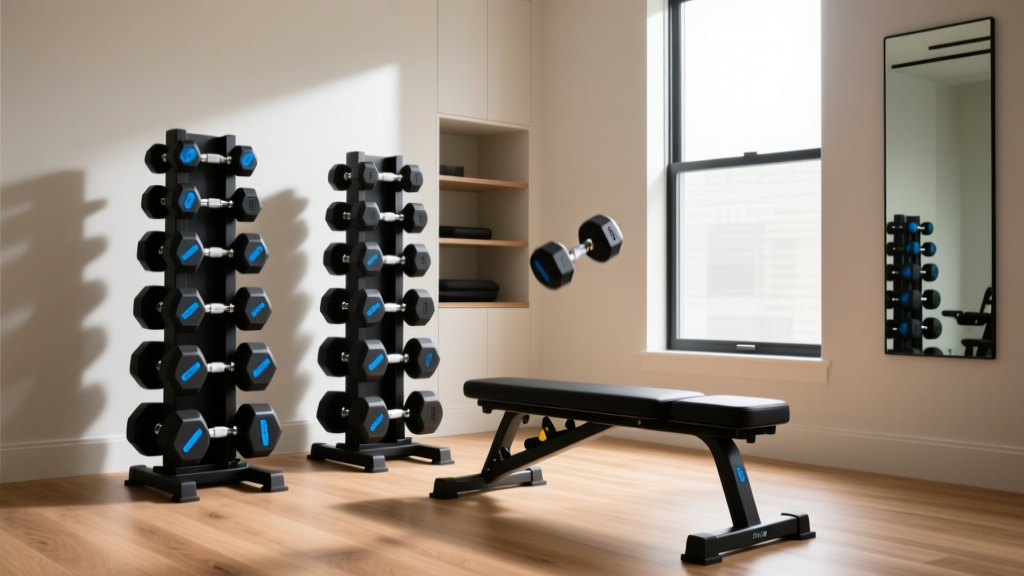
- The 36-Inch Rule: Maintain at least 36 inches of clearance between the end of your incline bench and the dumbbell rack. This allows you to pick up heavy dumbbells (e.g., 70+ lbs) and safely walk them back to the bench without tripping.
- Bench Angle Calibration: If using an adjustable bench (like the REP Fitness AB-4100), ensure the adjustment ladder is facing away from the dumbbell rack so the frame does not block your path when grabbing weights.
- Weight Progression Flow: Store your 15lb to 40lb dumbbells at waist height. Heavier dumbbells (45lb+) should be stored on the bottom tier to prevent lower back strain when lifting them off the rack to initiate the incline curl.
💡 Pro-Tip: The Stretch-and-Squeeze Protocol
To get the most out of the incline dumbbell curl, do not swing the weight up. Let the dumbbell pull your arm into a deep, painful (but safe) stretch at the bottom of the movement. Pause for 1 full second, then curl the weight up while keeping your elbows pinned back. Once your elbows drift forward past your torso, you remove the stretch from the long head and shift the bias back to the short head, defeating the purpose of the incline angle.
Frequently Asked Questions
How often should I clean my barbell knurling?
If you use chalk, you should brush your barbell with a nylon brush once a week. Chalk packs into the knurl valleys, absorbs moisture from the air, and accelerates oxidation (rust). Wipe the shaft down with a microfiber cloth and a light mist of mineral oil after cleaning.
Can I do incline curls with a barbell?
No. An 'incline barbell curl' is anatomically impractical and dangerous for the wrists. The fixed grip of a barbell combined with the shoulder extension required for an incline position places extreme torsional stress on the radioulnar joint in the forearm. Always use dumbbells or cables for incline curling movements to allow the wrists to rotate naturally.
What is the best bench angle for incline dumbbell curls?
Set the bench to a 45-degree or 60-degree angle. A 45-degree angle provides a deeper stretch on the long head but requires greater shoulder mobility. A 60-degree angle is slightly easier on the anterior deltoid and shoulder capsule while still providing excellent stretch-mediated hypertrophy for the biceps.
More gear to consider
All reviews
Beyond Starting Dumbbell Weight: Barbell Collar Clamp Mistakes

Home Gym Setup Walkthrough: Integrating a 45 lb Dumbbell Pair

Rubber Hex vs Urethane: 2026 Trends for Deltoids Dumbbell Exercises
2026 Dumbbell Racks for Chest Workouts With Dumbbells No Bench

EZ vs Straight Bar Value & Glute-Focused Split Squat Dumbbell Holds
