Barbell Buying Guide: Weight, Knurling & Bench Step Ups With Dumbbells
Compare 2026 Olympic barbells by weight and knurling. Plus, optimize leg day by pairing heavy squats with bench step ups with dumbbells.

The Foundation of Free Weight Training: Selecting Your Olympic Barbell
Building a comprehensive home gym or upgrading a commercial facility in 2026 requires a strategic approach to free weight equipment. The undisputed centerpiece of any serious strength program is the Olympic barbell. However, a truly balanced lower-body and full-body routine cannot rely on bilateral barbell movements alone. To address muscular imbalances, improve hip stability, and reduce spinal compression, elite coaches increasingly pair heavy barbell squats with unilateral accessory movements—most notably, bench step ups with dumbbells.
In this comprehensive head-to-head buying guide, we will dissect the critical specifications of Olympic barbells, focusing heavily on weight tolerances, tensile strength, and knurling profiles. Then, we will bridge the gap between barbell and dumbbell training, providing a biomechanical breakdown of why combining these two modalities yields superior hypertrophy and athletic transfer.
Expert Insight: Never confuse tensile strength with yield strength. Tensile strength (measured in PSI) is the maximum stress a bar can take before breaking, while yield strength is the point at which the bar permanently bends. Always look for a minimum tensile strength of 190,000 PSI for multi-purpose use, and 215,000 PSI for heavy powerlifting.Decoding Olympic Barbell Weight and Tensile Strength
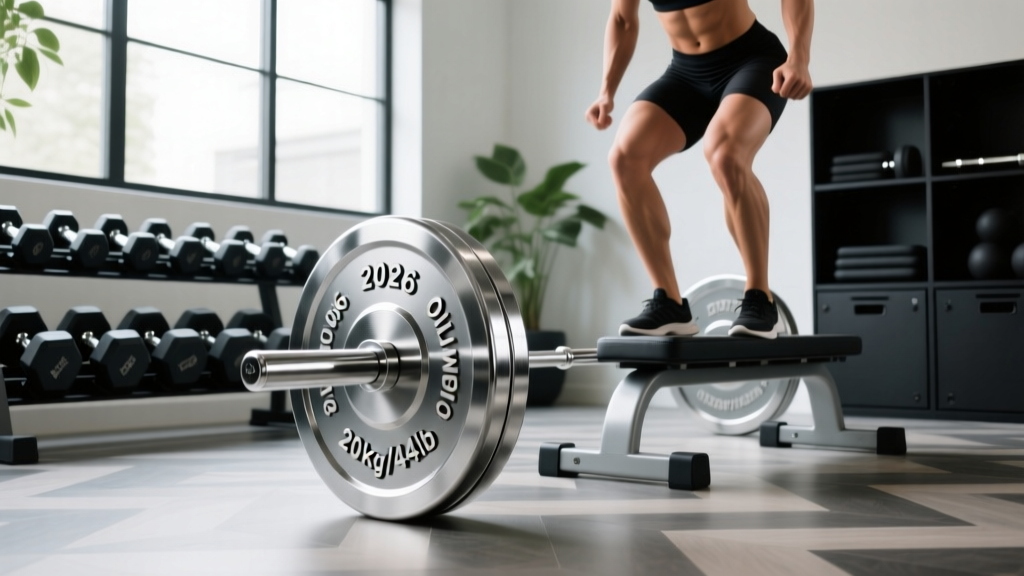
When shopping for an Olympic barbell, the baseline weight standard is 20 kilograms (approximately 44 pounds) for men's bars, and 15 kilograms (33 pounds) for women's bars. The 20kg bar features a 28mm to 29mm shaft diameter, while the 15kg bar utilizes a thinner 25mm shaft to accommodate smaller grip sizes and different whip characteristics.
PSI Ratings and Real-World Performance
The structural integrity of a barbell is defined by its tensile strength. Budget barbells often hover around 165,000 PSI, which is sufficient for beginners but prone to permanent warping (the dreaded 'taco bar') when subjected to heavy 1-rep max (1RM) squats or deadlifts over 400 lbs. For serious lifters in 2026, the industry standard starts at 190,000 PSI.
- 165,000 - 180,000 PSI: Entry-level, high risk of permanent deformation under heavy axial loading.
- 190,000 PSI: The sweet spot for multi-purpose bars (e.g., Rogue Ohio Bar). Offers excellent durability with a slight 'whip' beneficial for Olympic lifts.
- 215,000+ PSI: Elite powerlifting bars (e.g., REP Fitness Double Black Diamond, Eleiko IPF). Extremely stiff, minimal whip, designed to handle massive static loads without oscillating.
The Knurling Matrix: Finding Your Optimal Grip Profile
Knurling is the cross-hatched pattern machined into the steel shaft that provides traction. The depth and geometry of the knurl dramatically affect grip security and skin comfort, especially during high-volume sessions or heavy pulling movements.
| Knurl Type | Geometry Profile | Best Use Case | Example Barbell |
|---|---|---|---|
| Volcano | Deep valleys with a flattened peak | All-around, powerbuilding, high-rep work | Rogue Ohio Bar |
| Mountain | Sharp, aggressive, pointed peaks | Heavy deadlifts, low-rep powerlifting | Texas Power Bar |
| Hill | Shallow, rounded, smooth peaks | Olympic weightlifting, high-volume WODs | Eleiko Sport Weightlifting Bar |
According to equipment testing standards highlighted by the National Strength and Conditioning Association (NSCA), grip failure often precedes muscular failure in deadlifts and rows. Therefore, selecting a 'Mountain' or aggressive 'Volcano' knurl is critical for posterior chain development, whereas 'Hill' knurls prevent hand tearing during dynamic cleans and snatches.
Head-to-Head Comparison: Rogue Ohio Bar vs. REP Double Black Diamond
To illustrate how these specs translate to purchasing decisions, let us compare two of the most popular 20kg barbells on the market.
Rogue Ohio Bar (Stainless Steel)
- Tensile Strength: 190,000 PSI
- Knurl: Moderate Volcano
- Bushing/Bearing: Composite Bushings
- Price: ~$395 USD
- Verdict: The ultimate multi-purpose bar. The composite bushings provide a slow, controlled spin ideal for benching and squatting, while the moderate volcano knurl grips well without shredding calluses.
REP Fitness Double Black Diamond Bar
- Tensile Strength: 215,000 PSI
- Knurl: Aggressive Volcano
- Bushing/Bearing: Needle Bearings
- Price: ~$349 USD
- Verdict: A powerlifting-leaning hybrid. The needle bearings offer a fast spin, and the 215k PSI shaft ensures zero permanent deformation under 500+ lb squats. The knurl is notably sharper than the Rogue Ohio.
'If you are strictly powerlifting, prioritize tensile strength and aggressive knurling. If you are mixing Olympic lifts with powerbuilding, a 190k PSI bar with composite bushings will serve you better long-term.' — FitGearPulse Editorial Team, 2026
Bilateral vs. Unilateral: Squats vs. Bench Step Ups With Dumbbells
While investing in a high-quality Olympic barbell is non-negotiable for absolute strength development, relying exclusively on bilateral movements (like back squats and deadlifts) leaves critical gaps in athletic performance and injury prevention. This is where bench step ups with dumbbells become an indispensable component of your free-weight arsenal.
The Biomechanical Advantage of Step Ups
Heavy barbell squats place immense axial loading on the lumbar spine. Over a 12-week mesocycle, this cumulative fatigue can lead to lower back burnout. By integrating bench step ups with dumbbells into your accessory blocks, you achieve massive unilateral leg stimulus with a fraction of the spinal compression.
Barbell Back Squat
- Primary Driver: Absolute Load
- Spinal Compression: High
- Bilateral Deficit: Masks imbalances
- Equipment: Olympic Barbell, Rack
Bench Step Ups With Dumbbells
- Primary Driver: Unilateral Stability
- Spinal Compression: Low to Moderate
- Bilateral Deficit: Exposes and fixes imbalances
- Equipment: Dumbbells, Plyo Box/Bench
Research published in the Journal of Strength and Conditioning Research indicates that unilateral exercises elicit similar electromyographic (EMG) muscle activation in the gluteus maximus and vastus lateralis as bilateral exercises, but with significantly lower overall systemic fatigue. When you perform bench step ups with dumbbells, the hip stabilizers (gluteus medius and minimus) must work overtime to prevent the pelvis from dropping, a benefit entirely absent in a guided barbell squat.
Execution and Equipment Pairings
To properly execute bench step ups with dumbbells, your equipment selection matters just as much as your barbell choice.
- Box/Bench Height: The bench should be 12 to 18 inches high. The goal is to achieve 90 degrees of knee flexion at the bottom of the movement. A bench that is too high forces lumbar rounding ('butt wink') and shifts the load away from the glutes.
- Dumbbell Selection: For heavy hypertrophy, hex dumbbells (like the Rogue Urethane Hex Dumbbells, ~$2.50/lb) prevent rolling and allow for a secure grip. For home gyms with limited space, adjustable dumbbells like the Nuobell 80lb set offer rapid weight transitions between working sets.
- The Movement: Drive through the heel of the elevated foot. Do not push off the ground with the trailing leg—that turns the exercise into a lunge rather than a true step-up.
Programming Your 2026 Free Weight Arsenal
How do you combine your new Olympic barbell and dumbbells in a single session? Here is a highly effective lower-body template that leverages both bilateral strength and unilateral stability:
- 1. Barbell Back Squat: 4 sets of 5 reps @ 80% 1RM (Focus on absolute strength, utilizing your 215k PSI barbell).
- 2. Romanian Deadlift (Barbell): 3 sets of 8 reps (Focus on hamstring stretch and knurl grip).
- 3. Bench Step Ups With Dumbbells: 3 sets of 10-12 reps per leg (Focus on glute activation and pelvic stability).
- 4. Walking Lunges (Dumbbell): 2 sets to failure (Metabolic finisher).
Frequently Asked Questions
Do I need a center knurl on my Olympic barbell?
If you plan on front squatting or doing Olympic cleans, a center knurl is highly recommended as it helps the bar 'bite' into your upper back or clavicle shelf. However, if you exclusively do back squats and bench presses, a smooth center ring is more comfortable for high-bar positioning.
How heavy should my dumbbells be for step ups?
When performing bench step ups with dumbbells, start with a weight that is 20-30% of your body weight per hand. The limiting factor is usually grip strength and core stability, not raw leg power. Use lifting straps if your grip fails before your glutes do.
Can I use a women's 15kg bar for heavy powerlifting?
While a 15kg bar is excellent for lifters with smaller hands or for Olympic weightlifting, its 25mm shaft diameter and lower weight capacity make it less ideal for heavy powerlifting. The thinner shaft can dig into the hands during heavy deadlifts, and the increased 'whip' can cause instability during heavy bench presses.
More gear to consider
All reviews
Barbell Collar & Clamp Comparison: Best Quad Exercise with Dumbbells

Bumper vs Iron Plate Care: Gym Setup for Seated Dumbbell Presses
Cast Iron vs Competition Kettlebells & Dumbbell Bent Rows Value

Best Neoprene Dumbbells for Home Use & Dumbbell Flys GIF Guide

Bumper vs Iron Plates: 2026 Single Dumbbell Workout Trends