Barbell Collar Types & Standing Overhead Dumbbell Extension Fixes
Master free weight safety. We troubleshoot the standing overhead dumbbell extension and compare 2026 barbell collar types for ultimate home gym security.

Building a bulletproof home gym in 2026 requires more than just buying heavy iron; it demands a rigorous approach to biomechanics and hardware security. Two of the most frequently mismanaged areas in free weight training involve the triceps' most vulnerable stretch position and the external security of Olympic barbell sleeves. This guide bridges the gap between human movement and equipment engineering, troubleshooting the standing overhead dumbbell extension while delivering a definitive barbell collar and clamp types comparison.
Troubleshooting the Standing Overhead Dumbbell Extension
The standing overhead dumbbell extension is a staple for isolating the long head of the triceps brachii. Because the long head crosses the shoulder joint, it requires a deep overhead stretch to achieve maximal hypertrophy. However, according to ExRx.net's biomechanical database, this movement places immense shear force on the elbow and demands strict core stabilization.
Mistake 1: Using Overly Long Adjustable Dumbbells
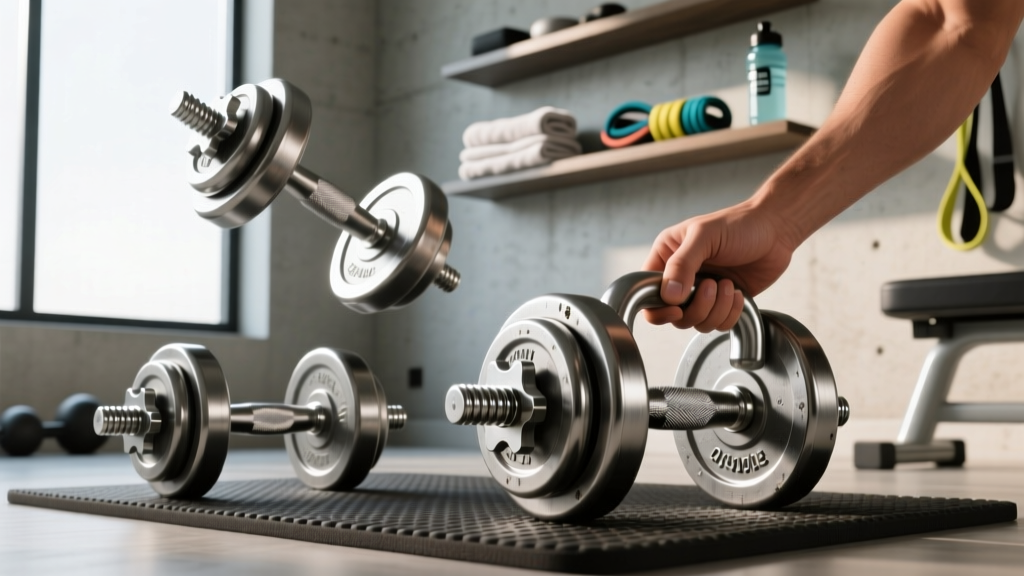
The most common equipment failure during this exercise stems from using the wrong adjustable dumbbell model. The popular Bowflex SelectTech 552 measures 15.75 inches in length. When held vertically with both hands under the top plate for an overhead extension, this excessive length creates a massive moment arm. If your grip slips, the dumbbell can tilt, potentially disengaging the internal dial mechanism and causing a catastrophic weight drop.
The Fix: Switch to a compact adjustable dumbbell like the PowerBlock Elite (approx. 12 inches) or, ideally, a fixed urethane hex dumbbell. The shorter handle length keeps the center of mass directly over your grip, eliminating leverage-induced tilt and protecting the adjustable mechanism from inverted stress.
Mistake 2: Lumbar Hyperextension and Rib Flare
Lifters often compensate for poor shoulder flexion mobility by arching their lower back, flaring their ribs, and shifting the load from the triceps to the lumbar spine. Squeezing the glutes is not enough to protect the spine in this position.
The Fix: Implement the bracing techniques popularized by Dr. Stuart McGill's Backfitpro. Before initiating the descent, actively pull your front ribs down toward your pelvis and brace your rectus abdominis as if anticipating a punch. Maintain this intra-abdominal pressure throughout the eccentric phase.
The 2026 Barbell Collar and Clamp Types Comparison
While dumbbells require internal dial security, Olympic barbells demand external clamp reliability. A failed collar during a heavy eccentric or a dropped barbell can result in catastrophic plate shifts, altering the bar's center of gravity mid-lift. Below is our rigorous comparison of the three primary collar types dominating the market today.
| Collar Type | Avg. Price (Pair) | Material | Drop Rating | Best Use Case |
|---|---|---|---|---|
| Spring Collars | $15 - $22 | Steel / Chrome | Poor | Light accessory work, warm-ups |
| Lock-Jaw Pro Loco 2.0 | $35 - $45 | Glass-Reinforced Nylon | Good | Home gyms, CrossFit, powerbuilding |
| Competition Clamps | $85 - $110 | Aircraft Aluminum | Excellent | Heavy eccentrics, Olympic lifts, IPF |
Spring Collars: The False Economy
Standard spring collars are ubiquitous in commercial gyms but are a liability in a serious home gym. They rely on tension that degrades after 6 to 12 months of regular use. More critically, during a dropped barbell (e.g., a failed bench press or a heavy clean), the kinetic energy easily overcomes the spring's lateral friction, causing plates to slide off the sleeve.
Lock-Jaw Pro Loco 2.0: The Home Gym Standard
The Lock-Jaw Pro Loco 2.0 utilizes a glass-reinforced nylon resin that clamps down via a leveraged cam system. At roughly $40 a pair, they offer the best price-to-security ratio. However, they are not indestructible. If a barbell is dropped directly onto the collar from a height greater than 4 feet (such as a missed overhead press), the nylon hinge can fracture.
Competition Clamps: When to Spend $90+
For heavy eccentrics, rack pulls, or Olympic weightlifting, competition clamps like the Rogue AB-2 are mandatory. Machined from aircraft-grade aluminum, these clamps use a threaded bolt and dead-blow hammer tightening mechanism. They apply thousands of pounds of lateral pressure against the plates. They will not slip, they will not crack on impact, and they are the only choice for lifters moving 400+ lbs.
Real-World Failure Modes & Edge Cases
Even the best clamps fail if you ignore sleeve tolerances. Olympic barbell sleeves are nominally 50mm in diameter. However, manufacturing variances mean a cheap import barbell might measure 49.2mm, while a calibrated Eleiko bar measures exactly 50.0mm.
- Undersized Sleeves (49.2mm - 49.6mm): Lock-Jaw clamps will feel loose and can slide during heavy negative reps. Spring collars are virtually useless here.
- Oversized Sleeves (50.2mm+): Often found on heavily rusted or poorly machined bars. Competition clamps may struggle to thread shut without a drop of machine oil on the bolt.
- The "Plate Rattle" Effect: If using machined steel plates instead of bumper plates, microscopic gaps between the plates amplify vibration during drops. Always use a competition clamp tightened with a rubber mallet to compress the plates into a single solid mass.
Frequently Asked Questions
Can I use a barbell collar on a standard 1-inch dumbbell handle?
No. Barbell collars are engineered for 50mm (2-inch) Olympic sleeves. For standard 1-inch handles, you must use 1-inch spring collars or star-lock nuts, though upgrading to Olympic-handled dumbbells is highly recommended for safety and plate compatibility.
Is the standing overhead dumbbell extension safe for rotator cuffs?
When performed with a neutral spine and controlled eccentric, it is safe. However, if you lack the shoulder flexion mobility to keep your biceps aligned with your ears without arching your back, you risk impingement. In that case, switch to a lying triceps extension (skull crusher) on a flat bench.
How often should I replace my Lock-Jaw clamps?
In a standard home gym environment, a pair of Lock-Jaws will easily last 3 to 5 years. Inspect the nylon cam for micro-fractures every 6 months, and replace them immediately if the lever fails to snap flush against the collar body.
More gear to consider
All reviews
EZ Bar vs Straight Bar & Rear Delt with Dumbbells: Budget Breakdown

Cast Iron vs Competition Kettlebells: Value & Rear Flyes Dumbbells

Space-Saving Dumbbell Racks for the Traps Dumbbell Exercise
Setup Guide: 75 Pound Dumbbells & Barbell Collar Types Compared

Plate Dumbbell Longevity: Rack Storage & Maintenance Guide