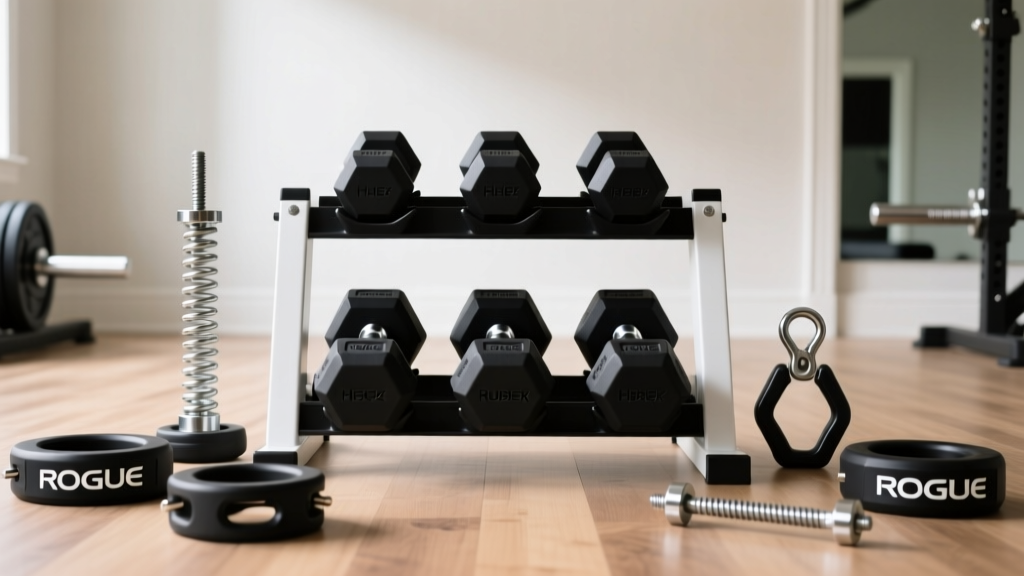
Barbell Collar Types Compared & Rogue Rubber Hex Dumbbell Setups
Compare barbell collar and clamp types for Olympic lifting, plus integration tips for Rogue rubber hex dumbbell racks and free weight safety.

The Architecture of Free Weight Safety
When outfitting a high-performance home gym or commercial facility in 2026, athletes often obsess over barbell tensile strength, plate calibration, and rack stability. Yet, the critical interface that secures hundreds of pounds of iron to a dynamic, whipping barbell is frequently an afterthought. A failure in retention hardware doesn't just ruin a lift; it can bend a $300 Olympic bar, shatter calibrated plates, or cause severe injury.
However, free weight safety extends beyond the barbell. While securing a 7-foot Olympic bar requires external clamping hardware, managing fixed-weight implements relies entirely on geometric design and proper racking protocols. In this comprehensive guide, we break down the exact metallurgy, polymer science, and clamping forces of modern barbell collars, while contrasting these requirements with the inherent safety and storage mechanics of fixed implements like the rogue rubber hex dumbbell.
Expert Insight: The primary job of a collar is not just to keep plates from falling off; it is to eliminate lateral oscillation. Unsecured plates create a 'pendulum effect' during heavy deadlifts or cleans, drastically altering the bar's center of mass and increasing the risk of a missed lift or sleeve damage.Barbell Collar and Clamp Types: A Deep-Dive Comparison
Not all collars are created equal. The market is segmented into four distinct categories, each engineered for specific training modalities. Let's examine the mechanical advantages and failure points of each.
1. Spring Collars (The Traditional Standard)
The classic zinc-plated steel spring collar relies on the torsional tension of coiled spring steel. Models like the Rogue Spring Collars are ubiquitous in commercial gyms due to their low cost (typically $15-$20 per pair) and simplicity.
- Clamping Force: Moderate (approx. 150-200 lbs of lateral grip).
- Failure Mode: Metal fatigue. If left clamped onto a barbell for weeks, the spring steel loses its memory, resulting in a permanent loss of tension. They also struggle to secure plates during high-impact drops.
- Best For: General fitness, light bodybuilding, and budget-conscious setups.
2. Lock-Jaw / Polymer Clamp Collars (The Heavy-Duty Workhorse)
Constructed from high-density nylon polymers with a cam-lever locking mechanism, clamp collars like the Lock-Jaw Pro are the gold standard for powerlifting and heavy garage gym use. They utilize a mechanical advantage via the lever to generate immense clamping force without relying on metal tension.
- Clamping Force: Extreme (1,500+ lbs of lateral grip).
- Failure Mode: Cold-weather brittleness. In unheated garage gyms where temperatures drop below 40°F (4°C), the polymer can develop micro-fractures and snap under the shock load of a dropped deadlift.
- Best For: Powerlifting, strongman training, and heavy static lifts.
3. Competition Calibration Collars (The Precision Choice)
Sanctioned Olympic weightlifting requires collars that weigh exactly 2.5 kilograms each to ensure the total loaded weight is mathematically precise. The Eleiko Competition Collars feature a machined aluminum body with a steel clamping band and a quick-release lever.
- Clamping Force: High, specifically calibrated to withstand repeated overhead drops from 2+ meters.
- Failure Mode: Cost and weight. At nearly $100+ per pair and adding 5kg to the bar, they are impractical for casual lifters or those tracking raw barbell weight without doing mental math.
- Best For: Olympic weightlifters, sanctioned meets, and precision-focused athletes.
4. Quick-Release Aluminum Collars (The Speed Demon)
Designed for high-volume, fast-paced workouts (like CrossFit), aluminum quick-release collars use a cam-action lever to secure a polymer or rubber inner grip ring. They are lightweight, incredibly fast to apply, and won't crack in the cold.
- Clamping Force: Moderate to High (approx. 800 lbs).
- Failure Mode: Inner grip ring wear. Over 12-18 months of daily use, the rubberized inner sleeve compresses and tears, requiring replacement rings to maintain a secure grip on the bar.
- Best For: CrossFit, metabolic conditioning, and supersets.
Comparison Matrix: Grip, Weight, and Cost
| Collar Type | Avg. Clamping Force | Weight (per pair) | 2026 Price Range | Drop-Rated? |
|---|---|---|---|---|
| Spring Steel | 150 - 200 lbs | 0.2 lbs | $15 - $25 | No |
| Polymer Clamp (Lock-Jaw) | 1,500+ lbs | 0.6 lbs | $30 - $45 | Yes (Above 40°F) |
| Competition (IWF) | 1,200+ lbs | 5.0 kg (11 lbs) | $90 - $130 | Yes |
| Quick-Release Aluminum | 800 lbs | 0.4 lbs | $40 - $60 | Yes |
The Dumbbell Equation: Why the Rogue Rubber Hex Dumbbell Changes the Math
While barbell collars are mandatory for dynamic loading, fixed-weight implements require a completely different approach to safety and storage. This is where the geometry of the rogue rubber hex dumbbell becomes a masterclass in functional design.
Unlike round dumbbells, which require constant vigilance to prevent rolling off uneven floors or bench saddles, the hexagonal heads of the Rogue Rubber Hex line act as an integrated anti-roll mechanism. This geometric 'collar' eliminates the floor hazard entirely. However, this design introduces specific racking considerations that gym owners must account for.
Material Science and Impact Absorption
The Rogue Fitness Dumbbell Lineup features a cast iron core encased in virgin rubber. Unlike cheap imported dumbbells that use recycled rubber (which off-gasses noxious odors and degrades under UV light), the vulcanized rubber coating on the Rogue hex models provides a high-durometer shell that absorbs impact noise and protects flooring.
- The Edge Case: While the flat sides prevent rolling, dropping a hex dumbbell directly on its sharp corner from overhead can cause the rubber to split or the cast iron core to chip. Athletes should be coached to control the descent, even with bumper-grade flooring.
- Handle Ergonomics: The standard 35mm shaft diameter and medium-deep knurling pattern provide a secure grip without the need for chalk during moderate-rep hypertrophy work, contrasting with the aggressive volcano knurling found on Olympic barbells.
Rack Clearance and Storage Protocols
When integrating the rogue rubber hex dumbbell into a 3-tier A-frame or horizontal wall rack, the angled geometry of the hex heads requires precise saddle spacing. If the rack saddles are spaced too narrowly, the rubber heads will bind against each other, making retrieval difficult and potentially scuffing the virgin rubber coating over time. Always ensure a minimum of 1.5 inches of lateral clearance between seated dumbbells on the rack.
Real-World Failure Modes & Edge Cases
According to extensive equipment testing by Garage Gym Reviews, the most common point of failure in free weight setups isn't the iron snapping—it's the retention hardware slipping during 'sleeve whip'.
"During a 500lb deadlift, the barbell bends significantly. As the bar snaps back to straight, the sleeves oscillate. If your collar lacks dynamic grip, the plates shift outward by a fraction of an inch with every rep. Over a set of 5, this lateral migration can unbalance the bar completely."WARNING: Never use standard spring collars for Olympic lifts (Snatch, Clean & Jerk). The torsional shock of dropping the bar from overhead will easily overpower the spring tension, resulting in plates ejecting from the sleeve mid-air.
2026 Buying Framework: Match the Collar to the Athlete
To build a truly optimized and safe free weight station, you must align your retention hardware with your specific training stimulus. Use this decision matrix to finalize your equipment cart:
- The Powerlifter / Strongman: Invest in heavy-duty polymer clamp collars (Lock-Jaw). The immense lateral grip is non-negotiable for heavy, slow, static pulls where bar whip is minimal but plate security is paramount.
- The Olympic Weightlifter: Budget for IWF-calibrated competition collars. The 2.5kg weight is necessary for meet prep accuracy, and the steel-banded grip is engineered specifically to survive repeated overhead drops onto bumper plates.
- The CrossFitter / Metcon Athlete: Purchase quick-release aluminum collars. In a workout where every second counts during transitions, the 2-second application time of a cam-lever collar will save you minutes over a 45-minute WOD.
- The Hypertrophy / Bodybuilding Athlete: Standard spring collars are perfectly adequate for controlled, non-impact lifting. Pair these with a comprehensive set of rogue rubber hex dumbbells to maximize unilateral stability and joint safety without the need for complex barbell loading.
Ultimately, whether you are securing 600 pounds on a deadlift bar or racking a pair of 80-pound hex dumbbells, respecting the engineering limits of your equipment is the foundation of longevity in the iron game. Choose your retention hardware with the same scrutiny you apply to your programming, and your home gym will remain safe, efficient, and built for the long haul.
More gear to consider
All reviews
Gym Setup for Dumbbell Exercises for Men Over 50: Plate Types

Cast Iron vs Competition Kettlebells vs Tone Fitness Dumbbells

Budget Breakdown: Loadable Plates for Bicep Workouts With Dumbbells

Iron vs Bumper Plate Care: Upgrading Workout with Dumbbells for Women

Skull and Dumbbells Gym Layout: Bumper vs Iron Plates
