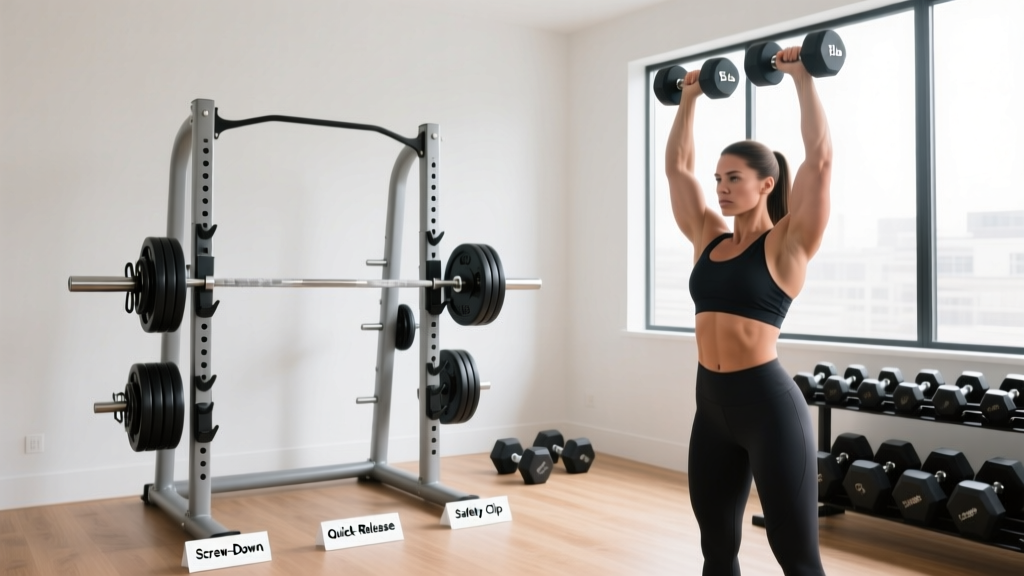
Barbell Collar Clamp Comparison & Tricep Kickbacks with Dumbbells
Compare barbell collar and clamp types for safe lifting, plus expert form tips for isolating the triceps using tricep kickbacks with dumbbells.

The Foundation of Free Weight Safety: Securing the Barbell
Building a comprehensive home gym requires mastering both the heavy, systemic compound lifts and the precise, unilateral isolation movements. However, before you can safely transition from a heavy barbell bench press to targeted accessory work, you must ensure your primary equipment is secure. A shifting weight plate during a heavy squat doesn't just ruin the set; it creates a catastrophic torsional force that can dump the barbell and cause severe injury. This is where understanding the nuances of barbell collars becomes non-negotiable.
As of 2026, the market for barbell security has evolved far beyond the cheap spring clips that come bundled with budget Olympic sets. Today, we are breaking down the engineering, holding force, and real-world failure modes of modern barbell collars, before transitioning into how to properly execute isolation movements like tricep kickbacks with dumbbells to complete your upper-body hypertrophy sessions.
Barbell Collar and Clamp Types Comparison Matrix
Not all collars are created equal. The holding force required for a dynamic Olympic lift differs vastly from a controlled powerlifting movement. Below is our 2026 comparison matrix of the most reliable collar types on the market.
| Collar Type | Top 2026 Model | Avg. Price | Holding Force | Best Application | Primary Failure Mode |
|---|---|---|---|---|---|
| Competition Clamp | Rogue HG-2.0 Aluminum | $48 - $55 | Extreme (IWF Spec) | Heavy Squats, Drops, Olympic Lifts | Thumb lever bolt stripping over time |
| Quick-Release Jaw | Lock-Jaw PRO | $35 - $40 | High | Bodybuilding, Quick Plate Changes | Slipping on heavily chalked sleeves |
| CNC Machined Clamp | OSO Barbell Clamps | $65 - $75 | Maximum | Uneven loading, Strongman events | Weight (adds 1.5 lbs per side) |
| Traditional Spring | Generic 50mm Spring Clips | $8 - $12 | Low | Light warm-ups, empty bar work | Spring fatigue, slipping on dynamic drops |
Deep Dive: Choosing the Right Collar for Your Training Style
1. Competition Clamp Collars (e.g., Rogue HG-2.0, Eleiko)
Machined from aircraft-grade aluminum and utilizing a cam-lever mechanism, competition clamps are the gold standard for heavy lifting. The Rogue HG-2.0 features a precision-machined inner diameter that grips the 50mm Olympic sleeve without scratching the zinc or chrome finish. Expert Insight: Always ensure the cam lever is fully locked past the 90-degree center point. If left slightly short of center, the vibration from a heavy deadlift drop can vibrate the lever open, leading to a plate shift.
2. Quick-Release Jaw Collars (e.g., Lock-Jaw PRO)
Constructed from high-density glass-reinforced nylon, jaw collars are beloved by bodybuilders and CrossFit athletes for their speed. You simply slide them on and snap the jaw shut. Real-World Troubleshooting: The polymer teeth rely on friction. If you use excessive lifting chalk and fail to wipe down your barbell sleeves with a microfiber cloth, the chalk acts as a dry lubricant, drastically reducing the collar's holding force during dynamic movements like push-presses.
3. Traditional Spring Clips
While we generally advise against spring clips for working sets over 135 lbs, they still have a place in commercial gym environments for rapid, light-weight changes. However, the metal fatigue on the tension springs usually renders them unsafe after 12 to 18 months of heavy commercial use.
⚠️ SAFETY CALLOUT: Asymmetrical LoadingNever rely on spring clips or worn jaw collars if you are performing asymmetrical loading (e.g., landmine rotations or uneven farmer's carries). The lateral force will easily overcome the friction of non-clamp collars. Always use CNC machined clamps or competition lever collars for rotational barbell work.
Transitioning to Isolation: Tricep Kickbacks with Dumbbells
Once your heavy barbell compounds (like close-grip bench presses or overhead presses) are complete and the barbell is safely stripped and collared, it is time to move to unilateral isolation. The triceps brachii makes up roughly two-thirds of your upper arm mass, and while heavy pressing builds the foundation, achieving full development requires targeting the muscle in its fully shortened position.
According to biomechanical analyses referenced by the ExRx exercise directory, the tricep kickback specifically isolates the lateral and medial heads of the triceps by removing the shoulder's ability to contribute to the extension, forcing the elbow joint to do 100% of the work.
Selecting the Optimal Dumbbell for Kickbacks
When performing tricep kickbacks with dumbbells, the physical design of the dumbbell matters more than you might think:
- Hex vs. Round: Always choose Hex dumbbells for kickbacks. Because you will be resting the dumbbell on your thigh or the bench between sets, round urethane dumbbells can roll off an incline bench, creating a tripping hazard in your home gym.
- Coating Material: Neoprene-coated hex dumbbells (typically in the 5 lb to 25 lb range) offer a slightly tacky grip, which is highly beneficial for kickbacks since your hands will be sweaty from heavy barbell work, and grip fatigue should not be the limiting factor in tricep isolation.
- Weight Selection: The kickback is a strict isolation movement. Most intermediate lifters will find their working weight falls between 10 lbs and 25 lbs per hand. Attempting to use 40 lb dumbbells almost always results in momentum-driven reps that bypass the triceps entirely.
Step-by-Step Execution: Perfecting the Kickback
To maximize hypertrophy and protect the elbow joint, follow this strict execution protocol endorsed by the National Strength and Conditioning Association (NSCA) guidelines for unilateral joint isolation:
- The Setup: Place one knee and the same-side hand on a flat bench. Hinge at the hips until your torso is nearly parallel to the floor. Maintain a neutral spine.
- The Anchor: Pull the dumbbell up so your upper arm is parallel to the floor and pinned tightly against your ribcage. This upper-arm anchor is the most critical part of the movement.
- The Extension: Keeping the upper arm completely frozen, extend the elbow until the arm is fully straight (180 degrees). Exhale sharply at the top.
- The Peak Contraction: Hold the fully extended position for a strict 1.5 seconds. Squeeze the lateral head of the tricep.
- The Eccentric: Lower the weight back to the starting position under a slow, 3-second eccentric count. Do not let the elbow drop below the horizontal plane.
Common Failure Modes & Corrections
Mistake: Swinging the elbow forward to heave the weight up.
Correction: Drop the weight by 30%. If you cannot hold the upper arm parallel to the floor without it drifting forward, the load is too heavy for the triceps to handle in isolation.
Expert Storage & Gym Flow Tips
A disorganized gym floor is a dangerous gym floor. After completing your tricep kickbacks with dumbbells, never leave the dumbbells on the bench or the floor. Return them to a tiered dumbbell rack. Furthermore, always store your barbell collars on a dedicated peg or in a drawer—leaving them on the barbell sleeve can trap moisture and cause localized rust on the steel sleeve over time.
Frequently Asked Questions (FAQ)
Do I really need to use collars for light warm-up sets?
While the risk of a plate sliding off during an empty-bar warm-up is low, making it a habit to use collars for every single set builds muscle memory and ensures you never accidentally perform a working set without them. We recommend keeping a pair of quick-release jaw collars on the bar at all times for this reason.
Why do I feel tricep kickbacks in my shoulder instead of my arm?
This happens when you fail to pin your upper arm to your ribcage. If your shoulder joint is mobile during the movement, the posterior deltoid takes over the work of extending the arm. Focus on the 'frozen elbow' cue and use a lighter dumbbell.
Are cable kickbacks better than dumbbell kickbacks?
Cables provide constant tension throughout the entire range of motion, whereas dumbbells rely on gravity, meaning there is zero tension on the tricep when the dumbbell is hanging straight down at the bottom of the movement. However, dumbbells are superior for fixing unilateral imbalances and are much easier to set up in a home gym environment without requiring a dual-pulley cable crossover machine.
More gear to consider
All reviews
Loadable Dumbbells & Dumbbell Upright Row Muscles Worked Guide
EZ vs Straight Bar: 2026 Trends & Flat Dumbbell Bench Press GIF Data

Power Rack vs Squat Rack: Room for the Dumbbell Lateral Raise Exercise

Olympic vs Standard Plates: Setup for Simple Dumbbell Exercises
Kettlebell Value: Cast Iron vs Competition & Dumbbell Lat Raise Form
