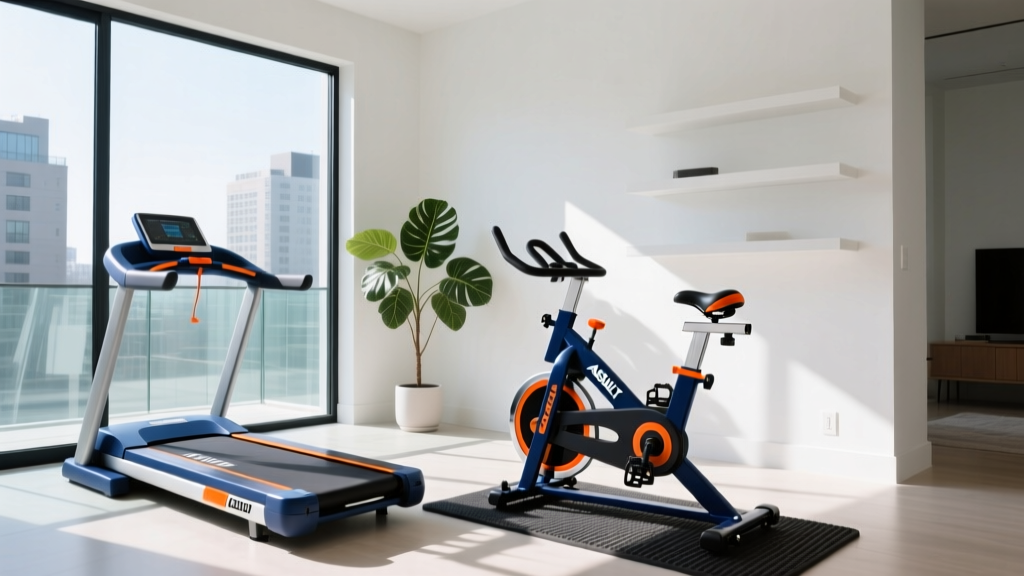
Air vs Assault Bike: What Burns More Calories, Treadmill or Elliptical?
Compare Air Bike vs Assault Bike costs and value for 2026. We also answer what burns more calories: treadmill or elliptical, plus air bike ROI analysis.

The Ultimate Cardio Showdown: Air Bike vs. Assault Bike
When outfitting a home gym for high-intensity conditioning, the fan-resistance bike is the undisputed king of metabolic output. However, a common point of confusion among buyers is the terminology. "Air bike" is the generic industry term for any stationary bike that uses a large front fan to generate wind resistance. "Assault Bike," on the other hand, is a specific trademarked brand (Assault Fitness) that popularized the machine in the CrossFit space. All Assault Bikes are air bikes, but not all air bikes are Assault Bikes.
In this 2026 budget breakdown and value analysis, we will dissect the top contenders in the fan bike market—specifically comparing the Assault Fitness lineup against the Rogue Echo and Schwinn Airdyne. Furthermore, we will address the most common cardiovascular debate in the fitness industry to help you determine where your money is best spent.
Terminology Check: Throughout this guide, we will use "Air Bike" to refer to the broader category of fan bikes, and "Assault Bike" when referring specifically to models manufactured by Assault Fitness (such as the Classic and Elite).The Calorie Question: What Burns More Calories, Treadmill or Elliptical?
When consumers search for what burns more calories treadmill or elliptical comparisons, they are usually looking for the most time-efficient fat-loss tool for their home gym. To answer this accurately, we must look at Metabolic Equivalent of Task (MET) values and real-world energy expenditure.
According to data from Harvard Health Publishing, a 155-pound person running at a 6 mph pace on a treadmill burns approximately 372 calories in 30 minutes. The same person using an elliptical machine at a moderate, steady-state effort burns roughly 335 calories in the same timeframe. Therefore, in a direct steady-state comparison, the treadmill edges out the elliptical due to the weight-bearing nature of running and the lack of momentum-assisted upper body movement.
However, both the treadmill and the elliptical are fundamentally limited by the user's ability to sustain a steady heart rate over long durations. This is where the Air Bike introduces a completely different metabolic paradigm.
The Air Bike Metabolic Spike
Unlike treadmills or ellipticals, air bikes utilize both the upper and lower body simultaneously against infinitely scalable wind resistance. The harder you pedal and push, the heavier the resistance becomes. Research published in the Journal of Sports Science and Medicine has demonstrated that maximal effort intervals on an air bike can elicit peak heart rates and VO2 max responses that exceed those of traditional cycling or running.
While you cannot sustain an air bike sprint for 30 minutes like you can a treadmill jog, a 20-minute High-Intensity Interval Training (HIIT) session on an air bike can trigger Excess Post-exercise Oxygen Consumption (EPOC), effectively keeping your metabolic rate elevated for hours after the workout. If your goal is pure, time-compressed caloric incineration, the air bike outperforms both the treadmill and the elliptical on a per-minute basis.
2026 Budget Breakdown: Air Bike vs. Assault Bike Pricing
With global supply chains fully normalized by 2026, the pricing on premium fan bikes has stabilized. Below is a comparative matrix of the top four models dominating the home and commercial gym market this year.
| Model | Drive System | 2026 MSRP | Warranty (Frame / Parts) | Best Use Case |
|---|---|---|---|---|
| Assault Fitness Classic | Chain | $899 | Lifetime / 2 Years | Budget buyers, garage gyms |
| Rogue Echo Bike (Gen 2) | Belt | $1,100 | Lifetime / 2 Years | Quiet home gyms, tech integrators |
| Assault Fitness Elite | Belt | $1,299 | Lifetime / 3 Years | Heavy users, commercial spaces |
| Schwinn Airdyne Pro | Belt | $1,399 | 10 Years / 1 Year | Traditionalists, smooth feel |
Value Analysis: Where is the Sweet Spot?
For the vast majority of home gym owners in 2026, the Rogue Echo Bike (Gen 2) at $1,100 represents the highest overall value. It utilizes a polyurethane belt drive, which eliminates the need for chain lubrication and significantly reduces noise—a critical factor if your gym is in a shared living space or an apartment. The Assault Fitness Classic is $200 cheaper, but the hidden maintenance costs of the chain drive (detailed below) often erase that initial savings over a three-year period.
The Assault Fitness Elite ($1,299) is a phenomenal machine built like a tank, featuring a heavier duty bottom bracket and a slightly more aggressive fan blade pitch. However, unless you are outfitting a commercial CrossFit box where multiple athletes are redlining the bike daily, the $199 premium over the Rogue Echo is difficult to justify for a standard home user.
The Hidden Costs: Maintenance and Failure Modes
When conducting a true budget breakdown, you must factor in the long-term maintenance and potential failure modes of the equipment. Fan bikes are subjected to violent, high-torque forces during standing sprints, which exposes mechanical weaknesses over time.
- Chain vs. Belt Drive Maintenance: The Assault Classic uses a standard motorcycle-style chain. Over time, chains stretch and accumulate dust mixed with lubricant, creating a grimy paste that accelerates sprocket wear. You will need to clean and lube the chain every 3 to 6 months, and replace the chain ($25) every few years. Belt drives (Rogue Echo, Assault Elite) require zero lubrication and run nearly silent. If a belt snaps (rare, but possible after 2,000+ hours), replacement costs around $65 and requires partial disassembly of the fan cage.
- Bottom Bracket (BB) Wear: The bottom bracket is the bearing cartridge that connects the crank arms through the frame. Heavy athletes performing standing sprints place immense lateral stress on the BB. Most air bikes use standard ISIS or square-taper bottom brackets. Expect to replace the BB cartridge ($30 part) every 1,500 to 2,000 hours of heavy use. This requires a specialized crank puller tool ($15).
- Fan Blade Dust Accumulation: The massive front fan acts as a magnet for household dust and pet hair. If not wiped down weekly, the dust builds up on the leading edge of the fan blades, altering their aerodynamics and creating a noticeable humming vibration at high RPMs.
Pro-Tip for Longevity: Never stop the fan blade abruptly with your legs while it is spinning at high RPMs. This sudden deceleration transfers shock directly into the bottom bracket bearings and the drivetrain, drastically shortening their lifespan. Always allow the fan to spool down naturally, or use the brake lever if your model is equipped with one.
ROI Framework: Which Machine Earns Its Keep?
To determine the true Return on Investment (ROI) of your cardio equipment, we must align the machine's capabilities with your specific fitness goals and the CDC's physical activity guidelines, which recommend at least 150 minutes of moderate-intensity or 75 minutes of vigorous-intensity aerobic activity per week.
Step 1: Define Your Primary Modality
- Steady-State Endurance (Zone 2): If your goal is long, 45-to-60-minute conversational-pace cardio, do not buy an air bike. The seat is designed for intervals, not long rides, and the upper body engagement will fatigue your shoulders before your cardiovascular system reaches its target. Buy a treadmill or a traditional indoor cycle.
- Low-Impact Recovery: If you are rehabbing a knee injury or need active recovery days, an elliptical is superior. The air bike's infinite resistance curve makes it very difficult to maintain a truly "easy" low-wattage output without the fan stalling out.
- HIIT and Metabolic Conditioning: If your goal is 15-to-25-minute sweat sessions, Tabata protocols, or CrossFit-style metcons, the air bike is the undisputed champion. The ROI here is measured in time saved and peak power output.
Step 2: Calculate Your Cost-Per-Use
Let us assume you purchase the Rogue Echo Bike for $1,100 and use it for three 20-minute HIIT sessions per week (156 sessions per year). Over a conservative 5-year lifespan, that equals 780 workouts. Your cost-per-use is $1.41. Compare this to a boutique fitness studio class charging $25 per drop-in, and the air bike pays for itself in less than two months of consistent use.
Final Verdict: Where Should You Put Your Money?
If you have decided that high-intensity interval training is the cornerstone of your fitness regimen, the fan bike is a non-negotiable addition to your gym. While the debate over what burns more calories, treadmill or elliptical, will continue to dominate steady-state cardio forums, the air bike operates in a league of its own for acute metabolic stress.
For the budget-conscious buyer who does not mind a bit of chain maintenance and a louder drivetrain, the Assault Fitness Classic ($899) remains a legendary, battle-tested workhorse. However, for the modern home gym owner prioritizing a frictionless, quiet, and low-maintenance experience, the Rogue Echo Bike Gen 2 ($1,100) is our top recommendation for 2026. It offers the perfect intersection of premium build quality, belt-drive silence, and long-term value, ensuring that your only excuse for skipping a workout is a lack of effort, not a lack of equipment reliability.
More gear to consider
All reviews
Roller Homegym Space & Budget Essentials: Smart Setup for Serious Indoor Cycling

Sole F89 Treadmill Reviews & 2026 Stationary Bike Trends
Space Layouts: Bowflex 216 Treadmill & Stationary Bike Types
Rowing Machine Setup Guide & NordicTrack C950i Treadmill Specs
Stair Climber vs Treadmill Belt: Home Fitness Guide