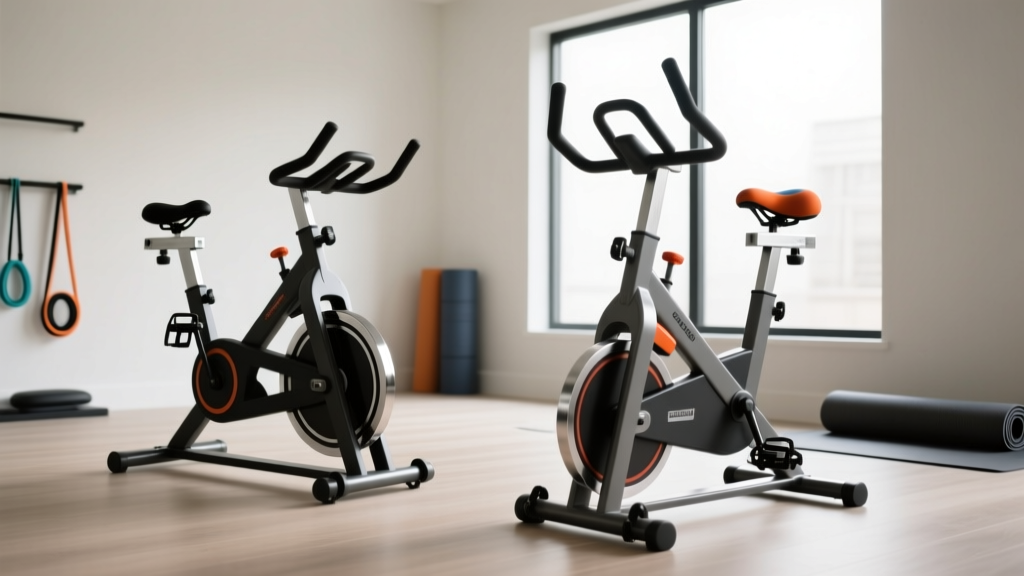
Air vs Assault Bike: Space-Saving Elliptical or Treadmill Fat Loss
Compare air vs assault bike footprints and layouts. Discover space-saving alternatives to the traditional elliptical or treadmill fat loss debate.

The Space Dilemma: Rethinking Home Gym Cardio
When designing a home gym, the spatial reality often clashes with our fitness ambitions. For years, the American Council on Exercise (ACE) and fitness publications have dominated search engines with the traditional elliptical or treadmill fat loss debate. However, a standard motorized treadmill requires a minimum of 30 to 35 square feet of dedicated floor space, while an elliptical demands 25 to 30 square feet, plus significant vertical clearance for the pedals and arm levers. In 2026, as urban living spaces shrink and garage gyms become multi-purpose zones, maximizing square footage without sacrificing caloric expenditure is paramount.
This is where the air resistance bike enters the conversation. Often colloquially referred to as an 'Assault Bike' (a specific brand name that has become synonymous with the category), these fan-based ergometers offer a remarkably compact footprint. But how do you choose between a generic air bike and a branded Assault Fitness model when spatial optimization is your primary constraint? This guide breaks down the exact dimensions, layout requirements, and physiological benefits of these space-saving cardio powerhouses.
Quick Spatial Summary: While a treadmill requires a dedicated 3' x 7' zone, high-end air bikes occupy roughly 10.5 square feet of floor space, freeing up nearly 70% of the room for free weights, racks, or functional movement areas.Air Bike vs Assault Bike: Footprint and Clearance Matrix
It is crucial to understand that 'Assault Bike' is a trademarked brand (Assault Fitness), while 'air bike' is the broad equipment category. Below is a precise spatial and financial comparison of the top-tier models currently dominating the home gym market.
| Model | Drive System | Footprint (L x W) | Height | Est. Price (2026) |
|---|---|---|---|---|
| Rogue Echo Bike | Belt-Driven | 52.5" x 29.5" | 52.5" | $1,199 |
| Assault Fitness Elite | Chain-Driven | 54.0" x 28.0" | 53.0" | $1,499 |
| Schwinn Airdyne AD7 | Belt-Driven | 51.0" x 28.0" | 52.0" | $1,299 |
Ceiling Height and Airflow Margins
Unlike treadmills, where ceiling height must account for the deck elevation (often 8 to 10 inches off the ground) plus the user's height, air bikes keep the user closer to the floor. However, the pedal stroke at the apex (12 o'clock position) requires vertical clearance. For a user who is 6'2", the maximum vertical reach during a sprint is approximately 6'8". Therefore, a minimum ceiling height of 7'0" is required, though 7'6" is recommended to prevent psychological claustrophobia during high-intensity intervals.
Designing Your Home Gym Layout for High-Intensity Cardio
Simply measuring the machine's base is a rookie mistake in space optimization. You must account for the 'operational envelope'—the space required for mounting, dismounting, airflow, and acoustic dissipation.
The 18-Inch Perimeter Rule
According to Rogue Fitness equipment guidelines and general ergonomic standards, you must maintain an 18-inch clearance on the left and right sides of the bike. This serves two purposes:
- Mounting/Dismounting: Allows you to step on and off the pegs safely without kicking a wall or adjacent dumbbell rack.
- Fan Intake/Exhaust: Air bikes move massive volumes of air. Placing the fan cage directly against a wall restricts intake, causes the motor to overheat, and creates a turbulent wind-tunnel effect in the room.
Acoustic Layout and Wall Proximity
The drive system heavily dictates your layout options. The Assault Fitness Elite uses a heavy-duty chain drive. While incredibly durable for commercial crossfit gyms, chains generate a distinct metallic clatter and require occasional lubrication. If placed in a shared living space or an apartment, the chain noise will transfer through hard flooring. You must position chain-driven bikes on thick, high-density rubber stall mats (minimum 3/4" thick) and avoid placing them directly against drywall shared with bedrooms.
Conversely, the Rogue Echo Bike utilizes a polyurethane belt drive. It is nearly silent, producing only the 'whoosh' of the fan. This allows for tighter spatial integration, meaning you can place the Echo Bike in a corner of a home office or living room with minimal acoustic disruption, provided the 18-inch side clearance for airflow is maintained.
Pro Layout Tip: Never place an air bike directly under a ceiling fan or HVAC vent. The cross-breeze will disrupt the aerodynamic drag of the bike's fan cage, altering the resistance curve and rendering the built-in calorie monitors inaccurate.
Fat Loss Efficacy: Does the Machine Matter?
When researching the traditional elliptical or treadmill fat loss protocols, most literature focuses on steady-state cardio (LISS) or moderate incline walking. While effective, these modalities require 45 to 60 minutes to achieve significant caloric expenditure, which is a luxury many do not have.
Air bikes are engineered for High-Intensity Interval Training (HIIT). The Centers for Disease Control and Prevention (CDC) notes that vigorous-intensity activities yield profound cardiovascular benefits in significantly shorter timeframes. The true advantage of the air bike for fat loss lies in EPOC (Excess Post-exercise Oxygen Consumption).
Steady-State (Treadmill/Elliptical)
- Calories burned primarily during the session.
- Requires 45+ minutes for optimal fat oxidation.
- Low joint impact, but high time commitment.
HIIT (Air/Assault Bike)
- Triggers massive EPOC (afterburn effect).
- Maximal caloric burn in 15-20 minutes.
- Simultaneous upper/lower body engagement spikes heart rate faster.
Because air bikes offer infinite, isokinetic resistance (the harder you push, the harder it pushes back), they force full central nervous system recruitment. A 20-minute Tabata-style protocol on an Assault Bike will often outpace a 45-minute steady-state jog on a treadmill in terms of total 24-hour caloric expenditure, making it the ultimate space-saving, time-saving fat loss tool.
Step-by-Step Space Optimization Guide
Follow this exact sequence when integrating an air bike into a constrained home gym layout:
- Map the Dead Zones: Identify corners or alcoves in your gym that cannot fit a power rack or bench. These are prime locations for an air bike.
- Lay the Foundation: Cut a 4' x 5' section of 3/4" horse stall mat. This protects the floor from sweat corrosion (which is highly acidic and will ruin hardwood or laminate) and dampens vibration.
- Position for the Wind: Orient the bike so the fan exhaust blows away from your face and away from loose papers or chalk buckets. Face the bike toward an open room or an open garage door.
- Secure the Perimeter: Use painter's tape to mark the 18-inch clearance zone on the floor. Ensure no kettlebells or dumbbells are ever stored inside this taped boundary to prevent mid-sprint tripping hazards.
Final Verdict: Which Fits Your Space and Goals?
If your primary constraint is noise and multi-room integration, the belt-driven Rogue Echo Bike or Schwinn AD7 is superior. Their quiet operation allows you to place them in tighter, shared living spaces without driving your household crazy.
If your primary constraint is budget and raw commercial durability, and you have a detached garage where chain noise is irrelevant, the Assault Fitness Elite remains a legendary workhorse. Ultimately, moving past the traditional elliptical or treadmill fat loss debate and embracing the compact, high-yield nature of the air bike will revolutionize both your home gym's floor plan and your cardiovascular conditioning.
More gear to consider
All reviews
Sole F89 Treadmill Reviews & 2026 Stationary Bike Trends

Horizon Treadmill Manual: Setup and Feature Comparison

30 Day Treadmill Challenge Setup: Cardio Machine Noise Guide

Does StairMaster Burn More Fat Than Treadmill? Noise & Calorie Guide

2026 Folding Treadmill Review: Treadmill Handrail Value Analysis
